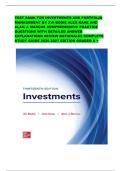
TEST BANK FOR INVESTMENTS AND PORTFOLIO
MANAGEMENT BY ZVI BODIE ALEX KANE AND
ALAN J. MARCUS COMPREHENSIVE PRACTICE
QUESTIONS WITH DETAILED ANSWER
EXPLANATIONS REVIEW RATIONALES COMPLETE
STUDY GUIDE 2026 2027 EDITION GRADED A +
,TABLE OF CONTENTS
Investments and Portfolio Management — Zvi Bodie, Alex Kane
& Alan J. Marcus
PART I: INTRODUCTION
1. The Investment Environment
2. Asset Classes and Financial Instruments
3. How Securities Are Traded
4. Mutual Funds and Other Investment Companies
PART II: PORTFOLIO THEORY AND PRACTICE
5. Risk, Return, and the Historical Record
6. Capital Allocation to Risky Assets
7. Optimal Risky Portfolios
8. Index Models
,PART III: EQUILIBRIUM IN CAPITAL MARKETS
9. The Capital Asset Pricing Model (CAPM)
10. Arbitrage Pricing Theory and Multifactor Models
11. The Efficient Market Hypothesis
12. Behavioral Finance and Technical Analysis
PART IV: FIXED-INCOME SECURITIES
13. Bond Prices and Yields
14. The Term Structure of Interest Rates
15. Managing Bond Portfolios
PART V: SECURITY ANALYSIS
16. Macroeconomic and Industry Analysis
17. Equity Valuation Models
18. Financial Statement Analysis
PART VI: DERIVATIVES MARKETS
19. Option Markets: Introduction
, 20. Option Valuation
21. Futures Markets
22. Futures, Swaps, and Risk Management
PART VII: APPLIED PORTFOLIO MANAGEMENT
23. Portfolio Performance Evaluation
24. International Diversification
25. Alternative Assets
26. The Theory of Active Portfolio Management
27. Investment Policy and the Framework of the CFA Institute
CHAPTER 1: THE INVESTMENT ENVIRONMENT
This chapter introduces the investment environment, defining key
concepts such as real and financial assets, financial markets, and the
role of financial intermediaries. It examines the functions of the
financial system, including capital allocation, risk sharing, and
liquidity. Understanding the investment environment is essential for
making informed investment decisions and evaluating the trade-offs
between risk and return.
MANAGEMENT BY ZVI BODIE ALEX KANE AND
ALAN J. MARCUS COMPREHENSIVE PRACTICE
QUESTIONS WITH DETAILED ANSWER
EXPLANATIONS REVIEW RATIONALES COMPLETE
STUDY GUIDE 2026 2027 EDITION GRADED A +
,TABLE OF CONTENTS
Investments and Portfolio Management — Zvi Bodie, Alex Kane
& Alan J. Marcus
PART I: INTRODUCTION
1. The Investment Environment
2. Asset Classes and Financial Instruments
3. How Securities Are Traded
4. Mutual Funds and Other Investment Companies
PART II: PORTFOLIO THEORY AND PRACTICE
5. Risk, Return, and the Historical Record
6. Capital Allocation to Risky Assets
7. Optimal Risky Portfolios
8. Index Models
,PART III: EQUILIBRIUM IN CAPITAL MARKETS
9. The Capital Asset Pricing Model (CAPM)
10. Arbitrage Pricing Theory and Multifactor Models
11. The Efficient Market Hypothesis
12. Behavioral Finance and Technical Analysis
PART IV: FIXED-INCOME SECURITIES
13. Bond Prices and Yields
14. The Term Structure of Interest Rates
15. Managing Bond Portfolios
PART V: SECURITY ANALYSIS
16. Macroeconomic and Industry Analysis
17. Equity Valuation Models
18. Financial Statement Analysis
PART VI: DERIVATIVES MARKETS
19. Option Markets: Introduction
, 20. Option Valuation
21. Futures Markets
22. Futures, Swaps, and Risk Management
PART VII: APPLIED PORTFOLIO MANAGEMENT
23. Portfolio Performance Evaluation
24. International Diversification
25. Alternative Assets
26. The Theory of Active Portfolio Management
27. Investment Policy and the Framework of the CFA Institute
CHAPTER 1: THE INVESTMENT ENVIRONMENT
This chapter introduces the investment environment, defining key
concepts such as real and financial assets, financial markets, and the
role of financial intermediaries. It examines the functions of the
financial system, including capital allocation, risk sharing, and
liquidity. Understanding the investment environment is essential for
making informed investment decisions and evaluating the trade-offs
between risk and return.