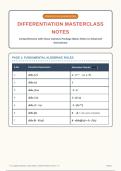
This document, titled **"Differentiation Masterclass Notes,"** is a comprehensive, highly structured mathematics study capsule specifically tailored for senior secondary (Class 12) calculus. It compiles everything from foundational algebraic properties to advanced derivative operations into a single, cohesive reference guide.
Here is a page-by-page breakdown of how the document is organized:
### 1. Foundational Rules & Operations (Pages 1 – 3)
* **Basic Algebraic Derivatives**: Contains the essential core formulas, including the power rule (d/dx(x^n)), derivatives of constants, fractions (1/x), and square roots (sqrt{x}).
* **Algebra of Derivatives**: Explicitly outlines the functional rules for handling operations between functions, mapping out the **Addition Rule**, **Subtraction Rule**, **Product Rule (Leibniz Rule)**, and **Quotient Rule**.
* **Trigonometric & Transcendental Functions**: A complete reference grid for standard trigonometric ratios (sin x, cos x, tan x, etc.), along with exponential (e^x, a^x) and logarithmic (log_e x, log_a x) expressions.
### 2. Composite Functions & Substitution Shortcuts (Pages 4 – 5)
* **Inverse Trigonometric Functions**: Provides a clean tabular layout containing the exact derivative formulas for sin^{-1}x, tan^{-1}x, sec^{-1}x, and their respective co-functions.
* **The Chain Rule Framework**: Explains the core operational logic of dealing with composite functions where y depends on an intermediate variable (t) before reaching x.
* **Shortcuts & Radical Substitutions**: Features practical problem-solving tricks (like the power-chain visual rule) alongside a critical substitution guide table showing exactly what to substitute (x = sintheta, tantheta, etc.) when simplifying complex radical expressions.
### 3. Advanced Calculus Paradigms (Pages 6 – 9)
* **Trigonometric Sub-forms**: Lists structural half-angle modifications (e.g., converting 1 - costheta into 2sin^2(theta/2)) used to simplify equations before differentiation.
* **Implicit Function Logic**: Details the structural equations and specific rules needed to differentiate mixed equations where x and y cannot be explicitly separated.
* **Infinite Loops & Higher-Order Derivatives**: Introduces a high-speed shortcut formula for dealing with infinite nested radical series, immediately followed by the mathematical framework for computing second-order derivatives (d^2y/dx^2).
**Design & Layout Overview:**
The entire document uses a premium modern layout utilizing clear borders, distinct header cards, highlighted operational blocks, and contrasting tables. This design ensures that complex mathematical variables, constraints, and formulas are highly scannable and easy to review at a single glance.
Content preview
COMPLETE FULL COURSE EDITION
DIFFERENTIATION MASTERCLASS
NOTES
Comprehensive 12th Class Calculus Package (Basic Rules to Advanced
Derivatives)
PAGE 1: FUNDAMENTAL ALGEBRAIC RULES
S.No. Function Expression Derivative Result (dy/dx)
1. d/dx (xⁿ) n · xⁿ⁻¹ ; (n ∈ ℝ)
2. d/dx (x) 1
3. d/dx (1/x) -1 / x²
4. d/dx (√x) 1 / (2√x)
5. d/dx (1 / √x) -1 / (2x³ᐟ²)
6. d/dx (k) 0 ; (k = non-zero constant)
7. d/dx [k · F(x)] k · d/dx(f(x)) = k · f'(x)
⚡ Complete Master Class Notes: Differentiation Series ⚡ Page 1
, PAGE 2: ALGEBRA OF DERIVATIVES
Let u and v be differentiable functions of x:
1. Addition Rule:
d/dx (u + v) = du/dx + dv/dx
2. Subtraction Rule:
d/dx (u - v) = du/dx - dv/dx
3. Product Rule (Leibniz Rule):
d/dx (u · v) = u · (dv/dx) + v · (du/dx)
4. Quotient Rule:
d/dx (u / v) = [ v · (du/dx) - u · (dv/dx) ] / v²
⚡ Complete Master Class Notes: Differentiation Series ⚡ Page 2