

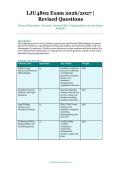
LJU4802 Exam 2026/2027 |
Revised Questions
Thomas Edison State University | Revised Q&A | Undergraduate Law and Justice
Students
Introduction
This original practice set covers Primary Legal Sources and Research Methodologies, Secondary
Sources and Citations, Legal Writing and Document Drafting, and Professional Ethics and Case
Management. It reinforces LJU4802 course objectives for exam readiness and better grades. It is
not an official TESU examination or a reproduction of secured questions; consult current course
materials and governing authorities.
Content Area Overview
Content Area Questions Key Topics Weight
Primary Legal 13 mandatory authority, 26%
Sources and Research persuasive authority,
Methodologies constitutional
provisions, statutory
history, case
treatment,
administrative
regulations and more
Secondary Sources, 12 legal encyclopedia, 24%
Citations, and Legal treatise research, law
Databases reviews, citator use,
Boolean searching,
headnotes and more
Legal Writing, 13 IRAC, CRAC, issue 26%
Analysis, and framing, rule
Document Drafting synthesis, analogical
reasoning,
distinguishing cases
and more
Professional Ethics, 12 confidentiality, 24%
Responsibility, and conflicts,
Case Management competence,
supervision,
unauthorized
practice, candor and
more
LJU4802 Exam 2026/2027
,Domain: Primary Legal Sources and Research Methodologies
1. A researcher is handling mandatory authority. Which approach is most
appropriate?
A. Locate the governing authority, confirm its jurisdiction and current status, and explain its
relevance precisely.
B. State a conclusion without linking the rule to the material facts.
C. Copy language without verifying currency, context, or ethical implications.
D. Rely on an uncited summary without checking the primary source.
Answer: A
Rationale: Answer A is correct because it addresses the distinct LJU4802 skill of mandatory
authority. The other options either rely on an unchecked source, confuse authority, omit legal
analysis, or overlook professional responsibility. Good legal research uses current primary
authority; good writing applies the rule to material facts; ethical practice protects the client and
the integrity of the process.
2. A legal writer reviewing persuasive authority should make which choice?
A. State a conclusion without linking the rule to the material facts.
B. Use an accurate, complete citation and connect the authority to the specific proposition it
supports.
C. Rely on an uncited summary without checking the primary source.
D. Treat a persuasive source as binding regardless of jurisdiction.
Answer: B
Rationale: Answer B is correct because it addresses the distinct LJU4802 skill of persuasive
authority. The other options either rely on an unchecked source, confuse authority, omit legal
analysis, or overlook professional responsibility. Good legal research uses current primary
authority; good writing applies the rule to material facts; ethical practice protects the client and
the integrity of the process.
3. A supervising attorney asks about constitutional provisions. Which answer is
best?
A. Copy language without verifying currency, context, or ethical implications.
B. Rely on an uncited summary without checking the primary source.
C. Analyze the issue objectively, distinguish material facts, and state the conclusion with
appropriate qualification.
D. State a conclusion without linking the rule to the material facts.
Answer: C
Rationale: Answer C is correct because it addresses the distinct LJU4802 skill of constitutional
provisions. The other options either rely on an unchecked source, confuse authority, omit legal
analysis, or overlook professional responsibility. Good legal research uses current primary
LJU4802 Exam 2026/2027
, authority; good writing applies the rule to material facts; ethical practice protects the client and
the integrity of the process.
4. Which statement most accurately describes statutory history?
A. Rely on an uncited summary without checking the primary source.
B. Treat a persuasive source as binding regardless of jurisdiction.
C. State a conclusion without linking the rule to the material facts.
D. Protect client interests, follow professional duties, and document the research or case-
management decision.
Answer: D
Rationale: Answer D is correct because it addresses the distinct LJU4802 skill of statutory
history. The other options either rely on an unchecked source, confuse authority, omit legal
analysis, or overlook professional responsibility. Good legal research uses current primary
authority; good writing applies the rule to material facts; ethical practice protects the client and
the integrity of the process.
5. A researcher is handling case treatment. Which approach is most appropriate?
A. Locate the governing authority, confirm its jurisdiction and current status, and explain its
relevance precisely.
B. State a conclusion without linking the rule to the material facts.
C. Copy language without verifying currency, context, or ethical implications.
D. Rely on an uncited summary without checking the primary source.
Answer: A
Rationale: Answer A is correct because it addresses the distinct LJU4802 skill of case treatment.
The other options either rely on an unchecked source, confuse authority, omit legal analysis, or
overlook professional responsibility. Good legal research uses current primary authority; good
writing applies the rule to material facts; ethical practice protects the client and the integrity of
the process.
6. A legal writer reviewing administrative regulations should make which choice?
A. State a conclusion without linking the rule to the material facts.
B. Use an accurate, complete citation and connect the authority to the specific proposition it
supports.
C. Rely on an uncited summary without checking the primary source.
D. Treat a persuasive source as binding regardless of jurisdiction.
Answer: B
Rationale: Answer B is correct because it addresses the distinct LJU4802 skill of administrative
regulations. The other options either rely on an unchecked source, confuse authority, omit legal
analysis, or overlook professional responsibility. Good legal research uses current primary
authority; good writing applies the rule to material facts; ethical practice protects the client and
the integrity of the process.
7. A supervising attorney asks about jurisdictional hierarchy. Which answer is best?
A. Copy language without verifying currency, context, or ethical implications.
LJU4802 Exam 2026/2027
Revised Questions
Thomas Edison State University | Revised Q&A | Undergraduate Law and Justice
Students
Introduction
This original practice set covers Primary Legal Sources and Research Methodologies, Secondary
Sources and Citations, Legal Writing and Document Drafting, and Professional Ethics and Case
Management. It reinforces LJU4802 course objectives for exam readiness and better grades. It is
not an official TESU examination or a reproduction of secured questions; consult current course
materials and governing authorities.
Content Area Overview
Content Area Questions Key Topics Weight
Primary Legal 13 mandatory authority, 26%
Sources and Research persuasive authority,
Methodologies constitutional
provisions, statutory
history, case
treatment,
administrative
regulations and more
Secondary Sources, 12 legal encyclopedia, 24%
Citations, and Legal treatise research, law
Databases reviews, citator use,
Boolean searching,
headnotes and more
Legal Writing, 13 IRAC, CRAC, issue 26%
Analysis, and framing, rule
Document Drafting synthesis, analogical
reasoning,
distinguishing cases
and more
Professional Ethics, 12 confidentiality, 24%
Responsibility, and conflicts,
Case Management competence,
supervision,
unauthorized
practice, candor and
more
LJU4802 Exam 2026/2027
,Domain: Primary Legal Sources and Research Methodologies
1. A researcher is handling mandatory authority. Which approach is most
appropriate?
A. Locate the governing authority, confirm its jurisdiction and current status, and explain its
relevance precisely.
B. State a conclusion without linking the rule to the material facts.
C. Copy language without verifying currency, context, or ethical implications.
D. Rely on an uncited summary without checking the primary source.
Answer: A
Rationale: Answer A is correct because it addresses the distinct LJU4802 skill of mandatory
authority. The other options either rely on an unchecked source, confuse authority, omit legal
analysis, or overlook professional responsibility. Good legal research uses current primary
authority; good writing applies the rule to material facts; ethical practice protects the client and
the integrity of the process.
2. A legal writer reviewing persuasive authority should make which choice?
A. State a conclusion without linking the rule to the material facts.
B. Use an accurate, complete citation and connect the authority to the specific proposition it
supports.
C. Rely on an uncited summary without checking the primary source.
D. Treat a persuasive source as binding regardless of jurisdiction.
Answer: B
Rationale: Answer B is correct because it addresses the distinct LJU4802 skill of persuasive
authority. The other options either rely on an unchecked source, confuse authority, omit legal
analysis, or overlook professional responsibility. Good legal research uses current primary
authority; good writing applies the rule to material facts; ethical practice protects the client and
the integrity of the process.
3. A supervising attorney asks about constitutional provisions. Which answer is
best?
A. Copy language without verifying currency, context, or ethical implications.
B. Rely on an uncited summary without checking the primary source.
C. Analyze the issue objectively, distinguish material facts, and state the conclusion with
appropriate qualification.
D. State a conclusion without linking the rule to the material facts.
Answer: C
Rationale: Answer C is correct because it addresses the distinct LJU4802 skill of constitutional
provisions. The other options either rely on an unchecked source, confuse authority, omit legal
analysis, or overlook professional responsibility. Good legal research uses current primary
LJU4802 Exam 2026/2027
, authority; good writing applies the rule to material facts; ethical practice protects the client and
the integrity of the process.
4. Which statement most accurately describes statutory history?
A. Rely on an uncited summary without checking the primary source.
B. Treat a persuasive source as binding regardless of jurisdiction.
C. State a conclusion without linking the rule to the material facts.
D. Protect client interests, follow professional duties, and document the research or case-
management decision.
Answer: D
Rationale: Answer D is correct because it addresses the distinct LJU4802 skill of statutory
history. The other options either rely on an unchecked source, confuse authority, omit legal
analysis, or overlook professional responsibility. Good legal research uses current primary
authority; good writing applies the rule to material facts; ethical practice protects the client and
the integrity of the process.
5. A researcher is handling case treatment. Which approach is most appropriate?
A. Locate the governing authority, confirm its jurisdiction and current status, and explain its
relevance precisely.
B. State a conclusion without linking the rule to the material facts.
C. Copy language without verifying currency, context, or ethical implications.
D. Rely on an uncited summary without checking the primary source.
Answer: A
Rationale: Answer A is correct because it addresses the distinct LJU4802 skill of case treatment.
The other options either rely on an unchecked source, confuse authority, omit legal analysis, or
overlook professional responsibility. Good legal research uses current primary authority; good
writing applies the rule to material facts; ethical practice protects the client and the integrity of
the process.
6. A legal writer reviewing administrative regulations should make which choice?
A. State a conclusion without linking the rule to the material facts.
B. Use an accurate, complete citation and connect the authority to the specific proposition it
supports.
C. Rely on an uncited summary without checking the primary source.
D. Treat a persuasive source as binding regardless of jurisdiction.
Answer: B
Rationale: Answer B is correct because it addresses the distinct LJU4802 skill of administrative
regulations. The other options either rely on an unchecked source, confuse authority, omit legal
analysis, or overlook professional responsibility. Good legal research uses current primary
authority; good writing applies the rule to material facts; ethical practice protects the client and
the integrity of the process.
7. A supervising attorney asks about jurisdictional hierarchy. Which answer is best?
A. Copy language without verifying currency, context, or ethical implications.
LJU4802 Exam 2026/2027


