

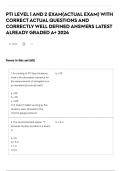
PTI LEVEL 1 AND 2 EXAM(ACTUAL EXAM) WITH
CORRECT ACTUAL QUESTIONS AND
CORRECTLY WELL DEFINED ANSWERS LATEST
ALREADY GRADED A+ 2026
Save
Terms in this set (60)
1. According to PTI Specifications, b. ±7%
what is the allowable tolerance for
the measurement of elongations in
an elevated (structural) slab?
a. ±5%
b. ±7%
c. ±10%
d. It doesn't matter as long as the
tendons were stressed to the
correct gauge pressure.
2. The recommended space, "Y" b. 1.5 in.
between tendon bundles in a beam
is.
a. 4in.
b. 1.5 in.
c. 1 in.
d. 0.5.
,3. What is the minimum number of b. Two
integrity tendons required in each
direction over columns in a flat
slab?
a. One
b. Two
c. Three
d. There is no minimum requirement.
4. In an encapsulated system, how a. None
much bare strands is acceptable
behind stressing anchorage?
a. None
b. ½" maximum
c. 6" maximum
d. It does not matter.
5. Longitudinal cracking of wedges a. True
may occur and is acceptable as a
result of wedges moving to their
final wedge set position.
a. True
b. False
, 6. What should be done when the a. Move the support bar to the nearest stirrup
beam stirrup spacing does not location and adjust the vertical height so that a
match the PT support bar spacing? smooth tendon profile is maintained, add
additional support bars at other stirrup locations
a. Move the support bar to the if needed so a maximum allowable support
nearest stirrup location and adjust spacing is not exceeded.
the vertical height so that a smooth
tendon profile is maintained, add
additional support bars at other
stirrup locations if needed so a
maximum allowable support
spacing is not exceeded.
b. Change the spacing of the beam
stirrup to match the support bar
spacing.
c. Do not proceed with installation
until further instructions are
received.
d. None of the above.
7. When installing tendons in a a. It is important to avoid excessive wobble in
narrow joist: tendons that could lead to concrete blowouts.
a. It is important to avoid excessive
wobble in tendons that could lead
to concrete blowouts.
b. Tendon placement is not critical
since there is only one tendon in
each joist.
c. It is important to check for any
reverse curvature in a tendon
profile to avoid problems.
d. Both A and C.
CORRECT ACTUAL QUESTIONS AND
CORRECTLY WELL DEFINED ANSWERS LATEST
ALREADY GRADED A+ 2026
Save
Terms in this set (60)
1. According to PTI Specifications, b. ±7%
what is the allowable tolerance for
the measurement of elongations in
an elevated (structural) slab?
a. ±5%
b. ±7%
c. ±10%
d. It doesn't matter as long as the
tendons were stressed to the
correct gauge pressure.
2. The recommended space, "Y" b. 1.5 in.
between tendon bundles in a beam
is.
a. 4in.
b. 1.5 in.
c. 1 in.
d. 0.5.
,3. What is the minimum number of b. Two
integrity tendons required in each
direction over columns in a flat
slab?
a. One
b. Two
c. Three
d. There is no minimum requirement.
4. In an encapsulated system, how a. None
much bare strands is acceptable
behind stressing anchorage?
a. None
b. ½" maximum
c. 6" maximum
d. It does not matter.
5. Longitudinal cracking of wedges a. True
may occur and is acceptable as a
result of wedges moving to their
final wedge set position.
a. True
b. False
, 6. What should be done when the a. Move the support bar to the nearest stirrup
beam stirrup spacing does not location and adjust the vertical height so that a
match the PT support bar spacing? smooth tendon profile is maintained, add
additional support bars at other stirrup locations
a. Move the support bar to the if needed so a maximum allowable support
nearest stirrup location and adjust spacing is not exceeded.
the vertical height so that a smooth
tendon profile is maintained, add
additional support bars at other
stirrup locations if needed so a
maximum allowable support
spacing is not exceeded.
b. Change the spacing of the beam
stirrup to match the support bar
spacing.
c. Do not proceed with installation
until further instructions are
received.
d. None of the above.
7. When installing tendons in a a. It is important to avoid excessive wobble in
narrow joist: tendons that could lead to concrete blowouts.
a. It is important to avoid excessive
wobble in tendons that could lead
to concrete blowouts.
b. Tendon placement is not critical
since there is only one tendon in
each joist.
c. It is important to check for any
reverse curvature in a tendon
profile to avoid problems.
d. Both A and C.


