

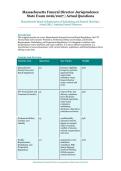
Massachusetts Funeral Director Jurisprudence
State Exam 2026/2027 | Actual Questions
Massachusetts Board of Registration of Embalming and Funeral Directing |
Actual Q&A | Aspiring Funeral Directors
Introduction
This original practice set covers Massachusetts Funeral Laws and Board Regulations, the FTC
Funeral Rule and Consumer Protection, Professional Ethics and Conduct, and Facility
Requirements, Embalming, and Preparation Regulations. It is designed to reinforce state
jurisprudence course objectives and exam readiness. It is not an official examination or a
reproduction of secured questions; verify current statutes, regulations, and Board guidance before
relying on any item.
Content Area Overview
Content Area Questions Key Topics Weight
Massachusetts 30 licensure eligibility, 30%
Funeral Laws and temporary permits,
Board Regulations apprenticeship
supervision,
embalmer scope,
funeral director
scope, renewal and
more
FTC Funeral Rule and 25 General Price List 25%
Consumer Protection delivery, telephone
price disclosure,
itemized statements,
outer burial
containers,
embalming
disclosure, alternative
containers and more
Professional Ethics, 25 confidentiality, 25%
Conduct, and informed consent,
Liability dignity of remains,
chain of custody,
conflict of interest,
referral compensation
and more
Facility 20 preparation-room 20%
Requirements, sanitation,
Embalming, and ventilation, PPE,
Preparation sharps disposal,
Regulations chemical labeling,
OSHA exposure
control and more
Massachusetts Funeral Director Jurisprudence State Exam 2026/2027
,Domain: Massachusetts Funeral Laws and Board Regulations
1. A licensee is reviewing a file involving licensure eligibility. Which action best
complies with the applicable rule?
A. Confirm the governing requirement, obtain required authorization, and document the decision.
B. Omit the information because disclosure could make the service less convenient.
C. Treat a verbal assumption as a substitute for consent, records, or supervision.
D. Proceed because the family appears to agree, even without required documentation.
Answer: A
Rationale: Answer A is best because it addresses the distinct issue of licensure eligibility.
Massachusetts licensure and conduct questions should be resolved using current MGL c. 112, 239
CMR, applicable Board guidance, and—when consumer pricing is involved—the FTC Funeral
Rule. Documentation, truthful communication, authorization, and protection of human dignity
are central compliance principles.
2. A consumer asks about temporary permits. Which response is most appropriate?
A. Omit the information because disclosure could make the service less convenient.
B. Provide accurate information, avoid coercion or misrepresentation, and preserve the
consumer’s lawful choices.
C. Proceed because the family appears to agree, even without required documentation.
D. Use a customary practice that conflicts with the written rule.
Answer: B
Rationale: Answer B is best because it addresses the distinct issue of temporary permits.
Massachusetts licensure and conduct questions should be resolved using current MGL c. 112, 239
CMR, applicable Board guidance, and—when consumer pricing is involved—the FTC Funeral
Rule. Documentation, truthful communication, authorization, and protection of human dignity
are central compliance principles.
3. During an inspection or service involving apprenticeship supervision, what
should the professional do?
A. Treat a verbal assumption as a substitute for consent, records, or supervision.
B. Proceed because the family appears to agree, even without required documentation.
C. Use the applicable safety and sanitation controls, maintain identification, and follow the
required record process.
D. Omit the information because disclosure could make the service less convenient.
Answer: C
Rationale: Answer C is best because it addresses the distinct issue of apprenticeship supervision.
Massachusetts licensure and conduct questions should be resolved using current MGL c. 112, 239
CMR, applicable Board guidance, and—when consumer pricing is involved—the FTC Funeral
Rule. Documentation, truthful communication, authorization, and protection of human dignity
are central compliance principles.
4. A complaint alleges a problem with embalmer scope. Which principle controls
the analysis?
A. Proceed because the family appears to agree, even without required documentation.
Massachusetts Funeral Director Jurisprudence State Exam 2026/2027
,B. Use a customary practice that conflicts with the written rule.
C. Omit the information because disclosure could make the service less convenient.
D. Escalate uncertainty through the Board, supervisor, or qualified authority rather than
guessing.
Answer: D
Rationale: Answer D is best because it addresses the distinct issue of embalmer scope.
Massachusetts licensure and conduct questions should be resolved using current MGL c. 112, 239
CMR, applicable Board guidance, and—when consumer pricing is involved—the FTC Funeral
Rule. Documentation, truthful communication, authorization, and protection of human dignity
are central compliance principles.
5. Before proceeding with funeral director scope, which fact or safeguard should be
addressed first?
A. Confirm the governing requirement, obtain required authorization, and document the decision.
B. Omit the information because disclosure could make the service less convenient.
C. Treat a verbal assumption as a substitute for consent, records, or supervision.
D. Proceed because the family appears to agree, even without required documentation.
Answer: A
Rationale: Answer A is best because it addresses the distinct issue of funeral director scope.
Massachusetts licensure and conduct questions should be resolved using current MGL c. 112, 239
CMR, applicable Board guidance, and—when consumer pricing is involved—the FTC Funeral
Rule. Documentation, truthful communication, authorization, and protection of human dignity
are central compliance principles.
6. A licensee is reviewing a file involving renewal. Which action best complies with
the applicable rule?
A. Omit the information because disclosure could make the service less convenient.
B. Provide accurate information, avoid coercion or misrepresentation, and preserve the
consumer’s lawful choices.
C. Proceed because the family appears to agree, even without required documentation.
D. Use a customary practice that conflicts with the written rule.
Answer: B
Rationale: Answer B is best because it addresses the distinct issue of renewal. Massachusetts
licensure and conduct questions should be resolved using current MGL c. 112, 239 CMR,
applicable Board guidance, and—when consumer pricing is involved—the FTC Funeral Rule.
Documentation, truthful communication, authorization, and protection of human dignity are
central compliance principles.
7. A consumer asks about continuing education. Which response is most
appropriate?
A. Treat a verbal assumption as a substitute for consent, records, or supervision.
B. Proceed because the family appears to agree, even without required documentation.
C. Use the applicable safety and sanitation controls, maintain identification, and follow the
required record process.
Massachusetts Funeral Director Jurisprudence State Exam 2026/2027
, D. Omit the information because disclosure could make the service less convenient.
Answer: C
Rationale: Answer C is best because it addresses the distinct issue of continuing education.
Massachusetts licensure and conduct questions should be resolved using current MGL c. 112, 239
CMR, applicable Board guidance, and—when consumer pricing is involved—the FTC Funeral
Rule. Documentation, truthful communication, authorization, and protection of human dignity
are central compliance principles.
8. During an inspection or service involving inactive status, what should the
professional do?
A. Proceed because the family appears to agree, even without required documentation.
B. Use a customary practice that conflicts with the written rule.
C. Omit the information because disclosure could make the service less convenient.
D. Escalate uncertainty through the Board, supervisor, or qualified authority rather than
guessing.
Answer: D
Rationale: Answer D is best because it addresses the distinct issue of inactive status.
Massachusetts licensure and conduct questions should be resolved using current MGL c. 112, 239
CMR, applicable Board guidance, and—when consumer pricing is involved—the FTC Funeral
Rule. Documentation, truthful communication, authorization, and protection of human dignity
are central compliance principles.
9. A complaint alleges a problem with name changes. Which principle controls the
analysis?
A. Confirm the governing requirement, obtain required authorization, and document the decision.
B. Omit the information because disclosure could make the service less convenient.
C. Treat a verbal assumption as a substitute for consent, records, or supervision.
D. Proceed because the family appears to agree, even without required documentation.
Answer: A
Rationale: Answer A is best because it addresses the distinct issue of name changes.
Massachusetts licensure and conduct questions should be resolved using current MGL c. 112, 239
CMR, applicable Board guidance, and—when consumer pricing is involved—the FTC Funeral
Rule. Documentation, truthful communication, authorization, and protection of human dignity
are central compliance principles.
10. Before proceeding with business ownership, which fact or safeguard should be
addressed first?
A. Omit the information because disclosure could make the service less convenient.
B. Provide accurate information, avoid coercion or misrepresentation, and preserve the
consumer’s lawful choices.
C. Proceed because the family appears to agree, even without required documentation.
D. Use a customary practice that conflicts with the written rule.
Answer: B
Massachusetts Funeral Director Jurisprudence State Exam 2026/2027
State Exam 2026/2027 | Actual Questions
Massachusetts Board of Registration of Embalming and Funeral Directing |
Actual Q&A | Aspiring Funeral Directors
Introduction
This original practice set covers Massachusetts Funeral Laws and Board Regulations, the FTC
Funeral Rule and Consumer Protection, Professional Ethics and Conduct, and Facility
Requirements, Embalming, and Preparation Regulations. It is designed to reinforce state
jurisprudence course objectives and exam readiness. It is not an official examination or a
reproduction of secured questions; verify current statutes, regulations, and Board guidance before
relying on any item.
Content Area Overview
Content Area Questions Key Topics Weight
Massachusetts 30 licensure eligibility, 30%
Funeral Laws and temporary permits,
Board Regulations apprenticeship
supervision,
embalmer scope,
funeral director
scope, renewal and
more
FTC Funeral Rule and 25 General Price List 25%
Consumer Protection delivery, telephone
price disclosure,
itemized statements,
outer burial
containers,
embalming
disclosure, alternative
containers and more
Professional Ethics, 25 confidentiality, 25%
Conduct, and informed consent,
Liability dignity of remains,
chain of custody,
conflict of interest,
referral compensation
and more
Facility 20 preparation-room 20%
Requirements, sanitation,
Embalming, and ventilation, PPE,
Preparation sharps disposal,
Regulations chemical labeling,
OSHA exposure
control and more
Massachusetts Funeral Director Jurisprudence State Exam 2026/2027
,Domain: Massachusetts Funeral Laws and Board Regulations
1. A licensee is reviewing a file involving licensure eligibility. Which action best
complies with the applicable rule?
A. Confirm the governing requirement, obtain required authorization, and document the decision.
B. Omit the information because disclosure could make the service less convenient.
C. Treat a verbal assumption as a substitute for consent, records, or supervision.
D. Proceed because the family appears to agree, even without required documentation.
Answer: A
Rationale: Answer A is best because it addresses the distinct issue of licensure eligibility.
Massachusetts licensure and conduct questions should be resolved using current MGL c. 112, 239
CMR, applicable Board guidance, and—when consumer pricing is involved—the FTC Funeral
Rule. Documentation, truthful communication, authorization, and protection of human dignity
are central compliance principles.
2. A consumer asks about temporary permits. Which response is most appropriate?
A. Omit the information because disclosure could make the service less convenient.
B. Provide accurate information, avoid coercion or misrepresentation, and preserve the
consumer’s lawful choices.
C. Proceed because the family appears to agree, even without required documentation.
D. Use a customary practice that conflicts with the written rule.
Answer: B
Rationale: Answer B is best because it addresses the distinct issue of temporary permits.
Massachusetts licensure and conduct questions should be resolved using current MGL c. 112, 239
CMR, applicable Board guidance, and—when consumer pricing is involved—the FTC Funeral
Rule. Documentation, truthful communication, authorization, and protection of human dignity
are central compliance principles.
3. During an inspection or service involving apprenticeship supervision, what
should the professional do?
A. Treat a verbal assumption as a substitute for consent, records, or supervision.
B. Proceed because the family appears to agree, even without required documentation.
C. Use the applicable safety and sanitation controls, maintain identification, and follow the
required record process.
D. Omit the information because disclosure could make the service less convenient.
Answer: C
Rationale: Answer C is best because it addresses the distinct issue of apprenticeship supervision.
Massachusetts licensure and conduct questions should be resolved using current MGL c. 112, 239
CMR, applicable Board guidance, and—when consumer pricing is involved—the FTC Funeral
Rule. Documentation, truthful communication, authorization, and protection of human dignity
are central compliance principles.
4. A complaint alleges a problem with embalmer scope. Which principle controls
the analysis?
A. Proceed because the family appears to agree, even without required documentation.
Massachusetts Funeral Director Jurisprudence State Exam 2026/2027
,B. Use a customary practice that conflicts with the written rule.
C. Omit the information because disclosure could make the service less convenient.
D. Escalate uncertainty through the Board, supervisor, or qualified authority rather than
guessing.
Answer: D
Rationale: Answer D is best because it addresses the distinct issue of embalmer scope.
Massachusetts licensure and conduct questions should be resolved using current MGL c. 112, 239
CMR, applicable Board guidance, and—when consumer pricing is involved—the FTC Funeral
Rule. Documentation, truthful communication, authorization, and protection of human dignity
are central compliance principles.
5. Before proceeding with funeral director scope, which fact or safeguard should be
addressed first?
A. Confirm the governing requirement, obtain required authorization, and document the decision.
B. Omit the information because disclosure could make the service less convenient.
C. Treat a verbal assumption as a substitute for consent, records, or supervision.
D. Proceed because the family appears to agree, even without required documentation.
Answer: A
Rationale: Answer A is best because it addresses the distinct issue of funeral director scope.
Massachusetts licensure and conduct questions should be resolved using current MGL c. 112, 239
CMR, applicable Board guidance, and—when consumer pricing is involved—the FTC Funeral
Rule. Documentation, truthful communication, authorization, and protection of human dignity
are central compliance principles.
6. A licensee is reviewing a file involving renewal. Which action best complies with
the applicable rule?
A. Omit the information because disclosure could make the service less convenient.
B. Provide accurate information, avoid coercion or misrepresentation, and preserve the
consumer’s lawful choices.
C. Proceed because the family appears to agree, even without required documentation.
D. Use a customary practice that conflicts with the written rule.
Answer: B
Rationale: Answer B is best because it addresses the distinct issue of renewal. Massachusetts
licensure and conduct questions should be resolved using current MGL c. 112, 239 CMR,
applicable Board guidance, and—when consumer pricing is involved—the FTC Funeral Rule.
Documentation, truthful communication, authorization, and protection of human dignity are
central compliance principles.
7. A consumer asks about continuing education. Which response is most
appropriate?
A. Treat a verbal assumption as a substitute for consent, records, or supervision.
B. Proceed because the family appears to agree, even without required documentation.
C. Use the applicable safety and sanitation controls, maintain identification, and follow the
required record process.
Massachusetts Funeral Director Jurisprudence State Exam 2026/2027
, D. Omit the information because disclosure could make the service less convenient.
Answer: C
Rationale: Answer C is best because it addresses the distinct issue of continuing education.
Massachusetts licensure and conduct questions should be resolved using current MGL c. 112, 239
CMR, applicable Board guidance, and—when consumer pricing is involved—the FTC Funeral
Rule. Documentation, truthful communication, authorization, and protection of human dignity
are central compliance principles.
8. During an inspection or service involving inactive status, what should the
professional do?
A. Proceed because the family appears to agree, even without required documentation.
B. Use a customary practice that conflicts with the written rule.
C. Omit the information because disclosure could make the service less convenient.
D. Escalate uncertainty through the Board, supervisor, or qualified authority rather than
guessing.
Answer: D
Rationale: Answer D is best because it addresses the distinct issue of inactive status.
Massachusetts licensure and conduct questions should be resolved using current MGL c. 112, 239
CMR, applicable Board guidance, and—when consumer pricing is involved—the FTC Funeral
Rule. Documentation, truthful communication, authorization, and protection of human dignity
are central compliance principles.
9. A complaint alleges a problem with name changes. Which principle controls the
analysis?
A. Confirm the governing requirement, obtain required authorization, and document the decision.
B. Omit the information because disclosure could make the service less convenient.
C. Treat a verbal assumption as a substitute for consent, records, or supervision.
D. Proceed because the family appears to agree, even without required documentation.
Answer: A
Rationale: Answer A is best because it addresses the distinct issue of name changes.
Massachusetts licensure and conduct questions should be resolved using current MGL c. 112, 239
CMR, applicable Board guidance, and—when consumer pricing is involved—the FTC Funeral
Rule. Documentation, truthful communication, authorization, and protection of human dignity
are central compliance principles.
10. Before proceeding with business ownership, which fact or safeguard should be
addressed first?
A. Omit the information because disclosure could make the service less convenient.
B. Provide accurate information, avoid coercion or misrepresentation, and preserve the
consumer’s lawful choices.
C. Proceed because the family appears to agree, even without required documentation.
D. Use a customary practice that conflicts with the written rule.
Answer: B
Massachusetts Funeral Director Jurisprudence State Exam 2026/2027


