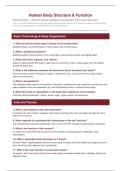
Human Body Structure & Function
Practice Exam — 60 Short-Answer Questions and Answers (Intro-Level Overview)
This is an original study guide covering the general topics typically found in an introductory anatomy and physiology
course. It is not excerpted or reproduced from any specific textbook.
Basic Terminology & Body Organization
1. What are the four basic types of tissue in the human body?
Epithelial tissue, connective tissue, muscle tissue, and nervous tissue.
2. What is anatomical position?
Standing upright, facing forward, arms at the sides, palms facing forward, feet slightly apart.
3. Define the terms 'superior' and 'inferior'.
Superior means toward the head or upper part of a structure; inferior means away from the head or
toward the lower part.
4. What is the difference between the anatomical terms 'proximal' and 'distal'?
Proximal means closer to the point of origin or attachment (e.g., closer to the trunk); distal means
farther from that point.
5. What is homeostasis?
The relatively stable internal environment of the body, maintained through regulatory mechanisms that
keep conditions such as temperature, pH, and fluid balance within a narrow normal range.
6. Name the levels of organization in the body from simplest to most complex.
Chemical (atoms/molecules), cellular, tissue, organ, organ system, and organism.
Cells and Tissues
7. What is the function of the cell membrane?
It encloses the cell contents, regulates what enters and leaves the cell, and helps maintain the cell's
internal environment.
8. What organelle is considered the 'powerhouse of the cell' and why?
The mitochondrion, because it generates most of the cell's ATP (energy) through cellular respiration.
9. What is the function of the nucleus?
It contains the cell's DNA and controls the cell's activities, including growth, metabolism, and
reproduction.
10. What is epithelial tissue and where is it found?
A tissue made of tightly packed cells that covers body surfaces and lines cavities and organs; found in
skin, the lining of the digestive tract, and glands.
11. What is the main function of connective tissue?
To support, bind, and protect other tissues and organs (examples include bone, cartilage, blood, and
adipose tissue).
, Integumentary System
12. What are the three main layers of the skin?
The epidermis (outer layer), the dermis (middle layer), and the subcutaneous layer (hypodermis,
beneath the dermis).
13. What are the main functions of the skin?
Protection against pathogens and injury, regulation of body temperature, sensation, and prevention of
water loss.
14. What structures are found in the dermis?
Blood vessels, nerve endings, hair follicles, sweat glands, and sebaceous (oil) glands.
15. How does the skin help regulate body temperature?
Through sweat gland secretion (evaporative cooling) and changes in blood vessel diameter
(vasodilation to release heat, vasoconstriction to conserve heat).
Skeletal System
16. What are the main functions of the skeletal system?
Support, protection of internal organs, movement (with muscles), mineral storage, and blood cell
production (hematopoiesis).
17. What is the difference between compact bone and spongy bone?
Compact bone is dense and forms the hard outer layer of bones; spongy bone is porous, lighter, and
found at the ends of long bones and inside flat bones.
18. Where does blood cell formation (hematopoiesis) occur?
In the red bone marrow, found in spongy bone tissue.
19. What is a joint, and name the three main types by movement?
A joint is a point where two or more bones meet. The three types by movement are synarthroses
(immovable), amphiarthroses (slightly movable), and diarthroses (freely movable, such as synovial
joints).
20. What is the function of cartilage in the skeletal system?
It cushions joints, provides flexible support (as in the nose and ears), and forms a template for bone
growth in the fetus and growth plates.
Muscular System
21. What are the three types of muscle tissue?
Skeletal muscle, cardiac muscle, and smooth muscle.
22. What is the difference between skeletal and smooth muscle?
Skeletal muscle is voluntary and striated, attached to bones to produce movement; smooth muscle is
involuntary and non-striated, found in the walls of internal organs and blood vessels.
Practice Exam — 60 Short-Answer Questions and Answers (Intro-Level Overview)
This is an original study guide covering the general topics typically found in an introductory anatomy and physiology
course. It is not excerpted or reproduced from any specific textbook.
Basic Terminology & Body Organization
1. What are the four basic types of tissue in the human body?
Epithelial tissue, connective tissue, muscle tissue, and nervous tissue.
2. What is anatomical position?
Standing upright, facing forward, arms at the sides, palms facing forward, feet slightly apart.
3. Define the terms 'superior' and 'inferior'.
Superior means toward the head or upper part of a structure; inferior means away from the head or
toward the lower part.
4. What is the difference between the anatomical terms 'proximal' and 'distal'?
Proximal means closer to the point of origin or attachment (e.g., closer to the trunk); distal means
farther from that point.
5. What is homeostasis?
The relatively stable internal environment of the body, maintained through regulatory mechanisms that
keep conditions such as temperature, pH, and fluid balance within a narrow normal range.
6. Name the levels of organization in the body from simplest to most complex.
Chemical (atoms/molecules), cellular, tissue, organ, organ system, and organism.
Cells and Tissues
7. What is the function of the cell membrane?
It encloses the cell contents, regulates what enters and leaves the cell, and helps maintain the cell's
internal environment.
8. What organelle is considered the 'powerhouse of the cell' and why?
The mitochondrion, because it generates most of the cell's ATP (energy) through cellular respiration.
9. What is the function of the nucleus?
It contains the cell's DNA and controls the cell's activities, including growth, metabolism, and
reproduction.
10. What is epithelial tissue and where is it found?
A tissue made of tightly packed cells that covers body surfaces and lines cavities and organs; found in
skin, the lining of the digestive tract, and glands.
11. What is the main function of connective tissue?
To support, bind, and protect other tissues and organs (examples include bone, cartilage, blood, and
adipose tissue).
, Integumentary System
12. What are the three main layers of the skin?
The epidermis (outer layer), the dermis (middle layer), and the subcutaneous layer (hypodermis,
beneath the dermis).
13. What are the main functions of the skin?
Protection against pathogens and injury, regulation of body temperature, sensation, and prevention of
water loss.
14. What structures are found in the dermis?
Blood vessels, nerve endings, hair follicles, sweat glands, and sebaceous (oil) glands.
15. How does the skin help regulate body temperature?
Through sweat gland secretion (evaporative cooling) and changes in blood vessel diameter
(vasodilation to release heat, vasoconstriction to conserve heat).
Skeletal System
16. What are the main functions of the skeletal system?
Support, protection of internal organs, movement (with muscles), mineral storage, and blood cell
production (hematopoiesis).
17. What is the difference between compact bone and spongy bone?
Compact bone is dense and forms the hard outer layer of bones; spongy bone is porous, lighter, and
found at the ends of long bones and inside flat bones.
18. Where does blood cell formation (hematopoiesis) occur?
In the red bone marrow, found in spongy bone tissue.
19. What is a joint, and name the three main types by movement?
A joint is a point where two or more bones meet. The three types by movement are synarthroses
(immovable), amphiarthroses (slightly movable), and diarthroses (freely movable, such as synovial
joints).
20. What is the function of cartilage in the skeletal system?
It cushions joints, provides flexible support (as in the nose and ears), and forms a template for bone
growth in the fetus and growth plates.
Muscular System
21. What are the three types of muscle tissue?
Skeletal muscle, cardiac muscle, and smooth muscle.
22. What is the difference between skeletal and smooth muscle?
Skeletal muscle is voluntary and striated, attached to bones to produce movement; smooth muscle is
involuntary and non-striated, found in the walls of internal organs and blood vessels.