
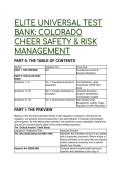
ELITE UNIVERSAL TEST
BANK: COLORADO
CHEER SAFETY & RISK
MANAGEMENT
PART 0: THE TABLE OF CONTENTS
Section Cognitive Tier Focus Area
PART I: THE PREVIEW N/A Foundational Axioms &
Executive Directives
PART II: THE ELITE TEST
BANK
Questions 1–10 Tier 1: Foundational Syntax & Core Definitions, Legal
Application Frameworks, NFHS Hard
Decks
Questions 11–20 Tier 2: Complex Application & Actionable Scenarios,
Simulation Symptom Identification,
Choreographic Legality
Questions 21–30 Tier 3: Grandmaster Synthesis Multi-Variable Crisis
Management, Liability Triage,
Regulatory Conflict Resolution
PART I: THE PREVIEW
Mastery of this test bank translates directly to elite regulatory compliance, clinical-level risk
mitigation, and absolute technical superiority in the administration of Colorado interscholastic
spirit programs. By internalizing these doctrines, the practitioner averts catastrophic liability and
ensures the uncompromising safety of the student-athlete population.
The "Critical Axioms" Cheat Sheet
Legislative / Regulatory Rule Absolute Directive
The Jake Snakenberg Act (SB11-040) Mandates the immediate removal of any athlete
with a suspected concussion. Return-to-play is
strictly prohibited on the same day and requires
written clearance exclusively from a defined
Health Care Provider.
Alyssa's Act (SB26-060) Compels biennial mental health training for
coaches and establishes a strict duty to
,Legislative / Regulatory Rule Absolute Directive
formally advise parents of potential
psychological symptoms and behavioral health
risks following a head injury.
NFHS Inversion & Toss Absolute Limitations Basket toss flips (hip-over-head rotation while
released) are unconditionally illegal in high
school cheerleading. Top persons may never
leave the floor unassisted to land in an inverted
position.
CHSAA Environmental & Prop Governance Zero tolerance exists for jewelry, artificial
noisemakers during live-ball situations, and the
throwing of powder substances due to severe
asthmatic and surface-friction risks.
The Spotter Matrix A spotter must maintain a clear, unobstructed
path to protect the top person's head, neck, and
shoulders. They may not provide primary
support nor step onto props during skill
execution.
PART II: THE ELITE TEST BANK
Q1: Under the provisions of the Jake Snakenberg Youth Concussion Act (Colorado SB11-040),
a concussed high school cheerleader is ready to begin a return-to-play protocol. Based on the
statutory definitions, which professional is legally authorized to provide the mandatory written
clearance for this athlete? A) A Certified Athletic Trainer (ATC) with specific knowledge of the
athlete's condition B) A Doctor of Chiropractic (DC) specializing in sports medicine C) A
Licensed Nurse Practitioner (NP) D) An advanced physical therapist with sports rehabilitation
credentials
● Answer: C (A Licensed Nurse Practitioner (NP))
● Distractor Analysis:
○ A is incorrect: While a registered athletic trainer may manage the graduated
return-to-play protocol, the statute strictly requires the initial written clearance to
come from a Health Care Provider.
○ B is incorrect: A Doctor of Chiropractic is only legally authorized by this specific
statute to clear an athlete who is part of the United States Olympic Training
Program, not a high school athlete.
○ D is incorrect: Physical therapists are not included in the statutory definition of a
Health Care Provider for concussion clearance under Colorado Law.
The Mentor's Analysis: The legislative text defines Health Care Provider precisely to prevent
non-diagnostic personnel from assuming neurological liability. The immediate priority is
distinguishing between the authority to clear the injury and the authority to manage the
rehabilitation. By utilizing licensed diagnostic medical providers (MD, DO, NP, PA, PsyD), you
bypass the common trap of allowing athletic trainers to issue primary medical clearance.
Professional/Academic Intuition: Clearance to return to play after a concussion is
exclusively a diagnostic medical directive, never a rehabilitative one.
Q2: Following the passage of Alyssa's Youth Concussion and Mental Health Protection Act
(Colorado SB26-060), a CHSAA spirit coach must integrate new protocols into their concussion
management strategy. Which action is now a MANDATORY requirement for the coach when an
, athlete is removed for a suspected concussion? A) Immediately enrolling the athlete in a
48-hour psychological observation hold B) Restricting the athlete's screen time and bright light
exposure for one week C) Advising the parent or legal guardian to seek an evaluation from a
licensed health-care provider for behavioral health guidance D) Providing the athlete with a
clinical diagnosis of trauma-induced anxiety disorder
● Answer: C (Advising the parent or legal guardian to seek an evaluation from a licensed
health-care provider for behavioral health guidance)
● Distractor Analysis:
○ A is incorrect: Coaches possess no authority to mandate psychological holds; this
exceeds the scope of scholastic athletics and medical law.
○ B is incorrect: While limiting screen time is a common medical recommendation, it
is not a statutory requirement mandated upon the coach by SB26-060.
○ D is incorrect: Coaches are prohibited from diagnosing medical or psychiatric
conditions; their duty is strictly observational and communicative.
The Mentor's Analysis: SB26-060 recognizes the physiological link between traumatic brain
injury and emotional dysregulation. When facing a suspected concussion, the immediate priority
is notifying parents of both physical and mental health risks. By utilizing formal communication
regarding behavioral health, you bypass the common novice error of treating concussions as
purely orthopedic or physical phenomena. Professional/Academic Intuition: A concussion is
a dual-threat injury requiring both cognitive and emotional risk disclosure to guardians.
Q3: According to current NFHS Spirit Rules governing high school cheerleading, which skill
execution is MOST ACCURATE regarding basket tosses? A) A basket toss back tuck is
permitted if executed with four original bases and an additional spotter. B) A basket toss
transitioning into a cradle is permitted provided the top person does not execute a hip-over-head
rotation. C) A basket toss may involve a flip if the team is competing in the Advanced Varsity
division. D) A basket toss is permitted to transition to a non-inverted flatback position without a
cradle.
● Answer: B (A basket toss transitioning into a cradle is permitted provided the top person
does not execute a hip-over-head rotation.)
● Distractor Analysis:
○ A is incorrect: Basket toss flips (tucks, layouts) are strictly illegal in high school
cheerleading, regardless of the number of bases or spotters.
○ C is incorrect: NFHS rules apply universally to all high school divisions; advanced
divisions do not override the absolute prohibition on basket toss inversions.
○ D is incorrect: Tosses are release stunts that must end in a cradle; a flatback
requires continuous contact or a specific prep-level release framework, not a basket
toss entry.
The Mentor's Analysis: The National Federation of State High School Associations (NFHS)
strictly isolates elite all-star skills from scholastic environments to minimize catastrophic risk.
When evaluating tosses, the immediate priority is confirming the absence of unassisted aerial
inversions. By utilizing strict upright or twisting vertical profiles during tosses, you bypass the
common trap of applying collegiate or club-level rules to high school athletes.
Professional/Academic Intuition: Hip-over-head rotation during a basket toss is the
absolute hard deck of illegality in scholastic spirit rules.
Q4: A CHSAA spirit squad is preparing to perform a stunting routine on the sideline during the
third quarter of a football game. The bases are wearing smartwatches with soft silicone bands,
and the flyer is wearing small post earrings. Based on CHSAA and NFHS Spirit Rules, what is
the MOST APPROPRIATE assessment? A) The routine is legal because post earrings are
BANK: COLORADO
CHEER SAFETY & RISK
MANAGEMENT
PART 0: THE TABLE OF CONTENTS
Section Cognitive Tier Focus Area
PART I: THE PREVIEW N/A Foundational Axioms &
Executive Directives
PART II: THE ELITE TEST
BANK
Questions 1–10 Tier 1: Foundational Syntax & Core Definitions, Legal
Application Frameworks, NFHS Hard
Decks
Questions 11–20 Tier 2: Complex Application & Actionable Scenarios,
Simulation Symptom Identification,
Choreographic Legality
Questions 21–30 Tier 3: Grandmaster Synthesis Multi-Variable Crisis
Management, Liability Triage,
Regulatory Conflict Resolution
PART I: THE PREVIEW
Mastery of this test bank translates directly to elite regulatory compliance, clinical-level risk
mitigation, and absolute technical superiority in the administration of Colorado interscholastic
spirit programs. By internalizing these doctrines, the practitioner averts catastrophic liability and
ensures the uncompromising safety of the student-athlete population.
The "Critical Axioms" Cheat Sheet
Legislative / Regulatory Rule Absolute Directive
The Jake Snakenberg Act (SB11-040) Mandates the immediate removal of any athlete
with a suspected concussion. Return-to-play is
strictly prohibited on the same day and requires
written clearance exclusively from a defined
Health Care Provider.
Alyssa's Act (SB26-060) Compels biennial mental health training for
coaches and establishes a strict duty to
,Legislative / Regulatory Rule Absolute Directive
formally advise parents of potential
psychological symptoms and behavioral health
risks following a head injury.
NFHS Inversion & Toss Absolute Limitations Basket toss flips (hip-over-head rotation while
released) are unconditionally illegal in high
school cheerleading. Top persons may never
leave the floor unassisted to land in an inverted
position.
CHSAA Environmental & Prop Governance Zero tolerance exists for jewelry, artificial
noisemakers during live-ball situations, and the
throwing of powder substances due to severe
asthmatic and surface-friction risks.
The Spotter Matrix A spotter must maintain a clear, unobstructed
path to protect the top person's head, neck, and
shoulders. They may not provide primary
support nor step onto props during skill
execution.
PART II: THE ELITE TEST BANK
Q1: Under the provisions of the Jake Snakenberg Youth Concussion Act (Colorado SB11-040),
a concussed high school cheerleader is ready to begin a return-to-play protocol. Based on the
statutory definitions, which professional is legally authorized to provide the mandatory written
clearance for this athlete? A) A Certified Athletic Trainer (ATC) with specific knowledge of the
athlete's condition B) A Doctor of Chiropractic (DC) specializing in sports medicine C) A
Licensed Nurse Practitioner (NP) D) An advanced physical therapist with sports rehabilitation
credentials
● Answer: C (A Licensed Nurse Practitioner (NP))
● Distractor Analysis:
○ A is incorrect: While a registered athletic trainer may manage the graduated
return-to-play protocol, the statute strictly requires the initial written clearance to
come from a Health Care Provider.
○ B is incorrect: A Doctor of Chiropractic is only legally authorized by this specific
statute to clear an athlete who is part of the United States Olympic Training
Program, not a high school athlete.
○ D is incorrect: Physical therapists are not included in the statutory definition of a
Health Care Provider for concussion clearance under Colorado Law.
The Mentor's Analysis: The legislative text defines Health Care Provider precisely to prevent
non-diagnostic personnel from assuming neurological liability. The immediate priority is
distinguishing between the authority to clear the injury and the authority to manage the
rehabilitation. By utilizing licensed diagnostic medical providers (MD, DO, NP, PA, PsyD), you
bypass the common trap of allowing athletic trainers to issue primary medical clearance.
Professional/Academic Intuition: Clearance to return to play after a concussion is
exclusively a diagnostic medical directive, never a rehabilitative one.
Q2: Following the passage of Alyssa's Youth Concussion and Mental Health Protection Act
(Colorado SB26-060), a CHSAA spirit coach must integrate new protocols into their concussion
management strategy. Which action is now a MANDATORY requirement for the coach when an
, athlete is removed for a suspected concussion? A) Immediately enrolling the athlete in a
48-hour psychological observation hold B) Restricting the athlete's screen time and bright light
exposure for one week C) Advising the parent or legal guardian to seek an evaluation from a
licensed health-care provider for behavioral health guidance D) Providing the athlete with a
clinical diagnosis of trauma-induced anxiety disorder
● Answer: C (Advising the parent or legal guardian to seek an evaluation from a licensed
health-care provider for behavioral health guidance)
● Distractor Analysis:
○ A is incorrect: Coaches possess no authority to mandate psychological holds; this
exceeds the scope of scholastic athletics and medical law.
○ B is incorrect: While limiting screen time is a common medical recommendation, it
is not a statutory requirement mandated upon the coach by SB26-060.
○ D is incorrect: Coaches are prohibited from diagnosing medical or psychiatric
conditions; their duty is strictly observational and communicative.
The Mentor's Analysis: SB26-060 recognizes the physiological link between traumatic brain
injury and emotional dysregulation. When facing a suspected concussion, the immediate priority
is notifying parents of both physical and mental health risks. By utilizing formal communication
regarding behavioral health, you bypass the common novice error of treating concussions as
purely orthopedic or physical phenomena. Professional/Academic Intuition: A concussion is
a dual-threat injury requiring both cognitive and emotional risk disclosure to guardians.
Q3: According to current NFHS Spirit Rules governing high school cheerleading, which skill
execution is MOST ACCURATE regarding basket tosses? A) A basket toss back tuck is
permitted if executed with four original bases and an additional spotter. B) A basket toss
transitioning into a cradle is permitted provided the top person does not execute a hip-over-head
rotation. C) A basket toss may involve a flip if the team is competing in the Advanced Varsity
division. D) A basket toss is permitted to transition to a non-inverted flatback position without a
cradle.
● Answer: B (A basket toss transitioning into a cradle is permitted provided the top person
does not execute a hip-over-head rotation.)
● Distractor Analysis:
○ A is incorrect: Basket toss flips (tucks, layouts) are strictly illegal in high school
cheerleading, regardless of the number of bases or spotters.
○ C is incorrect: NFHS rules apply universally to all high school divisions; advanced
divisions do not override the absolute prohibition on basket toss inversions.
○ D is incorrect: Tosses are release stunts that must end in a cradle; a flatback
requires continuous contact or a specific prep-level release framework, not a basket
toss entry.
The Mentor's Analysis: The National Federation of State High School Associations (NFHS)
strictly isolates elite all-star skills from scholastic environments to minimize catastrophic risk.
When evaluating tosses, the immediate priority is confirming the absence of unassisted aerial
inversions. By utilizing strict upright or twisting vertical profiles during tosses, you bypass the
common trap of applying collegiate or club-level rules to high school athletes.
Professional/Academic Intuition: Hip-over-head rotation during a basket toss is the
absolute hard deck of illegality in scholastic spirit rules.
Q4: A CHSAA spirit squad is preparing to perform a stunting routine on the sideline during the
third quarter of a football game. The bases are wearing smartwatches with soft silicone bands,
and the flyer is wearing small post earrings. Based on CHSAA and NFHS Spirit Rules, what is
the MOST APPROPRIATE assessment? A) The routine is legal because post earrings are


