

NSG 5140 Thyroid and Adrenal Disorders Updated Exam 2026 WITH
RecentNewest Verified And Well Analyzed Exam Questions (Actual
Exam 2026-2027) Correct Detailed & Verified ANSWERS (100%
Accurate Solutions) ALREADY GRADED A+||NEWEST VERSION Of The
Exam Guarantee Pass!!|INSTANT DOWNLOAD PDF
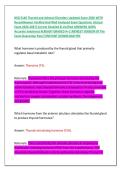
What hormone is produced by the thyroid gland that primarily
regulates basal metabolic rate?
Answer: Thyroxine (T4).
Rationale: Thyroxine (T4) is the principal hormone secreted by the
thyroid gland. Although triiodothyronine (T3) is the more biologically
active hormone, most thyroid hormone is released as T4 and converted
to T3 in peripheral tissues. Together, these hormones regulate
metabolism, oxygen consumption, protein synthesis, thermogenesis,
and growth.
Which hormone from the anterior pituitary stimulates the thyroid gland
to produce thyroid hormones?
Answer: Thyroid-stimulating hormone (TSH).
Rationale: TSH is secreted by the anterior pituitary in response to
thyrotropin-releasing hormone (TRH) from the hypothalamus. TSH
stimulates thyroid follicular cells to synthesize and release T3 and T4.
,Elevated TSH commonly indicates primary hypothyroidism, while
suppressed TSH often indicates hyperthyroidism.
What mineral is essential for the synthesis of thyroid hormones?
Answer: Iodine.
Rationale: Iodine is an essential component of T3 and T4. Without
adequate iodine intake, thyroid hormone synthesis decreases, resulting
in compensatory thyroid enlargement (goiter) and possible
hypothyroidism.
What is the most common cause of primary hypothyroidism in
developed countries?
Answer: Hashimoto thyroiditis.
Rationale: Hashimoto thyroiditis is an autoimmune disorder
characterized by gradual destruction of thyroid tissue through
autoimmune antibodies. It leads to progressive thyroid hormone
deficiency and is the leading cause of hypothyroidism where iodine
intake is sufficient.
What is the most common cause of hyperthyroidism?
,Answer: Graves disease.
Rationale: Graves disease is an autoimmune disorder in which thyroid-
stimulating immunoglobulins activate TSH receptors, causing excessive
thyroid hormone production and diffuse thyroid enlargement. It is the
leading cause of hyperthyroidism.
Which laboratory finding is most consistent with primary
hypothyroidism?
Answer: Elevated TSH with decreased free T4.
Rationale: Primary hypothyroidism results from thyroid gland failure.
Reduced thyroid hormone production removes negative feedback on
the pituitary, causing increased TSH secretion while free T4 remains
low.
Which laboratory finding is expected in untreated Graves disease?
Answer: Suppressed TSH with elevated free T4 and T3.
Rationale: Excess thyroid hormone suppresses pituitary TSH secretion
through negative feedback. Elevated circulating T3 and T4 confirm
hyperthyroidism.
, What characteristic eye finding is associated with Graves disease?
Answer: Exophthalmos (proptosis).
Rationale: Exophthalmos results from autoimmune inflammation and
accumulation of glycosaminoglycans within the orbital tissues, leading
to protrusion of the eyes. It is a distinctive feature of Graves disease.
Which antibody is most commonly associated with Hashimoto
thyroiditis?
Answer: Anti-thyroid peroxidase (anti-TPO) antibody.
Rationale: Anti-TPO antibodies attack thyroid peroxidase, an enzyme
essential for thyroid hormone synthesis. Their presence strongly
supports the diagnosis of autoimmune hypothyroidism.
What is the first-line medication for treating hypothyroidism?
Answer: Levothyroxine.
Rationale: Levothyroxine is synthetic T4 that restores normal thyroid
hormone levels. It has a long half-life, provides stable hormone
replacement, and is the preferred lifelong therapy for hypothyroidism.
RecentNewest Verified And Well Analyzed Exam Questions (Actual
Exam 2026-2027) Correct Detailed & Verified ANSWERS (100%
Accurate Solutions) ALREADY GRADED A+||NEWEST VERSION Of The
Exam Guarantee Pass!!|INSTANT DOWNLOAD PDF
What hormone is produced by the thyroid gland that primarily
regulates basal metabolic rate?
Answer: Thyroxine (T4).
Rationale: Thyroxine (T4) is the principal hormone secreted by the
thyroid gland. Although triiodothyronine (T3) is the more biologically
active hormone, most thyroid hormone is released as T4 and converted
to T3 in peripheral tissues. Together, these hormones regulate
metabolism, oxygen consumption, protein synthesis, thermogenesis,
and growth.
Which hormone from the anterior pituitary stimulates the thyroid gland
to produce thyroid hormones?
Answer: Thyroid-stimulating hormone (TSH).
Rationale: TSH is secreted by the anterior pituitary in response to
thyrotropin-releasing hormone (TRH) from the hypothalamus. TSH
stimulates thyroid follicular cells to synthesize and release T3 and T4.
,Elevated TSH commonly indicates primary hypothyroidism, while
suppressed TSH often indicates hyperthyroidism.
What mineral is essential for the synthesis of thyroid hormones?
Answer: Iodine.
Rationale: Iodine is an essential component of T3 and T4. Without
adequate iodine intake, thyroid hormone synthesis decreases, resulting
in compensatory thyroid enlargement (goiter) and possible
hypothyroidism.
What is the most common cause of primary hypothyroidism in
developed countries?
Answer: Hashimoto thyroiditis.
Rationale: Hashimoto thyroiditis is an autoimmune disorder
characterized by gradual destruction of thyroid tissue through
autoimmune antibodies. It leads to progressive thyroid hormone
deficiency and is the leading cause of hypothyroidism where iodine
intake is sufficient.
What is the most common cause of hyperthyroidism?
,Answer: Graves disease.
Rationale: Graves disease is an autoimmune disorder in which thyroid-
stimulating immunoglobulins activate TSH receptors, causing excessive
thyroid hormone production and diffuse thyroid enlargement. It is the
leading cause of hyperthyroidism.
Which laboratory finding is most consistent with primary
hypothyroidism?
Answer: Elevated TSH with decreased free T4.
Rationale: Primary hypothyroidism results from thyroid gland failure.
Reduced thyroid hormone production removes negative feedback on
the pituitary, causing increased TSH secretion while free T4 remains
low.
Which laboratory finding is expected in untreated Graves disease?
Answer: Suppressed TSH with elevated free T4 and T3.
Rationale: Excess thyroid hormone suppresses pituitary TSH secretion
through negative feedback. Elevated circulating T3 and T4 confirm
hyperthyroidism.
, What characteristic eye finding is associated with Graves disease?
Answer: Exophthalmos (proptosis).
Rationale: Exophthalmos results from autoimmune inflammation and
accumulation of glycosaminoglycans within the orbital tissues, leading
to protrusion of the eyes. It is a distinctive feature of Graves disease.
Which antibody is most commonly associated with Hashimoto
thyroiditis?
Answer: Anti-thyroid peroxidase (anti-TPO) antibody.
Rationale: Anti-TPO antibodies attack thyroid peroxidase, an enzyme
essential for thyroid hormone synthesis. Their presence strongly
supports the diagnosis of autoimmune hypothyroidism.
What is the first-line medication for treating hypothyroidism?
Answer: Levothyroxine.
Rationale: Levothyroxine is synthetic T4 that restores normal thyroid
hormone levels. It has a long half-life, provides stable hormone
replacement, and is the preferred lifelong therapy for hypothyroidism.


