

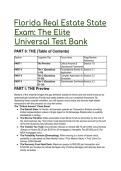
Florida Real Estate State
Exam: The Elite
Universal Test Bank
PART 0: THE (Table of Contents)
Section Cognitive Tier Focus Area Page/Section
Reference
PART I The Preview Critical Axioms & Section 1.0
Operational Framework
PART II Tier 1 (Questions Foundational Syntax & Section 2.1
1–10) Application
PART II Tier 2 (Questions Complex Application & Section 2.2
11–20) Simulation
PART II Tier 3 (Questions Grandmaster Synthesis Section 2.3
21–30)
PART I: THE Preview
Mastery of this material bridges the gap between academic theory and real-world licensure by
systematically hardwiring Florida real estate statutes into your analytical framework. By
dissecting these complex variables, you will bypass novice traps and execute high-stakes
transactions with the precision of a top-tier broker.
The "Critical Axioms" Cheat Sheet:
● The Default State: In Florida, all licensees operate as Transaction Brokers providing
limited representation unless a Single Agent or No Brokerage Relationship is explicitly
established in writing.
● The Escrow Timeline: Sales associates must deliver funds to the broker by the end of
the next business day. The broker must deposit funds into the escrow account by the end
of the third business day following initial receipt.
● The Transfer Tax Triad: Documentary Stamps on Deeds ($0.70 per $100); Documentary
Stamps on Notes ($0.35 per $100 for all mortgages); Intangible Tax ($0.002 per $1 for
NEW mortgages only).
● The Portability Formula (Downsizing): When moving to a home of lesser value,
portability is calculated as (New Market Value / Prior Market Value) × Prior Save Our
Homes (SOH) Benefit.
● The Recovery Fund Hard Deck: Maximum payout is $50,000 per transaction and
$150,000 per licensee for actual damages only. Punitive damages and attorney fees are
strictly excluded.
,PART II: THE ELITE TEST BANK
Tier 1: Foundational Syntax & Application
Q1: A sales associate receives an earnest money deposit check from a prospective buyer on a
Tuesday at 4:00 PM. Assuming there are no legal holidays during the week, what is the
LATEST time the employing broker must deposit these funds into the brokerage escrow account
to remain in compliance with Florida Administrative Code Chapter 61J2? A) By the end of
business on Wednesday. B) By the end of business on Thursday. C) By the end of business on
Friday. D) Within 72 hours of the sales contract being fully executed by all parties.
● The Answer: C (By the end of business on Friday.)
● Distractor Analysis:
○ A is incorrect: This is the deadline for the sales associate to deliver the funds to
their employing broker (the end of the next business day), not the final deadline for
the broker to deposit the funds into the formal escrow account.
○ B is incorrect: This calculates a rigid three-day window without including the day of
initial receipt as "Day 0." The statutory rule explicitly grants the broker until the end
of the third business day following the initial receipt by the brokerage.
○ D is incorrect: Escrow deposit timelines are triggered exclusively by the physical or
electronic receipt of funds by any associate of the brokerage, not by the execution
of the sales contract. Delaying deposit until contract execution constitutes illegal
commingling or failure to account.
The Mentor's Analysis: Statutory deadlines for trust funds are absolute and unforgiving. The
sales associate serves as an extension of the broker. Therefore, the timeline begins the moment
the associate touches the funds. The associate has one business day to deliver; the broker has
up to three business days from the original receipt to secure the funds in the escrow account.
Custodian Deadline Requirement
Sales Associate End of the next business day following receipt
Employing Broker End of the third business day following initial
receipt
Professional/Academic Intuition: Count the
timeline from the moment the associate
touches the funds: Associate = 1 business
day; Broker = 3 business days.
Q2: A prospective buyer walks into a real estate brokerage in Orlando to inquire about a listing.
The licensee immediately begins answering financial questions and showing properties without
having the buyer sign any disclosures. Under Chapter 475 of the Florida Statutes, which
brokerage relationship is legally PRESUMED to exist? A) Single Agent Relationship B) Dual
Agent Relationship C) Transaction Broker Relationship D) No Brokerage Relationship
● The Answer: C (Transaction Broker Relationship)
● Distractor Analysis:
○ A is incorrect: A Single Agent relationship creates a stringent fiduciary duty that
requires an explicit, written disclosure signed or initialed by the principal prior to
representation.
○ B is incorrect: Dual agency—representing both the buyer and seller as a fiduciary in
the same residential transaction—is strictly illegal in Florida. No implied or written
, contract can validate it.
○ D is incorrect: While a No Brokerage Relationship does not require fiduciary duties,
it still requires a written disclosure before the showing of property to ensure the
consumer understands they are completely unrepresented.
The Mentor's Analysis: Florida law eliminates ambiguity by defaulting to a standard of limited
representation. Unless a specific written disclosure dictates otherwise, all licensees are legally
viewed as facilitating the transaction neutrally. This protects the public by ensuring a baseline of
skill, care, and diligence, while protecting the broker from unintended fiduciary liabilities.
Professional/Academic Intuition: In the absence of ink, Florida presumes you are a
Transaction Broker.
Q3: A consumer suffers a severe financial loss due to the fraudulent actions of a licensed real
estate broker. A civil court awards the consumer $65,000 in actual damages, $20,000 in punitive
damages, and $15,000 in attorney fees. What is the MAXIMUM amount the consumer can
collect from the Florida Real Estate Recovery Fund for this single transaction? A) $100,000 B)
$65,000 C) $50,000 D) $150,000
● The Answer: C ($50,000)
● Distractor Analysis:
○ A is incorrect: This incorrectly sums the actual damages, punitive damages, and
attorney fees. The fund strictly excludes non-actual damages, making this
calculation analytically flawed.
○ B is incorrect: While the fund covers actual damages, it strictly caps payouts at
$50,000 per transaction, even if the verified actual damages exceed this threshold.
○ D is incorrect: $150,000 is the lifetime maximum payout against a single licensee
for multiple transactions, not the ceiling for a single, isolated transaction.
The Mentor's Analysis: The Recovery Fund is a safety net of last resort funded by licensee
fees, not a mechanism for total restitution or punishment. It isolates and reimburses only raw
financial loss up to a rigid statutory ceiling. Any payout automatically results in the mandatory
suspension of the offending broker's license until the fund is repaid with interest.
Payout Category Statutory Limit
Single Transaction Maximum $50,000
Lifetime Licensee Maximum $150,000
Eligible Damages Actual Damages Only (No punitive/legal fees)
Professional/Academic Intuition: The
Recovery Fund pays a maximum of $50,000
per transaction for actual damages only—no
punitive damages, no legal fees.
Q4: A legally blind, non-veteran homeowner resides in a Florida property assessed at $350,000.
They qualify for the standard homestead exemption. What is the total assessed value
completely exempt from county and city (non-school) property taxes? A) $25,500 B) $50,000 C)
$50,500 D) $51,000
● The Answer: C ($50,500)
● Distractor Analysis:
○ A is incorrect: This reflects the base $25,000 exemption plus the $500 blind
exemption. This amount applies only to school taxes, completely ignoring the
additional $25,000 exemption reserved for non-school taxes.
○ B is incorrect: This is the standard maximum homestead exemption for non-school
taxes ($25,000 base + $25,000 additional), but it fails to add the specific $500
Exam: The Elite
Universal Test Bank
PART 0: THE (Table of Contents)
Section Cognitive Tier Focus Area Page/Section
Reference
PART I The Preview Critical Axioms & Section 1.0
Operational Framework
PART II Tier 1 (Questions Foundational Syntax & Section 2.1
1–10) Application
PART II Tier 2 (Questions Complex Application & Section 2.2
11–20) Simulation
PART II Tier 3 (Questions Grandmaster Synthesis Section 2.3
21–30)
PART I: THE Preview
Mastery of this material bridges the gap between academic theory and real-world licensure by
systematically hardwiring Florida real estate statutes into your analytical framework. By
dissecting these complex variables, you will bypass novice traps and execute high-stakes
transactions with the precision of a top-tier broker.
The "Critical Axioms" Cheat Sheet:
● The Default State: In Florida, all licensees operate as Transaction Brokers providing
limited representation unless a Single Agent or No Brokerage Relationship is explicitly
established in writing.
● The Escrow Timeline: Sales associates must deliver funds to the broker by the end of
the next business day. The broker must deposit funds into the escrow account by the end
of the third business day following initial receipt.
● The Transfer Tax Triad: Documentary Stamps on Deeds ($0.70 per $100); Documentary
Stamps on Notes ($0.35 per $100 for all mortgages); Intangible Tax ($0.002 per $1 for
NEW mortgages only).
● The Portability Formula (Downsizing): When moving to a home of lesser value,
portability is calculated as (New Market Value / Prior Market Value) × Prior Save Our
Homes (SOH) Benefit.
● The Recovery Fund Hard Deck: Maximum payout is $50,000 per transaction and
$150,000 per licensee for actual damages only. Punitive damages and attorney fees are
strictly excluded.
,PART II: THE ELITE TEST BANK
Tier 1: Foundational Syntax & Application
Q1: A sales associate receives an earnest money deposit check from a prospective buyer on a
Tuesday at 4:00 PM. Assuming there are no legal holidays during the week, what is the
LATEST time the employing broker must deposit these funds into the brokerage escrow account
to remain in compliance with Florida Administrative Code Chapter 61J2? A) By the end of
business on Wednesday. B) By the end of business on Thursday. C) By the end of business on
Friday. D) Within 72 hours of the sales contract being fully executed by all parties.
● The Answer: C (By the end of business on Friday.)
● Distractor Analysis:
○ A is incorrect: This is the deadline for the sales associate to deliver the funds to
their employing broker (the end of the next business day), not the final deadline for
the broker to deposit the funds into the formal escrow account.
○ B is incorrect: This calculates a rigid three-day window without including the day of
initial receipt as "Day 0." The statutory rule explicitly grants the broker until the end
of the third business day following the initial receipt by the brokerage.
○ D is incorrect: Escrow deposit timelines are triggered exclusively by the physical or
electronic receipt of funds by any associate of the brokerage, not by the execution
of the sales contract. Delaying deposit until contract execution constitutes illegal
commingling or failure to account.
The Mentor's Analysis: Statutory deadlines for trust funds are absolute and unforgiving. The
sales associate serves as an extension of the broker. Therefore, the timeline begins the moment
the associate touches the funds. The associate has one business day to deliver; the broker has
up to three business days from the original receipt to secure the funds in the escrow account.
Custodian Deadline Requirement
Sales Associate End of the next business day following receipt
Employing Broker End of the third business day following initial
receipt
Professional/Academic Intuition: Count the
timeline from the moment the associate
touches the funds: Associate = 1 business
day; Broker = 3 business days.
Q2: A prospective buyer walks into a real estate brokerage in Orlando to inquire about a listing.
The licensee immediately begins answering financial questions and showing properties without
having the buyer sign any disclosures. Under Chapter 475 of the Florida Statutes, which
brokerage relationship is legally PRESUMED to exist? A) Single Agent Relationship B) Dual
Agent Relationship C) Transaction Broker Relationship D) No Brokerage Relationship
● The Answer: C (Transaction Broker Relationship)
● Distractor Analysis:
○ A is incorrect: A Single Agent relationship creates a stringent fiduciary duty that
requires an explicit, written disclosure signed or initialed by the principal prior to
representation.
○ B is incorrect: Dual agency—representing both the buyer and seller as a fiduciary in
the same residential transaction—is strictly illegal in Florida. No implied or written
, contract can validate it.
○ D is incorrect: While a No Brokerage Relationship does not require fiduciary duties,
it still requires a written disclosure before the showing of property to ensure the
consumer understands they are completely unrepresented.
The Mentor's Analysis: Florida law eliminates ambiguity by defaulting to a standard of limited
representation. Unless a specific written disclosure dictates otherwise, all licensees are legally
viewed as facilitating the transaction neutrally. This protects the public by ensuring a baseline of
skill, care, and diligence, while protecting the broker from unintended fiduciary liabilities.
Professional/Academic Intuition: In the absence of ink, Florida presumes you are a
Transaction Broker.
Q3: A consumer suffers a severe financial loss due to the fraudulent actions of a licensed real
estate broker. A civil court awards the consumer $65,000 in actual damages, $20,000 in punitive
damages, and $15,000 in attorney fees. What is the MAXIMUM amount the consumer can
collect from the Florida Real Estate Recovery Fund for this single transaction? A) $100,000 B)
$65,000 C) $50,000 D) $150,000
● The Answer: C ($50,000)
● Distractor Analysis:
○ A is incorrect: This incorrectly sums the actual damages, punitive damages, and
attorney fees. The fund strictly excludes non-actual damages, making this
calculation analytically flawed.
○ B is incorrect: While the fund covers actual damages, it strictly caps payouts at
$50,000 per transaction, even if the verified actual damages exceed this threshold.
○ D is incorrect: $150,000 is the lifetime maximum payout against a single licensee
for multiple transactions, not the ceiling for a single, isolated transaction.
The Mentor's Analysis: The Recovery Fund is a safety net of last resort funded by licensee
fees, not a mechanism for total restitution or punishment. It isolates and reimburses only raw
financial loss up to a rigid statutory ceiling. Any payout automatically results in the mandatory
suspension of the offending broker's license until the fund is repaid with interest.
Payout Category Statutory Limit
Single Transaction Maximum $50,000
Lifetime Licensee Maximum $150,000
Eligible Damages Actual Damages Only (No punitive/legal fees)
Professional/Academic Intuition: The
Recovery Fund pays a maximum of $50,000
per transaction for actual damages only—no
punitive damages, no legal fees.
Q4: A legally blind, non-veteran homeowner resides in a Florida property assessed at $350,000.
They qualify for the standard homestead exemption. What is the total assessed value
completely exempt from county and city (non-school) property taxes? A) $25,500 B) $50,000 C)
$50,500 D) $51,000
● The Answer: C ($50,500)
● Distractor Analysis:
○ A is incorrect: This reflects the base $25,000 exemption plus the $500 blind
exemption. This amount applies only to school taxes, completely ignoring the
additional $25,000 exemption reserved for non-school taxes.
○ B is incorrect: This is the standard maximum homestead exemption for non-school
taxes ($25,000 base + $25,000 additional), but it fails to add the specific $500


