

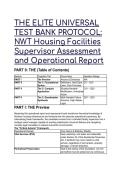
THE ELITE UNIVERSAL
TEST BANK PROTOCOL:
NWT Housing Facilities
Supervisor Assessment
and Operational Report
PART 0: THE (Table of Contents)
Section Cognitive Tier Focus Area Question Range
PART I The Preview Axioms & Directives N/A
PART II Tier 1: Foundational Definitions, Hard Deck Q1 – Q10
Syntax Laws, Core Formulas
PART II Tier 2: Complex Situation/Variable Q11 – Q20
Application Modification, Immediate
Action
PART II Tier 3: Grandmaster Multi-Variable Failure Q21 – Q30
Synthesis Aversion, High-Stakes
Logic
PART I: THE Preview
Mastering this operational report and assessment bank transforms theoretical knowledge of
Northern housing infrastructure and territorial law into absolute operational supremacy. By
internalizing these frameworks, the candidate evolves from a standard facility supervisor into a
strategic asset manager capable of averting catastrophic structural failures and navigating
complex legal mandates in extreme sub-Arctic environments.
The "Critical Axioms" Framework
Operational Domain Core Axiom & Statutory Reality
Vital Services (RTA) Heat, electricity, and water are inalienable
under Section 33 of the Residential Tenancies
Act. A landlord may never restrict a vital
service, regardless of rent arrears, property
damage, or tenant breaches.
Permafrost Preservation Heat is the enemy of the foundation. Ice-rich
permafrost must be preserved via continuous
,Operational Domain Core Axiom & Statutory Reality
crawlspace ventilation, winter snow clearing (to
remove the insulating blanket effect), and
proper pad/wedge or thermosyphon
maintenance. Water accumulation is the
primary catalyst for rapid thaw.
Fall Protection (WSCC) Any work conducted at an elevation of 3 meters
(10 feet) or more absolutely requires a fully
compliant, documented fall protection system.
There is no leniency for residential scale.
Asbestos Protocols Disturbance of Asbestos-Containing Materials
(ACM) requires a minimum of 5 days' advance
notification to the WSCC, superseding standard
maintenance timelines unless a catastrophic
emergency is actively unfolding.
Hydrocarbon Storage All outdoor residential heating oil tanks installed
after July 2010 must be double-walled with
interstitial monitoring. The property owner
retains absolute financial and environmental
liability for all hydrocarbon spills.
PART II: THE ELITE TEST BANK
Tier 1: Foundational Syntax & Application
Q1: A tenant in a Yellowknife public housing unit has failed to pay rent for three consecutive
months during the winter. The tenant's unit utilizes a landlord-controlled central boiler. Based on
the principles of the Northwest Territories Residential Tenancies Act (RTA), which action
regarding the unit's heating is the MOST ACCURATE? A) The landlord may reduce the ambient
temperature of the unit to 15°C to conserve fuel until the arrears are cleared. B) The landlord
may temporarily suspend heating services only if the tenant is given a 30-day written notice of
eviction. C) The landlord must maintain the continuous supply of heat, as it is classified as a
non-negotiable vital service. D) The landlord can disconnect the heat if they provide the tenant
with portable, plug-in electrical heaters as a substitute.
● The Answer: C (The landlord must maintain the continuous supply of heat, as it is
classified as a non-negotiable vital service.)
● Distractor Analysis:
○ A is incorrect: Deliberately dropping the temperature below habitable standards
constitutes interference with a vital service, strictly prohibited under Section 33 of
the RTA.
○ B is incorrect: Even during an active eviction process or after a termination notice is
served, vital services cannot be suspended under any circumstances.
○ D is incorrect: Substituting a primary, stable heat source with temporary electric
heaters does not fulfill the legal obligation to maintain the primary heating system
and creates secondary fire and electrical hazards.
The Mentor's Analysis: Section 33 of the RTA treats heat, water, and electricity as absolute
human rights within a tenancy, entirely divorced from a tenant's financial compliance. When
facing severe rent arrears, the immediate priority is to utilize the legal eviction and Rental Officer
, arbitration processes, rather than weaponizing the physical infrastructure of the building. By
utilizing the statutory eviction procedures for non-payment, the facility manager bypasses the
common trap of initiating an illegal constructive eviction, which would expose the organization to
severe penalties and mandate the immediate restoration of services. Professional/Academic
Intuition: Never weaponize a vital service; infrastructure operation is legally and
functionally independent of tenant financial compliance.
Q2: A maintenance worker is scheduled to inspect a suspected plumbing leak in a tenant's
bathroom chase. It is a routine diagnostic check, and there is no active flooding visible. Based
on the principles of the NWT Residential Tenancies Act, which action is the FIRST requirement
before the worker enters the unit? A) The landlord must provide the tenant with at least 24
hours' written notice specifying the time and purpose of entry. B) The worker may knock and
enter immediately if the inspection occurs during standard operational hours between 8:00 AM
and 5:00 PM. C) The landlord must obtain the tenant's verbal consent over the phone prior to
dispatching the worker to the site. D) The worker must post a 72-hour notice on the unit's door
before gaining access to the plumbing chase.
● The Answer: A (The landlord must provide the tenant with at least 24 hours' written
notice specifying the time and purpose of entry.)
● Distractor Analysis:
○ B is incorrect: Entering without notice is legally permissible only in a true, active
emergency, such as uncontrolled flooding or a fire. A suspected, non-active leak
requires standard statutory notice.
○ C is incorrect: While verbal consent is practically helpful for scheduling, the strict
legal standard requires written notice to definitively protect the landlord from claims
of illegal entry and trespass.
○ D is incorrect: A 72-hour timeframe is an arbitrary operational metric not supported
by the RTA; the statutory requirement dictates a minimum of 24 hours.
The Mentor's Analysis: The RTA meticulously balances the landlord's fundamental right to
maintain the physical asset with the tenant's inalienable right to quiet enjoyment. When facing
routine or non-emergency maintenance, the immediate priority is absolute regulatory
compliance via written documentation. By utilizing the mandated 24-hour written notice protocol,
the facility supervisor bypasses the common trap of invalidating their legal standing in future
Rental Officer disputes due to documented trespass. Professional/Academic Intuition:
Unless water or fire is actively destroying the asset, the 24-hour written notice remains
the absolute hard deck for unit entry.
Q3: A facility supervisor is ordering a replacement for an outdoor heating oil tank at a residential
unit. Based on the principles of current territorial environmental and fuel storage regulations,
which specification represents the MOST ACCURATE requirement for the new tank? A) It must
be a single-walled steel tank elevated on wooden blocks to prevent ground freezing and frost
heave. B) It must be constructed of single-walled fiberglass to prevent internal corrosion from
condensation. C) It must be a double-walled tank equipped with an interstitial monitoring device.
D) It must be buried underground to insulate the fuel from extreme sub-zero ambient
temperatures.
● The Answer: C (It must be a double-walled tank equipped with an interstitial monitoring
device.)
● Distractor Analysis:
○ A is incorrect: Single-walled steel tanks installed outdoors are obsolete and
explicitly illegal under post-2010 codes due to their extreme environmental spill
liability.
TEST BANK PROTOCOL:
NWT Housing Facilities
Supervisor Assessment
and Operational Report
PART 0: THE (Table of Contents)
Section Cognitive Tier Focus Area Question Range
PART I The Preview Axioms & Directives N/A
PART II Tier 1: Foundational Definitions, Hard Deck Q1 – Q10
Syntax Laws, Core Formulas
PART II Tier 2: Complex Situation/Variable Q11 – Q20
Application Modification, Immediate
Action
PART II Tier 3: Grandmaster Multi-Variable Failure Q21 – Q30
Synthesis Aversion, High-Stakes
Logic
PART I: THE Preview
Mastering this operational report and assessment bank transforms theoretical knowledge of
Northern housing infrastructure and territorial law into absolute operational supremacy. By
internalizing these frameworks, the candidate evolves from a standard facility supervisor into a
strategic asset manager capable of averting catastrophic structural failures and navigating
complex legal mandates in extreme sub-Arctic environments.
The "Critical Axioms" Framework
Operational Domain Core Axiom & Statutory Reality
Vital Services (RTA) Heat, electricity, and water are inalienable
under Section 33 of the Residential Tenancies
Act. A landlord may never restrict a vital
service, regardless of rent arrears, property
damage, or tenant breaches.
Permafrost Preservation Heat is the enemy of the foundation. Ice-rich
permafrost must be preserved via continuous
,Operational Domain Core Axiom & Statutory Reality
crawlspace ventilation, winter snow clearing (to
remove the insulating blanket effect), and
proper pad/wedge or thermosyphon
maintenance. Water accumulation is the
primary catalyst for rapid thaw.
Fall Protection (WSCC) Any work conducted at an elevation of 3 meters
(10 feet) or more absolutely requires a fully
compliant, documented fall protection system.
There is no leniency for residential scale.
Asbestos Protocols Disturbance of Asbestos-Containing Materials
(ACM) requires a minimum of 5 days' advance
notification to the WSCC, superseding standard
maintenance timelines unless a catastrophic
emergency is actively unfolding.
Hydrocarbon Storage All outdoor residential heating oil tanks installed
after July 2010 must be double-walled with
interstitial monitoring. The property owner
retains absolute financial and environmental
liability for all hydrocarbon spills.
PART II: THE ELITE TEST BANK
Tier 1: Foundational Syntax & Application
Q1: A tenant in a Yellowknife public housing unit has failed to pay rent for three consecutive
months during the winter. The tenant's unit utilizes a landlord-controlled central boiler. Based on
the principles of the Northwest Territories Residential Tenancies Act (RTA), which action
regarding the unit's heating is the MOST ACCURATE? A) The landlord may reduce the ambient
temperature of the unit to 15°C to conserve fuel until the arrears are cleared. B) The landlord
may temporarily suspend heating services only if the tenant is given a 30-day written notice of
eviction. C) The landlord must maintain the continuous supply of heat, as it is classified as a
non-negotiable vital service. D) The landlord can disconnect the heat if they provide the tenant
with portable, plug-in electrical heaters as a substitute.
● The Answer: C (The landlord must maintain the continuous supply of heat, as it is
classified as a non-negotiable vital service.)
● Distractor Analysis:
○ A is incorrect: Deliberately dropping the temperature below habitable standards
constitutes interference with a vital service, strictly prohibited under Section 33 of
the RTA.
○ B is incorrect: Even during an active eviction process or after a termination notice is
served, vital services cannot be suspended under any circumstances.
○ D is incorrect: Substituting a primary, stable heat source with temporary electric
heaters does not fulfill the legal obligation to maintain the primary heating system
and creates secondary fire and electrical hazards.
The Mentor's Analysis: Section 33 of the RTA treats heat, water, and electricity as absolute
human rights within a tenancy, entirely divorced from a tenant's financial compliance. When
facing severe rent arrears, the immediate priority is to utilize the legal eviction and Rental Officer
, arbitration processes, rather than weaponizing the physical infrastructure of the building. By
utilizing the statutory eviction procedures for non-payment, the facility manager bypasses the
common trap of initiating an illegal constructive eviction, which would expose the organization to
severe penalties and mandate the immediate restoration of services. Professional/Academic
Intuition: Never weaponize a vital service; infrastructure operation is legally and
functionally independent of tenant financial compliance.
Q2: A maintenance worker is scheduled to inspect a suspected plumbing leak in a tenant's
bathroom chase. It is a routine diagnostic check, and there is no active flooding visible. Based
on the principles of the NWT Residential Tenancies Act, which action is the FIRST requirement
before the worker enters the unit? A) The landlord must provide the tenant with at least 24
hours' written notice specifying the time and purpose of entry. B) The worker may knock and
enter immediately if the inspection occurs during standard operational hours between 8:00 AM
and 5:00 PM. C) The landlord must obtain the tenant's verbal consent over the phone prior to
dispatching the worker to the site. D) The worker must post a 72-hour notice on the unit's door
before gaining access to the plumbing chase.
● The Answer: A (The landlord must provide the tenant with at least 24 hours' written
notice specifying the time and purpose of entry.)
● Distractor Analysis:
○ B is incorrect: Entering without notice is legally permissible only in a true, active
emergency, such as uncontrolled flooding or a fire. A suspected, non-active leak
requires standard statutory notice.
○ C is incorrect: While verbal consent is practically helpful for scheduling, the strict
legal standard requires written notice to definitively protect the landlord from claims
of illegal entry and trespass.
○ D is incorrect: A 72-hour timeframe is an arbitrary operational metric not supported
by the RTA; the statutory requirement dictates a minimum of 24 hours.
The Mentor's Analysis: The RTA meticulously balances the landlord's fundamental right to
maintain the physical asset with the tenant's inalienable right to quiet enjoyment. When facing
routine or non-emergency maintenance, the immediate priority is absolute regulatory
compliance via written documentation. By utilizing the mandated 24-hour written notice protocol,
the facility supervisor bypasses the common trap of invalidating their legal standing in future
Rental Officer disputes due to documented trespass. Professional/Academic Intuition:
Unless water or fire is actively destroying the asset, the 24-hour written notice remains
the absolute hard deck for unit entry.
Q3: A facility supervisor is ordering a replacement for an outdoor heating oil tank at a residential
unit. Based on the principles of current territorial environmental and fuel storage regulations,
which specification represents the MOST ACCURATE requirement for the new tank? A) It must
be a single-walled steel tank elevated on wooden blocks to prevent ground freezing and frost
heave. B) It must be constructed of single-walled fiberglass to prevent internal corrosion from
condensation. C) It must be a double-walled tank equipped with an interstitial monitoring device.
D) It must be buried underground to insulate the fuel from extreme sub-zero ambient
temperatures.
● The Answer: C (It must be a double-walled tank equipped with an interstitial monitoring
device.)
● Distractor Analysis:
○ A is incorrect: Single-walled steel tanks installed outdoors are obsolete and
explicitly illegal under post-2010 codes due to their extreme environmental spill
liability.


