

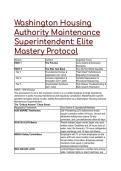
Washington Housing
Authority Maintenance
Superintendent: Elite
Mastery Protocol
Section Content Cognitive Focus
PART I The Preview Core Axioms & Executive
Directives
PART II The Elite Test Bank The 30-Point MCQ Gauntlet
- Tier 1 Foundational Syntax & "Hard Deck" Definitions &
Application (Q1–Q10) Regulatory Frameworks
- Tier 2 Complex Application & Variable Manipulation &
Simulation (Q11–Q20) Procedural Sequencing
- Tier 3 Grandmaster Synthesis High-Stakes Troubleshooting &
(Q21–Q30) Multi-System Resolution
PART I: THE Preview
This assessment is not a test of passive recall; it is a crucible designed to forge operational
dominance in public housing maintenance and regulatory compliance. Mastering this specific
gauntlet translates directly to elite, liability-free performance as a Washington Housing Authority
Maintenance Superintendent.
The "Critical Axioms" Cheat Sheet:
Regulatory Framework Core Axiom & Operational Mandate
HUD NSPIRE Timeframes Life-Threatening (LT) deficiencies strictly
require correction within 24 hours. Severe and
Moderate deficiencies require 30-day
correction, and Low deficiencies allow 60 days.
RCW 59.18.070 Matrix Tenant-initiated repair clocks begin only upon
written notice. Deadlines are 24 hours (loss of
water, heat, life hazards), 72 hours (refrigerator,
major plumbing), and 10 days (all others).
WISHA Safety Committees Employers with 11 or more employees on the
same shift and same location must establish a
formal Safety Committee. Employee-elected
members must equal or outnumber
employer-selected members.
WAC 296-803 LOTO Lockout/Tagout requires a verified zero-energy
state. Indicator lights or silent machinery are
,Regulatory Framework Core Axiom & Operational Mandate
never proof of de-energization; kinetic, physical
verification is an absolute mandate.
Small Works Procurement Under RCW 39.04.152, for direct contracts
under $150,000, if a roster contains six or more
certified small businesses, the agency must
direct contract with one small business and
rotate opportunities.
PART II: THE ELITE TEST BANK
Tier 1: Foundational Syntax & Application
Q1: An annual NSPIRE inspection identifies a missing carbon monoxide detector inside a
tenant unit. Based on the principles of the NSPIRE deficiency categories, which
action/conclusion is the MOST ACCURATE? A) The deficiency is classified as Severe and must
be permanently repaired within 30 days of the notification. B) The deficiency is classified as
Life-Threatening and the housing authority must correct the issue within 24 hours of notification.
C) The deficiency is classified as Moderate because the unit possesses a functional smoke
alarm, requiring a 30-day correction. D) The deficiency requires an immediate tenant charge
and a 72-hour abatement window per Washington State local codes.
● The Answer: B (The deficiency is classified as Life-Threatening and the housing
authority must correct the issue within 24 hours of notification.)
● Distractor Analysis:
○ A is incorrect: Carbon monoxide and smoke alarm failures are explicitly categorized
as Life-Threatening (LT) under NSPIRE, not Severe, thereby triggering the 24-hour
rule, not the 30-day rule.
○ C is incorrect: The presence of a functional smoke alarm does not downgrade the
severity of a missing carbon monoxide detector; both are independent
Life-Threatening fire/safety standards that must be treated in isolation.
○ D is incorrect: While tenant charges may be assessed later if damage was
intentional, the absolute federal regulatory mandate dictates a 24-hour correction
timeframe regardless of fault or local code abatement windows.
The Mentor's Analysis: When facing critical fire and life-safety failures, the immediate priority
is absolute hazard mitigation within 24 hours. The origin of this strict enforcement stems from
the transition from UPCS to NSPIRE, which fundamentally shifted HUD's focus from aesthetic
property conditions to objective, resident-centric health and safety outcomes. By utilizing the
NSPIRE Life-Threatening List, you bypass the common trap of delaying essential life-safety
repairs while investigating fault. Professional/Academic Intuition: In HUD housing, absent or
defective smoke and CO alarms are strictly 24-hour Life-Threatening defects; compliance
precedes fault-finding.
Q2: A tenant submits a written notice on Tuesday at 9:00 AM stating that their agency-supplied
refrigerator has completely stopped cooling. Based on the principles of the Washington State
Residential Landlord-Tenant Act (RCW 59.18), which action/conclusion is the MOST
ACCURATE? A) The landlord has exactly 24 hours to restore the appliance because it stores
perishable food, constituting an imminent hazard. B) The landlord must commence remedial
action to repair or replace the refrigerator within 72 hours of receiving the written notice. C) The
landlord has 10 days to correct the deficiency, as appliances are considered secondary
, amenities under RCW 59.18.060. D) The timeframe for repair does not begin until the
maintenance superintendent visually verifies the appliance failure.
● The Answer: B (The landlord must commence remedial action to repair or replace the
refrigerator within 72 hours of receiving the written notice.)
● Distractor Analysis:
○ A is incorrect: The 24-hour requirement is strictly reserved for the loss of hot/cold
water, heat, electricity, or conditions imminently hazardous to life. Food spoilage
does not meet the statutory definition of an imminent life hazard.
○ C is incorrect: While many general repairs fall under the 10-day rule, refrigerators,
ranges, ovens, and major plumbing fixtures are explicitly carved out and assigned a
72-hour statutory deadline.
○ D is incorrect: A common legacy error. The statutory clock under RCW 59.18.070
begins the exact moment the landlord receives the written notice, completely
independent of internal visual verification workflows.
The Mentor's Analysis: When facing tenant appliance failures, the immediate priority is clock
management based strictly on statutory definitions. Washington's legislative framework
purposefully segregates repair urgencies into three distinct operational tiers to balance tenant
habitability with realistic municipal and contractor response times. By utilizing the RCW
59.18.070 tier system, you bypass the common trap of treating all non-emergency work orders
with the standard 10-day response. Professional/Academic Intuition: Written notice dictates
the clock: 24 hours for life/utilities, 72 hours for major appliances/plumbing, and 10 days
for everything else.
Q3: A Washington housing authority employs 14 maintenance technicians who all work the day
shift out of the central maintenance facility. Based on the principles of WISHA Safety Committee
requirements (WAC 296-800-130), which action/conclusion is the MOST ACCURATE? A)
Management may opt to hold monthly safety meetings instead of forming a committee, provided
a management representative is present. B) Management must establish a formal Safety
Committee where the number of employer-selected members outnumbers employee-elected
members. C) Management must establish a formal Safety Committee where employee-elected
members equal or exceed the number of employer-selected members. D) Management is
exempt from Safety Committee requirements until the workforce exceeds 25 personnel at a
single location.
● The Answer: C (Management must establish a formal Safety Committee where
employee-elected members equal or exceed the number of employer-selected members.)
● Distractor Analysis:
○ A is incorrect: Because the employer has 11 or more employees on the same shift
at the same location, they are legally barred from the "monthly safety meeting"
alternative and must form a formal committee.
○ B is incorrect: WISHA regulations explicitly require that the number of
employee-elected members must equal or exceed the number of
management-selected members to prevent management dominance and ensure
peer-driven safety culture.
○ D is incorrect: The strict threshold for mandatory Safety Committees under
Washington Labor & Industries (L&I) is 11 employees, not 25.
The Mentor's Analysis: When facing WISHA compliance for workforce safety, the immediate
priority is establishing the correct organizational structure based on headcount and shift
distribution. The statutory mechanism is designed to prevent top-down corporate safety
mandates by forcing a democratic, ground-up safety dialogue among frontline workers who face
Authority Maintenance
Superintendent: Elite
Mastery Protocol
Section Content Cognitive Focus
PART I The Preview Core Axioms & Executive
Directives
PART II The Elite Test Bank The 30-Point MCQ Gauntlet
- Tier 1 Foundational Syntax & "Hard Deck" Definitions &
Application (Q1–Q10) Regulatory Frameworks
- Tier 2 Complex Application & Variable Manipulation &
Simulation (Q11–Q20) Procedural Sequencing
- Tier 3 Grandmaster Synthesis High-Stakes Troubleshooting &
(Q21–Q30) Multi-System Resolution
PART I: THE Preview
This assessment is not a test of passive recall; it is a crucible designed to forge operational
dominance in public housing maintenance and regulatory compliance. Mastering this specific
gauntlet translates directly to elite, liability-free performance as a Washington Housing Authority
Maintenance Superintendent.
The "Critical Axioms" Cheat Sheet:
Regulatory Framework Core Axiom & Operational Mandate
HUD NSPIRE Timeframes Life-Threatening (LT) deficiencies strictly
require correction within 24 hours. Severe and
Moderate deficiencies require 30-day
correction, and Low deficiencies allow 60 days.
RCW 59.18.070 Matrix Tenant-initiated repair clocks begin only upon
written notice. Deadlines are 24 hours (loss of
water, heat, life hazards), 72 hours (refrigerator,
major plumbing), and 10 days (all others).
WISHA Safety Committees Employers with 11 or more employees on the
same shift and same location must establish a
formal Safety Committee. Employee-elected
members must equal or outnumber
employer-selected members.
WAC 296-803 LOTO Lockout/Tagout requires a verified zero-energy
state. Indicator lights or silent machinery are
,Regulatory Framework Core Axiom & Operational Mandate
never proof of de-energization; kinetic, physical
verification is an absolute mandate.
Small Works Procurement Under RCW 39.04.152, for direct contracts
under $150,000, if a roster contains six or more
certified small businesses, the agency must
direct contract with one small business and
rotate opportunities.
PART II: THE ELITE TEST BANK
Tier 1: Foundational Syntax & Application
Q1: An annual NSPIRE inspection identifies a missing carbon monoxide detector inside a
tenant unit. Based on the principles of the NSPIRE deficiency categories, which
action/conclusion is the MOST ACCURATE? A) The deficiency is classified as Severe and must
be permanently repaired within 30 days of the notification. B) The deficiency is classified as
Life-Threatening and the housing authority must correct the issue within 24 hours of notification.
C) The deficiency is classified as Moderate because the unit possesses a functional smoke
alarm, requiring a 30-day correction. D) The deficiency requires an immediate tenant charge
and a 72-hour abatement window per Washington State local codes.
● The Answer: B (The deficiency is classified as Life-Threatening and the housing
authority must correct the issue within 24 hours of notification.)
● Distractor Analysis:
○ A is incorrect: Carbon monoxide and smoke alarm failures are explicitly categorized
as Life-Threatening (LT) under NSPIRE, not Severe, thereby triggering the 24-hour
rule, not the 30-day rule.
○ C is incorrect: The presence of a functional smoke alarm does not downgrade the
severity of a missing carbon monoxide detector; both are independent
Life-Threatening fire/safety standards that must be treated in isolation.
○ D is incorrect: While tenant charges may be assessed later if damage was
intentional, the absolute federal regulatory mandate dictates a 24-hour correction
timeframe regardless of fault or local code abatement windows.
The Mentor's Analysis: When facing critical fire and life-safety failures, the immediate priority
is absolute hazard mitigation within 24 hours. The origin of this strict enforcement stems from
the transition from UPCS to NSPIRE, which fundamentally shifted HUD's focus from aesthetic
property conditions to objective, resident-centric health and safety outcomes. By utilizing the
NSPIRE Life-Threatening List, you bypass the common trap of delaying essential life-safety
repairs while investigating fault. Professional/Academic Intuition: In HUD housing, absent or
defective smoke and CO alarms are strictly 24-hour Life-Threatening defects; compliance
precedes fault-finding.
Q2: A tenant submits a written notice on Tuesday at 9:00 AM stating that their agency-supplied
refrigerator has completely stopped cooling. Based on the principles of the Washington State
Residential Landlord-Tenant Act (RCW 59.18), which action/conclusion is the MOST
ACCURATE? A) The landlord has exactly 24 hours to restore the appliance because it stores
perishable food, constituting an imminent hazard. B) The landlord must commence remedial
action to repair or replace the refrigerator within 72 hours of receiving the written notice. C) The
landlord has 10 days to correct the deficiency, as appliances are considered secondary
, amenities under RCW 59.18.060. D) The timeframe for repair does not begin until the
maintenance superintendent visually verifies the appliance failure.
● The Answer: B (The landlord must commence remedial action to repair or replace the
refrigerator within 72 hours of receiving the written notice.)
● Distractor Analysis:
○ A is incorrect: The 24-hour requirement is strictly reserved for the loss of hot/cold
water, heat, electricity, or conditions imminently hazardous to life. Food spoilage
does not meet the statutory definition of an imminent life hazard.
○ C is incorrect: While many general repairs fall under the 10-day rule, refrigerators,
ranges, ovens, and major plumbing fixtures are explicitly carved out and assigned a
72-hour statutory deadline.
○ D is incorrect: A common legacy error. The statutory clock under RCW 59.18.070
begins the exact moment the landlord receives the written notice, completely
independent of internal visual verification workflows.
The Mentor's Analysis: When facing tenant appliance failures, the immediate priority is clock
management based strictly on statutory definitions. Washington's legislative framework
purposefully segregates repair urgencies into three distinct operational tiers to balance tenant
habitability with realistic municipal and contractor response times. By utilizing the RCW
59.18.070 tier system, you bypass the common trap of treating all non-emergency work orders
with the standard 10-day response. Professional/Academic Intuition: Written notice dictates
the clock: 24 hours for life/utilities, 72 hours for major appliances/plumbing, and 10 days
for everything else.
Q3: A Washington housing authority employs 14 maintenance technicians who all work the day
shift out of the central maintenance facility. Based on the principles of WISHA Safety Committee
requirements (WAC 296-800-130), which action/conclusion is the MOST ACCURATE? A)
Management may opt to hold monthly safety meetings instead of forming a committee, provided
a management representative is present. B) Management must establish a formal Safety
Committee where the number of employer-selected members outnumbers employee-elected
members. C) Management must establish a formal Safety Committee where employee-elected
members equal or exceed the number of employer-selected members. D) Management is
exempt from Safety Committee requirements until the workforce exceeds 25 personnel at a
single location.
● The Answer: C (Management must establish a formal Safety Committee where
employee-elected members equal or exceed the number of employer-selected members.)
● Distractor Analysis:
○ A is incorrect: Because the employer has 11 or more employees on the same shift
at the same location, they are legally barred from the "monthly safety meeting"
alternative and must form a formal committee.
○ B is incorrect: WISHA regulations explicitly require that the number of
employee-elected members must equal or exceed the number of
management-selected members to prevent management dominance and ensure
peer-driven safety culture.
○ D is incorrect: The strict threshold for mandatory Safety Committees under
Washington Labor & Industries (L&I) is 11 employees, not 25.
The Mentor's Analysis: When facing WISHA compliance for workforce safety, the immediate
priority is establishing the correct organizational structure based on headcount and shift
distribution. The statutory mechanism is designed to prevent top-down corporate safety
mandates by forcing a democratic, ground-up safety dialogue among frontline workers who face


