

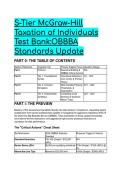
S-Tier McGraw-Hill
Taxation of Individuals
Test Bank:OBBBA
Standards Update
PART 0: THE TABLE OF CONTENTS
Section Reference Cognitive Tier Primary Subject Focus Question Range
Part I Protocol Executive Briefing & N/A
OBBBA Critical Axioms
Part II Tier 1: Foundational Hard-Deck Definitions, Q1 – Q10
Syntax Core Limits, & Primary
Theory
Part II Tier 2: Complex Multi-Variable Phasing, Q11 – Q20
Simulation Thresholds, &
Degradation
Part II Tier 3: Grandmaster Competing Code Q21 – Q30
Synthesis Sections & Systemic
Macro-Traps
PART I: THE PREVIEW
Mastery of this assessment translates directly into elite advisory competence, separating legacy
practitioners from top-tier professionals capable of navigating the aggressive legislative shifts of
the 2025 One Big Beautiful Bill Act (OBBBA). Total assimilation of these updated thresholds,
novel above-the-line deductions, and aggressive high-income phaseout mechanics is
mandatory for elite performance.
The "Critical Axioms" Cheat Sheet
Tax Mechanism 2026 OBBBA Statutory Phaseout Trigger & Velocity
Standard
Standard Deduction $16,100 (Single) / $32,200 N/A
(MFJ)
Senior Bonus (65+) $6,000 per qualifying individual $75k (Single) / $150k (MFJ) @
6%
Above-the-Line Tips Maximum $25,000 limit $150k (Single) / $300k (MFJ)
,Tax Mechanism 2026 OBBBA Statutory Phaseout Trigger & Velocity
Standard
@ 10%
Overtime Premium Max $12,500 (Single) / $25,000 $150k (Single) / $300k (MFJ)
(MFJ) @ 10%
Auto Loan Interest Maximum $10,000 limit $100k (Single) / $200k (MFJ)
(US-assembled) @ 20%
SALT Cap Limit $40,400 statutory baseline $505,000 (MFJ) @ 5%
Charitable Deductions $2,000 max (Non-Itemizer MFJ) Itemizers face a 0.5% of AGI
floor
Itemization Haircut Tax utility capped at 35% Triggered at the 37% tax
equivalence bracket
PART II: THE ELITE TEST BANK
Q1: A married couple files jointly for the 2026 tax year. Both individuals are 45 years old, claim
no dependents, and possess standard W-2 income. They incurred $25,000 in state income
taxes but generated no other itemized deductions. Based on the principles of the 2026 OBBBA
standard deduction framework, which action is the MOST ACCURATE? A) The taxpayers
should itemize deductions using the $25,000 state income tax, as it falls cleanly under the new
$40,400 SALT cap. B) The taxpayers should claim the 2026 standard deduction of $31,500. C)
The taxpayers should claim the 2026 standard deduction of $32,200. D) The taxpayers should
claim the 2026 standard deduction of $24,800.
● The Answer: C (The taxpayers should claim the 2026 standard deduction of $32,200.)
● Distractor Analysis:
○ A is incorrect: While the $25,000 sits comfortably under the new $40,400 SALT cap,
itemizing yields a $25,000 deduction, which is mathematically inferior to the new
standard deduction baseline.
○ B is incorrect: The $31,500 figure represents the legacy standard deduction for the
2025 tax year under OBBBA, not the inflation-adjusted 2026 figure.
○ D is incorrect: The $24,800 metric represents the upper threshold of the 10% tax
bracket for Married Filing Jointly, lacking relevance to deduction schedules.
The Mentor's Analysis: A tax practitioner must continually test allowable itemized deductions
against the prevailing standard deduction baseline. In 2026, the OBBBA pushes the Married
Filing Jointly standard deduction to $32,200, rendering lower-tier itemization highly inefficient for
the majority of the population. Professional/Academic Intuition: Always default to the highest
mathematical shelter; standard deductions dictate the absolute floor of shielded income
regardless of underlying itemized tracking.
Q2: A 66-year-old single taxpayer is calculating their 2026 federal income tax. Their Modified
Adjusted Gross Income (MAGI) equals $60,000. Based on the principles of the OBBBA Senior
Bonus Deduction, which conclusion is the MOST ACCURATE? A) The taxpayer receives a
$6,000 Senior Bonus Deduction in addition to their standard or itemized deductions. B) The
taxpayer receives a $2,050 standard deduction increase for being over 65, which legally
replaces the Senior Bonus Deduction. C) The taxpayer receives a $12,000 Senior Bonus
Deduction because they are over 65 and filing as a single entity. D) The taxpayer is ineligible for
the Senior Bonus Deduction because their MAGI exceeds the $50,000 phaseout threshold.
● The Answer: A (The taxpayer receives a $6,000 Senior Bonus Deduction in addition to
their standard or itemized deductions.)
, ● Distractor Analysis:
○ B is incorrect: The traditional $2,050 additional standard deduction for
age/blindness stacks directly with the new OBBBA Senior Bonus Deduction; it does
not serve as a replacement.
○ C is incorrect: The $12,000 threshold represents the maximum Senior Bonus
Deduction for Married Filing Jointly when both spouses are over 65, not for single
filers.
○ D is incorrect: The phaseout threshold for single filers begins at $75,000 of MAGI,
meaning a $60,000 MAGI avoids degradation entirely.
The Mentor's Analysis: The OBBBA established a powerful, standalone $6,000 Senior Bonus
Deduction explicitly engineered to offset the taxation of retirement and Social Security benefits.
It operates as a distinct structural benefit independent of standard or itemized elections.
Professional/Academic Intuition: The Senior Bonus Deduction stacks dynamically above the
line; it is an additive shelter designed to insulate fixed-income populations, not a mutually
exclusive choice.
Q3: A single server operating in the hospitality sector earns $50,000 in standard W-2 wages and
an additional $35,000 in properly reported W-2 tip income during 2026. Their MAGI is $85,000.
Based on the principles of the OBBBA No Tax on Tips provision, which action is the MOST
ACCURATE? A) The taxpayer deducts the entire $35,000 in tip income, reducing their taxable
income by that exact volumetric amount. B) The taxpayer deducts $25,000 in tip income,
thereby capping the allowable above-the-line deduction. C) The taxpayer deducts $0 because
the tip deduction mandates a rigorous itemization schedule. D) The taxpayer deducts $35,000
exclusively against payroll (FICA) taxes, leaving federal income tax exposure unaffected.
● The Answer: B (The taxpayer deducts $25,000 in tip income, thereby capping the
allowable above-the-line deduction.)
● Distractor Analysis:
○ A is incorrect: The OBBBA imposes a strict statutory cap of $25,000 on the tip
deduction per individual, regardless of the total tipped volume acquired.
○ C is incorrect: The tip deduction operates dynamically above the line and remains
fully available whether the taxpayer claims the standard deduction or itemizes.
○ D is incorrect: This demonstrates a fundamental misinterpretation of the tax code;
the deduction exclusively shields federal income tax, while federal payroll taxes
(FICA) remain fully applicable to the tipped wages.
The Mentor's Analysis: The No Tax on Tips framework provides a maximum $25,000 federal
income tax deduction, leaving systemic FICA exposure entirely untouched. This precise
architectural limit prevents systemic abuse by capping the shelter regardless of total tipped
yield. Professional/Academic Intuition: Statutory caps definitively establish the ceiling of
legislative relief; any excess income bleeds immediately back into standard taxable parameters.
Q4: A manufacturing employee with a Married Filing Jointly status earns a base salary of
$80,000 and receives $30,000 in total gross overtime pay under the Fair Labor Standards Act
(FLSA) in 2026. The overtime was compensated at standard "time-and-a-half." Based on the
principles of the OBBBA Overtime Deduction, what is the MOST ACCURATE allowable
deduction prior to any MAGI phaseout calculations? A) $30,000 B) $25,000 C) $10,000 D)
$15,000
● The Answer: C ($10,000)
● Distractor Analysis:
○ A is incorrect: The deduction applies strictly to the premium portion of the
overtime—the "half" in time-and-a-half—not the total gross overtime yield.
Taxation of Individuals
Test Bank:OBBBA
Standards Update
PART 0: THE TABLE OF CONTENTS
Section Reference Cognitive Tier Primary Subject Focus Question Range
Part I Protocol Executive Briefing & N/A
OBBBA Critical Axioms
Part II Tier 1: Foundational Hard-Deck Definitions, Q1 – Q10
Syntax Core Limits, & Primary
Theory
Part II Tier 2: Complex Multi-Variable Phasing, Q11 – Q20
Simulation Thresholds, &
Degradation
Part II Tier 3: Grandmaster Competing Code Q21 – Q30
Synthesis Sections & Systemic
Macro-Traps
PART I: THE PREVIEW
Mastery of this assessment translates directly into elite advisory competence, separating legacy
practitioners from top-tier professionals capable of navigating the aggressive legislative shifts of
the 2025 One Big Beautiful Bill Act (OBBBA). Total assimilation of these updated thresholds,
novel above-the-line deductions, and aggressive high-income phaseout mechanics is
mandatory for elite performance.
The "Critical Axioms" Cheat Sheet
Tax Mechanism 2026 OBBBA Statutory Phaseout Trigger & Velocity
Standard
Standard Deduction $16,100 (Single) / $32,200 N/A
(MFJ)
Senior Bonus (65+) $6,000 per qualifying individual $75k (Single) / $150k (MFJ) @
6%
Above-the-Line Tips Maximum $25,000 limit $150k (Single) / $300k (MFJ)
,Tax Mechanism 2026 OBBBA Statutory Phaseout Trigger & Velocity
Standard
@ 10%
Overtime Premium Max $12,500 (Single) / $25,000 $150k (Single) / $300k (MFJ)
(MFJ) @ 10%
Auto Loan Interest Maximum $10,000 limit $100k (Single) / $200k (MFJ)
(US-assembled) @ 20%
SALT Cap Limit $40,400 statutory baseline $505,000 (MFJ) @ 5%
Charitable Deductions $2,000 max (Non-Itemizer MFJ) Itemizers face a 0.5% of AGI
floor
Itemization Haircut Tax utility capped at 35% Triggered at the 37% tax
equivalence bracket
PART II: THE ELITE TEST BANK
Q1: A married couple files jointly for the 2026 tax year. Both individuals are 45 years old, claim
no dependents, and possess standard W-2 income. They incurred $25,000 in state income
taxes but generated no other itemized deductions. Based on the principles of the 2026 OBBBA
standard deduction framework, which action is the MOST ACCURATE? A) The taxpayers
should itemize deductions using the $25,000 state income tax, as it falls cleanly under the new
$40,400 SALT cap. B) The taxpayers should claim the 2026 standard deduction of $31,500. C)
The taxpayers should claim the 2026 standard deduction of $32,200. D) The taxpayers should
claim the 2026 standard deduction of $24,800.
● The Answer: C (The taxpayers should claim the 2026 standard deduction of $32,200.)
● Distractor Analysis:
○ A is incorrect: While the $25,000 sits comfortably under the new $40,400 SALT cap,
itemizing yields a $25,000 deduction, which is mathematically inferior to the new
standard deduction baseline.
○ B is incorrect: The $31,500 figure represents the legacy standard deduction for the
2025 tax year under OBBBA, not the inflation-adjusted 2026 figure.
○ D is incorrect: The $24,800 metric represents the upper threshold of the 10% tax
bracket for Married Filing Jointly, lacking relevance to deduction schedules.
The Mentor's Analysis: A tax practitioner must continually test allowable itemized deductions
against the prevailing standard deduction baseline. In 2026, the OBBBA pushes the Married
Filing Jointly standard deduction to $32,200, rendering lower-tier itemization highly inefficient for
the majority of the population. Professional/Academic Intuition: Always default to the highest
mathematical shelter; standard deductions dictate the absolute floor of shielded income
regardless of underlying itemized tracking.
Q2: A 66-year-old single taxpayer is calculating their 2026 federal income tax. Their Modified
Adjusted Gross Income (MAGI) equals $60,000. Based on the principles of the OBBBA Senior
Bonus Deduction, which conclusion is the MOST ACCURATE? A) The taxpayer receives a
$6,000 Senior Bonus Deduction in addition to their standard or itemized deductions. B) The
taxpayer receives a $2,050 standard deduction increase for being over 65, which legally
replaces the Senior Bonus Deduction. C) The taxpayer receives a $12,000 Senior Bonus
Deduction because they are over 65 and filing as a single entity. D) The taxpayer is ineligible for
the Senior Bonus Deduction because their MAGI exceeds the $50,000 phaseout threshold.
● The Answer: A (The taxpayer receives a $6,000 Senior Bonus Deduction in addition to
their standard or itemized deductions.)
, ● Distractor Analysis:
○ B is incorrect: The traditional $2,050 additional standard deduction for
age/blindness stacks directly with the new OBBBA Senior Bonus Deduction; it does
not serve as a replacement.
○ C is incorrect: The $12,000 threshold represents the maximum Senior Bonus
Deduction for Married Filing Jointly when both spouses are over 65, not for single
filers.
○ D is incorrect: The phaseout threshold for single filers begins at $75,000 of MAGI,
meaning a $60,000 MAGI avoids degradation entirely.
The Mentor's Analysis: The OBBBA established a powerful, standalone $6,000 Senior Bonus
Deduction explicitly engineered to offset the taxation of retirement and Social Security benefits.
It operates as a distinct structural benefit independent of standard or itemized elections.
Professional/Academic Intuition: The Senior Bonus Deduction stacks dynamically above the
line; it is an additive shelter designed to insulate fixed-income populations, not a mutually
exclusive choice.
Q3: A single server operating in the hospitality sector earns $50,000 in standard W-2 wages and
an additional $35,000 in properly reported W-2 tip income during 2026. Their MAGI is $85,000.
Based on the principles of the OBBBA No Tax on Tips provision, which action is the MOST
ACCURATE? A) The taxpayer deducts the entire $35,000 in tip income, reducing their taxable
income by that exact volumetric amount. B) The taxpayer deducts $25,000 in tip income,
thereby capping the allowable above-the-line deduction. C) The taxpayer deducts $0 because
the tip deduction mandates a rigorous itemization schedule. D) The taxpayer deducts $35,000
exclusively against payroll (FICA) taxes, leaving federal income tax exposure unaffected.
● The Answer: B (The taxpayer deducts $25,000 in tip income, thereby capping the
allowable above-the-line deduction.)
● Distractor Analysis:
○ A is incorrect: The OBBBA imposes a strict statutory cap of $25,000 on the tip
deduction per individual, regardless of the total tipped volume acquired.
○ C is incorrect: The tip deduction operates dynamically above the line and remains
fully available whether the taxpayer claims the standard deduction or itemizes.
○ D is incorrect: This demonstrates a fundamental misinterpretation of the tax code;
the deduction exclusively shields federal income tax, while federal payroll taxes
(FICA) remain fully applicable to the tipped wages.
The Mentor's Analysis: The No Tax on Tips framework provides a maximum $25,000 federal
income tax deduction, leaving systemic FICA exposure entirely untouched. This precise
architectural limit prevents systemic abuse by capping the shelter regardless of total tipped
yield. Professional/Academic Intuition: Statutory caps definitively establish the ceiling of
legislative relief; any excess income bleeds immediately back into standard taxable parameters.
Q4: A manufacturing employee with a Married Filing Jointly status earns a base salary of
$80,000 and receives $30,000 in total gross overtime pay under the Fair Labor Standards Act
(FLSA) in 2026. The overtime was compensated at standard "time-and-a-half." Based on the
principles of the OBBBA Overtime Deduction, what is the MOST ACCURATE allowable
deduction prior to any MAGI phaseout calculations? A) $30,000 B) $25,000 C) $10,000 D)
$15,000
● The Answer: C ($10,000)
● Distractor Analysis:
○ A is incorrect: The deduction applies strictly to the premium portion of the
overtime—the "half" in time-and-a-half—not the total gross overtime yield.


