

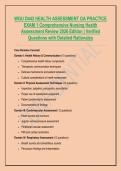
WGU D443 HEALTH ASSESSMENT OA PRACTICE
EXAM 1 Comprehensive Nursing Health
Assessment Review 2026 Edition | Verified
Questions with Detailed Rationales
Core Domains Covered:
Domain I: Health History & Communication (15 questions)
• Comprehensive health history components
• Therapeutic communication techniques
• Defense mechanisms and patient behaviors
• Cultural considerations in health assessment
Domain II: Physical Assessment Techniques (15 questions)
• Inspection, palpation, percussion, auscultation
• Proper use of assessment equipment
• Patient positioning for assessment
• Documentation of findings
Domain III: Cardiovascular Assessment (12 questions)
• Heart sounds and murmurs
• Jugular venous pressure assessment
• Peripheral vascular assessment
• PMI and cardiac landmarks
Domain IV: Respiratory Assessment (12 questions)
• Breath sounds and adventitious sounds
• Percussion findings and interpretation
, • Lung assessment techniques
• Respiratory patterns and abnormalities
Domain V: Neurological & Mental Status Assessment (12 questions)
• Cranial nerve assessment
• Mental status examination
• Reflex testing and motor function
• Sensory and cerebellar assessment
Domain VI: Pain & Skin Assessment (10 questions)
• Pain assessment tools and scales
• Skin turgor and integrity assessment
• Pressure injury staging and risk
• Capillary refill and perfusion
Domain VII: Musculoskeletal & Mobility Assessment (8 questions)
• Range of motion assessment
• Muscle strength grading
• Gait and posture evaluation
• Joint inspection and palpation
Domain VIII: Gastrointestinal & Genitourinary Assessment (6 questions)
• Abdominal assessment techniques
• Bowel sounds and patterns
• Genitourinary assessment
• Rectal and prostate examination
Domain IX: Head, Neck, Eyes, Ears, Nose, Throat (HEENT) (5 questions)
• Eye examination and vision testing
• Ear assessment and hearing
, • Neck assessment and lymph nodes
• Mouth and throat inspection
Domain I: Health History & Communication
1. During a health history interview, the nurse notices the patient frequently changes
the subject when asked about their alcohol use. This is an example of which defense
mechanism?
Answer: C. Avoidance
Rationale: Avoidance is a defense mechanism where the patient diverts attention
from topics that are uncomfortable or distressing. The nurse should acknowledge the
behavior and gently redirect while respecting patient comfort.
A. Denial
B. Rationalization
C. Avoidance
D. Projection
2. What is the best position to assess jugular venous pressure (JVP)?
Answer: B. Supine at 30 to 45 degrees
Rationale: The supine position at 30 to 45 degrees allows for optimal
visualization of jugular vein distention, which is important for evaluating right-sided
heart function. The JVP is measured vertically from the sternal angle.
A. Sitting upright at 90 degrees
B. Supine at 30 to 45 degrees
C. Left lateral decubitus position
D. Trendelenburg position
3. A patient complains of sudden shortness of breath. Which assessment is the
priority?
Answer: C. Auscultation of breath sounds
Rationale: Auscultating breath sounds is the priority to determine if there are
, abnormalities or diminished sounds, indicating possible pulmonary pathologies such
as pneumothorax, pulmonary embolism, or bronchospasm.
A. Check blood pressure
B. Obtain oxygen saturation
C. Auscultation of breath sounds
D. Assess capillary refill
4. When taking a health history, which of the following is an example of an open-
ended question?
Answer: C. "Can you tell me about your pain?"
Rationale: Open-ended questions encourage the patient to provide detailed
information and allow them to express concerns in their own words. They begin with
"how," "what," or "tell me about."
A. "Do you have pain?"
B. "Is your pain severe?"
C. "Can you tell me about your pain?"
D. "Is your pain worse at night?"
5. The CAGE questionnaire is best used to assess which condition?
Answer: B. Alcohol dependence
Rationale: The CAGE questionnaire is a brief, validated screening tool used to
identify possible alcohol dependence. The acronym stands for: Cut down, Annoyed,
Guilty, and Eye-opener.
A. Depression
B. Alcohol dependence
C. Anxiety disorder
D. Opioid misuse
6. Which component of a health history includes information about the patient's
immunization status?
EXAM 1 Comprehensive Nursing Health
Assessment Review 2026 Edition | Verified
Questions with Detailed Rationales
Core Domains Covered:
Domain I: Health History & Communication (15 questions)
• Comprehensive health history components
• Therapeutic communication techniques
• Defense mechanisms and patient behaviors
• Cultural considerations in health assessment
Domain II: Physical Assessment Techniques (15 questions)
• Inspection, palpation, percussion, auscultation
• Proper use of assessment equipment
• Patient positioning for assessment
• Documentation of findings
Domain III: Cardiovascular Assessment (12 questions)
• Heart sounds and murmurs
• Jugular venous pressure assessment
• Peripheral vascular assessment
• PMI and cardiac landmarks
Domain IV: Respiratory Assessment (12 questions)
• Breath sounds and adventitious sounds
• Percussion findings and interpretation
, • Lung assessment techniques
• Respiratory patterns and abnormalities
Domain V: Neurological & Mental Status Assessment (12 questions)
• Cranial nerve assessment
• Mental status examination
• Reflex testing and motor function
• Sensory and cerebellar assessment
Domain VI: Pain & Skin Assessment (10 questions)
• Pain assessment tools and scales
• Skin turgor and integrity assessment
• Pressure injury staging and risk
• Capillary refill and perfusion
Domain VII: Musculoskeletal & Mobility Assessment (8 questions)
• Range of motion assessment
• Muscle strength grading
• Gait and posture evaluation
• Joint inspection and palpation
Domain VIII: Gastrointestinal & Genitourinary Assessment (6 questions)
• Abdominal assessment techniques
• Bowel sounds and patterns
• Genitourinary assessment
• Rectal and prostate examination
Domain IX: Head, Neck, Eyes, Ears, Nose, Throat (HEENT) (5 questions)
• Eye examination and vision testing
• Ear assessment and hearing
, • Neck assessment and lymph nodes
• Mouth and throat inspection
Domain I: Health History & Communication
1. During a health history interview, the nurse notices the patient frequently changes
the subject when asked about their alcohol use. This is an example of which defense
mechanism?
Answer: C. Avoidance
Rationale: Avoidance is a defense mechanism where the patient diverts attention
from topics that are uncomfortable or distressing. The nurse should acknowledge the
behavior and gently redirect while respecting patient comfort.
A. Denial
B. Rationalization
C. Avoidance
D. Projection
2. What is the best position to assess jugular venous pressure (JVP)?
Answer: B. Supine at 30 to 45 degrees
Rationale: The supine position at 30 to 45 degrees allows for optimal
visualization of jugular vein distention, which is important for evaluating right-sided
heart function. The JVP is measured vertically from the sternal angle.
A. Sitting upright at 90 degrees
B. Supine at 30 to 45 degrees
C. Left lateral decubitus position
D. Trendelenburg position
3. A patient complains of sudden shortness of breath. Which assessment is the
priority?
Answer: C. Auscultation of breath sounds
Rationale: Auscultating breath sounds is the priority to determine if there are
, abnormalities or diminished sounds, indicating possible pulmonary pathologies such
as pneumothorax, pulmonary embolism, or bronchospasm.
A. Check blood pressure
B. Obtain oxygen saturation
C. Auscultation of breath sounds
D. Assess capillary refill
4. When taking a health history, which of the following is an example of an open-
ended question?
Answer: C. "Can you tell me about your pain?"
Rationale: Open-ended questions encourage the patient to provide detailed
information and allow them to express concerns in their own words. They begin with
"how," "what," or "tell me about."
A. "Do you have pain?"
B. "Is your pain severe?"
C. "Can you tell me about your pain?"
D. "Is your pain worse at night?"
5. The CAGE questionnaire is best used to assess which condition?
Answer: B. Alcohol dependence
Rationale: The CAGE questionnaire is a brief, validated screening tool used to
identify possible alcohol dependence. The acronym stands for: Cut down, Annoyed,
Guilty, and Eye-opener.
A. Depression
B. Alcohol dependence
C. Anxiety disorder
D. Opioid misuse
6. Which component of a health history includes information about the patient's
immunization status?


