

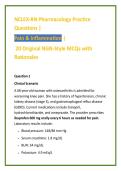
NCLEX-RN Pharmacology Practice
Questions |
Pain & Inflammation |
20 Original NGN-Style MCQs with
Rationales
Question 1
Clinical Scenario
A 68-year-old woman with osteoarthritis is admitted for
worsening knee pain. She has a history of hypertension, chronic
kidney disease (stage 3), and gastroesophageal reflux disease
(GERD). Current medications include lisinopril,
hydrochlorothiazide, and omeprazole. The provider prescribes
ibuprofen 600 mg orally every 6 hours as needed for pain.
Laboratory results include:
• Blood pressure: 148/86 mm Hg
• Serum creatinine: 1.8 mg/dL
• BUN: 34 mg/dL
• Potassium: 4.9 mEq/L
,Question Stem
Which nursing action is the priority before administering the
first dose of ibuprofen?
Options
A. Administer the medication with food.
B. Notify the provider about the client's renal function.
C. Encourage increased oral fluid intake.
D. Assess the client's pain level using a standardized pain scale.
Correct Answer
Correct Answer: B. Notify the provider about the client's renal
function.
Detailed Rationale
Ibuprofen is a nonsteroidal anti-inflammatory drug (NSAID) that
inhibits cyclooxygenase (COX) enzymes, reducing prostaglandin
synthesis. Although effective for pain and inflammation,
prostaglandins also help maintain renal blood flow. In patients
with chronic kidney disease, NSAIDs can significantly decrease
renal perfusion, worsening kidney function and potentially
leading to acute kidney injury. This client already has elevated
creatinine and BUN, indicating impaired renal function. The
nurse should question the prescription and notify the provider
before administration.
,Option A is appropriate patient teaching because taking NSAIDs
with food decreases gastrointestinal irritation, but it does not
address the immediate safety concern.
Option C may help maintain hydration but cannot prevent
NSAID-induced renal injury and should not replace provider
notification.
Option D is part of routine pain assessment before analgesic
administration but is not the priority when a contraindication or
significant safety concern exists.
Nurses should also monitor urine output, renal laboratory
values, blood pressure, and signs of fluid retention during
NSAID therapy. Older adults and patients receiving ACE
inhibitors or diuretics have an increased risk of NSAID-related
nephrotoxicity.
Learning Objectives
After completing this question, the learner should be able to:
• Recognize renal impairment as a major precaution for
NSAID therapy.
• Prioritize patient safety before medication administration.
• Identify nursing assessments required before
administering NSAIDs.
Medication Safety Focus
, Contraindication and renal function monitoring
Question 2
Clinical Scenario
A 24-year-old woman visits the outpatient clinic after spraining
her ankle while playing soccer. The provider prescribes
naproxen 500 mg twice daily for 10 days. During discharge
teaching, the nurse reviews medication instructions.
Question Stem
Which statement by the client indicates a need for further
teaching?
Options
A. "I will avoid taking other over-the-counter pain medicines
unless I ask my provider."
B. "I'll take the medication with meals if it upsets my stomach."
C. "If my pain improves after two days, I'll double my next dose
so the swelling goes away faster."
D. "I'll report black or tarry stools to my healthcare provider."
Correct Answer
Correct Answer: C. "If my pain improves after two days, I'll
double my next dose so the swelling goes away faster."
Questions |
Pain & Inflammation |
20 Original NGN-Style MCQs with
Rationales
Question 1
Clinical Scenario
A 68-year-old woman with osteoarthritis is admitted for
worsening knee pain. She has a history of hypertension, chronic
kidney disease (stage 3), and gastroesophageal reflux disease
(GERD). Current medications include lisinopril,
hydrochlorothiazide, and omeprazole. The provider prescribes
ibuprofen 600 mg orally every 6 hours as needed for pain.
Laboratory results include:
• Blood pressure: 148/86 mm Hg
• Serum creatinine: 1.8 mg/dL
• BUN: 34 mg/dL
• Potassium: 4.9 mEq/L
,Question Stem
Which nursing action is the priority before administering the
first dose of ibuprofen?
Options
A. Administer the medication with food.
B. Notify the provider about the client's renal function.
C. Encourage increased oral fluid intake.
D. Assess the client's pain level using a standardized pain scale.
Correct Answer
Correct Answer: B. Notify the provider about the client's renal
function.
Detailed Rationale
Ibuprofen is a nonsteroidal anti-inflammatory drug (NSAID) that
inhibits cyclooxygenase (COX) enzymes, reducing prostaglandin
synthesis. Although effective for pain and inflammation,
prostaglandins also help maintain renal blood flow. In patients
with chronic kidney disease, NSAIDs can significantly decrease
renal perfusion, worsening kidney function and potentially
leading to acute kidney injury. This client already has elevated
creatinine and BUN, indicating impaired renal function. The
nurse should question the prescription and notify the provider
before administration.
,Option A is appropriate patient teaching because taking NSAIDs
with food decreases gastrointestinal irritation, but it does not
address the immediate safety concern.
Option C may help maintain hydration but cannot prevent
NSAID-induced renal injury and should not replace provider
notification.
Option D is part of routine pain assessment before analgesic
administration but is not the priority when a contraindication or
significant safety concern exists.
Nurses should also monitor urine output, renal laboratory
values, blood pressure, and signs of fluid retention during
NSAID therapy. Older adults and patients receiving ACE
inhibitors or diuretics have an increased risk of NSAID-related
nephrotoxicity.
Learning Objectives
After completing this question, the learner should be able to:
• Recognize renal impairment as a major precaution for
NSAID therapy.
• Prioritize patient safety before medication administration.
• Identify nursing assessments required before
administering NSAIDs.
Medication Safety Focus
, Contraindication and renal function monitoring
Question 2
Clinical Scenario
A 24-year-old woman visits the outpatient clinic after spraining
her ankle while playing soccer. The provider prescribes
naproxen 500 mg twice daily for 10 days. During discharge
teaching, the nurse reviews medication instructions.
Question Stem
Which statement by the client indicates a need for further
teaching?
Options
A. "I will avoid taking other over-the-counter pain medicines
unless I ask my provider."
B. "I'll take the medication with meals if it upsets my stomach."
C. "If my pain improves after two days, I'll double my next dose
so the swelling goes away faster."
D. "I'll report black or tarry stools to my healthcare provider."
Correct Answer
Correct Answer: C. "If my pain improves after two days, I'll
double my next dose so the swelling goes away faster."


