
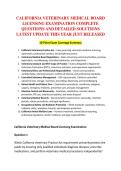
CALIFORNIA VETERINARY MEDICAL BOARD
LICENSING EXAMINATION COMPLETE
QUESTIONS AND DETAILED SOLUTIONS
LATEST UPDATE THIS YEAR JUST RELEASED
10-Point Exam Coverage Summary
1. California Veterinary Practice Act – Laws governing veterinary medicine, licensing,
supervision, professional conduct, and disciplinary actions.
2. Veterinary Medical Board Regulations – Rules concerning veterinary facilities, premises
registration, recordkeeping, controlled substances, and inspections.
3. Veterinary Assistant and RVT Scope of Practice – Duties delegated to Registered
Veterinary Technicians (RVTs), veterinary assistants, and supervision requirements.
4. Veterinary Ethics and Professional Responsibilities – Client communication,
confidentiality, informed consent, conflicts of interest, and professional standards.
5. Controlled Substance Management – DEA requirements, California controlled
substance laws, storage, inventory, prescribing, dispensing, and recordkeeping.
6. Animal Health and Patient Care – Examination procedures, anesthesia, analgesia,
surgery, emergency medicine, preventive care, and pain management.
7. Infection Control and Biosecurity – Sanitation, sterilization, zoonotic disease
prevention, PPE use, isolation procedures, and waste disposal.
8. Veterinary Medical Records – Documentation requirements, ownership, retention
periods, release procedures, and legal significance.
9. Occupational Safety and Radiation Protection – OSHA standards, hazardous materials,
radiation safety, workplace hazards, and employee protection.
10. California Animal Welfare Laws – Humane treatment, animal abuse reporting,
euthanasia regulations, shelter medicine, and legal responsibilities.
California Veterinary Medical Board Licensing Examination
Question 1
Which California Veterinary Practice Act requirement primarily protects the
public by ensuring only qualified individuals diagnose diseases, prescribe
medications, and perform veterinary medical procedures independently?
,A. Allowing experienced assistants to diagnose illnesses independently
B. Restricting veterinary practice to properly licensed veterinarians except
where specifically authorized by law
C. Permitting any employee to prescribe medications under indirect
supervision
D. Allowing animal owners to delegate medical procedures to anyone they
choose
Correct Answer: B
Rationale: California law reserves veterinary diagnosis, treatment, surgery,
and prescribing authority to licensed veterinarians unless specific statutory
exceptions apply.
Question 2
A veterinarian delegates a technical procedure to a Registered Veterinary
Technician while remaining immediately available within the veterinary
facility. Which supervision level best describes this situation?
A. No supervision
B. Indirect supervision
C. Immediate supervision
D. Direct supervision
Correct Answer: D
,Rationale: Direct supervision requires the veterinarian to be on the
premises and readily available while the delegated procedure is performed.
Question 3
Why are complete and accurate veterinary medical records considered
essential for patient care, legal compliance, and professional accountability
within California veterinary practice?
A. They primarily reduce paper consumption.
B. They provide continuity of care, document professional decisions, and
satisfy legal recordkeeping requirements.
C. They eliminate the need for client communication.
D. They replace informed consent documentation.
Correct Answer: B
Rationale: Medical records support patient care, facilitate communication,
provide legal documentation, and demonstrate compliance with
professional standards.
Question 4
Before performing a non-emergency surgical procedure on a companion
animal, what should a California veterinarian generally obtain from the
animal's owner?
, A. Only verbal acknowledgment without discussing risks
B. Written informed consent after explaining the procedure, risks, benefits,
and alternatives
C. Permission from another veterinary clinic
D. Approval from the Veterinary Medical Board
Correct Answer: B
Rationale: Informed consent requires discussing the procedure and
obtaining authorization before elective treatment whenever practical.
Question 5
Which practice best demonstrates appropriate controlled substance security
within a California veterinary hospital operating under federal and state
regulations?
A. Storing controlled drugs in unlocked cabinets for convenient staff access
B. Keeping controlled substances in securely locked storage with accurate
inventory documentation
C. Allowing all employees unrestricted medication access
D. Mixing controlled substances with general inventory supplies
Correct Answer: B
LICENSING EXAMINATION COMPLETE
QUESTIONS AND DETAILED SOLUTIONS
LATEST UPDATE THIS YEAR JUST RELEASED
10-Point Exam Coverage Summary
1. California Veterinary Practice Act – Laws governing veterinary medicine, licensing,
supervision, professional conduct, and disciplinary actions.
2. Veterinary Medical Board Regulations – Rules concerning veterinary facilities, premises
registration, recordkeeping, controlled substances, and inspections.
3. Veterinary Assistant and RVT Scope of Practice – Duties delegated to Registered
Veterinary Technicians (RVTs), veterinary assistants, and supervision requirements.
4. Veterinary Ethics and Professional Responsibilities – Client communication,
confidentiality, informed consent, conflicts of interest, and professional standards.
5. Controlled Substance Management – DEA requirements, California controlled
substance laws, storage, inventory, prescribing, dispensing, and recordkeeping.
6. Animal Health and Patient Care – Examination procedures, anesthesia, analgesia,
surgery, emergency medicine, preventive care, and pain management.
7. Infection Control and Biosecurity – Sanitation, sterilization, zoonotic disease
prevention, PPE use, isolation procedures, and waste disposal.
8. Veterinary Medical Records – Documentation requirements, ownership, retention
periods, release procedures, and legal significance.
9. Occupational Safety and Radiation Protection – OSHA standards, hazardous materials,
radiation safety, workplace hazards, and employee protection.
10. California Animal Welfare Laws – Humane treatment, animal abuse reporting,
euthanasia regulations, shelter medicine, and legal responsibilities.
California Veterinary Medical Board Licensing Examination
Question 1
Which California Veterinary Practice Act requirement primarily protects the
public by ensuring only qualified individuals diagnose diseases, prescribe
medications, and perform veterinary medical procedures independently?
,A. Allowing experienced assistants to diagnose illnesses independently
B. Restricting veterinary practice to properly licensed veterinarians except
where specifically authorized by law
C. Permitting any employee to prescribe medications under indirect
supervision
D. Allowing animal owners to delegate medical procedures to anyone they
choose
Correct Answer: B
Rationale: California law reserves veterinary diagnosis, treatment, surgery,
and prescribing authority to licensed veterinarians unless specific statutory
exceptions apply.
Question 2
A veterinarian delegates a technical procedure to a Registered Veterinary
Technician while remaining immediately available within the veterinary
facility. Which supervision level best describes this situation?
A. No supervision
B. Indirect supervision
C. Immediate supervision
D. Direct supervision
Correct Answer: D
,Rationale: Direct supervision requires the veterinarian to be on the
premises and readily available while the delegated procedure is performed.
Question 3
Why are complete and accurate veterinary medical records considered
essential for patient care, legal compliance, and professional accountability
within California veterinary practice?
A. They primarily reduce paper consumption.
B. They provide continuity of care, document professional decisions, and
satisfy legal recordkeeping requirements.
C. They eliminate the need for client communication.
D. They replace informed consent documentation.
Correct Answer: B
Rationale: Medical records support patient care, facilitate communication,
provide legal documentation, and demonstrate compliance with
professional standards.
Question 4
Before performing a non-emergency surgical procedure on a companion
animal, what should a California veterinarian generally obtain from the
animal's owner?
, A. Only verbal acknowledgment without discussing risks
B. Written informed consent after explaining the procedure, risks, benefits,
and alternatives
C. Permission from another veterinary clinic
D. Approval from the Veterinary Medical Board
Correct Answer: B
Rationale: Informed consent requires discussing the procedure and
obtaining authorization before elective treatment whenever practical.
Question 5
Which practice best demonstrates appropriate controlled substance security
within a California veterinary hospital operating under federal and state
regulations?
A. Storing controlled drugs in unlocked cabinets for convenient staff access
B. Keeping controlled substances in securely locked storage with accurate
inventory documentation
C. Allowing all employees unrestricted medication access
D. Mixing controlled substances with general inventory supplies
Correct Answer: B


