

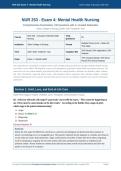
NUR 253 Exam 4 - Mental Health Nursing Galen College of Nursing | 2026-2027
NUR 253 - Exam 4: Mental Health Nursing
Comprehensive Examination | 50 Questions with A+ Graded Rationales
Galen College of Nursing | Academic Year
NUR 253 - Concepts of Mental Health Total
Course 50
Nursing Questions
Multiple Choice (A-D) + Select All
Institution Galen College of Nursing Format
That Apply
25% Recall | 55% Application | 20%
Term Academic Year Cognitive Mix
Analysis
75% Scenario-Based | 20% Direct
Exam Exam 4 - Mental Health Style
Recall | 5% Clinical Analysis
This comprehensive examination is aligned with the Galen College of Nursing NUR 253 Concepts of Mental Health Nursing
curriculum, current DSM-5-TR diagnostic criteria, and contemporary psychiatric-mental health nursing best practices. The
exam covers six core content domains: grief and end-of-life care; eating disorders; substance use disorders; abuse, violence,
and crisis intervention; legal and ethical issues; and integrated clinical reasoning. Each question includes a detailed
rationale explaining the correct answer and why distractors are incorrect, providing a complete review tool for examination
preparation.
Section 1: Grief, Loss, and End-of-Life Care
Kübler-Ross Stages | Hospice | Palliative Care | Therapeutic Communication in Dying
Q1. A 68-year-old male with stage IV pancreatic cancer tells the nurse, "This cannot be happening to
me. There must be some mistake in the lab results." According to the Kübler-Ross stages of grief,
which stage is the patient demonstrating?
A. Anger
B. Denial [CORRECT]
C. Bargaining
D. Depression
Correct Answer: B
Rationale
Denial, the first stage of Kübler-Ross, functions as a protective psychological mechanism that allows patients to
absorb overwhelming news at a manageable pace. The patient's statement that the diagnosis is a mistake and refusal to
accept reality are classic denial statements. Anger would present as hostility or blame directed at others, bargaining
involves attempting to negotiate for more time (often with God), and depression manifests as withdrawal and
profound sadness. Nurses should not confront denial directly but rather provide factual information and allow the
patient to set the pace of acceptance.
Concepts of Mental Health 50
Nursing
Questions
| Comprehensive
| Cognitive Levels:
Exam Recall 25%, Application 55%, Analysis 20% Page 1
,NUR 253 Exam 4 - Mental Health Nursing Galen College of Nursing | 2026-2027
Q2. A terminally ill patient with metastatic lung cancer says to the nurse, "If I promise to be a better
person and go to church every Sunday, maybe God will let me live long enough to see my
granddaughter graduate." Which Kübler-Ross stage is being exhibited?
A. Denial
B. Anger
C. Bargaining [CORRECT]
D. Acceptance
Correct Answer: C
Rationale
Bargaining is characterized by attempts to negotiate for additional time, often with God or a higher power, in
exchange for changed behavior or promises. The patient's attempt to exchange church attendance for survival to see a
milestone event is a textbook bargaining statement. Denial would involve rejecting the diagnosis entirely, anger would
manifest as hostility toward staff or family, and acceptance would demonstrate peaceful acknowledgment of the
prognosis. Bargaining often represents an attempt to postpone the inevitable rather than reverse it, and nurses should
listen therapeutically without making false promises.
Q3. A hospice patient with end-stage heart failure has become increasingly withdrawn, refuses
visitors, and cries frequently when alone. She tells the nurse, "I just do not see the point anymore."
The nurse correctly identifies which Kübler-Ross stage, and what is the priority nursing intervention?
A. Denial; encourage the patient to discuss her diagnosis openly
B. Anger; allow the patient to express frustration without judgment
C. Depression; sit with the patient and offer presence without pressure to speak [CORRECT]
D. Acceptance; reinforce that the patient has reached the final stage
Correct Answer: C
Rationale
Withdrawal, frequent crying, hopelessness, and statements such as "I do not see the point anymore" are hallmark
features of the depression stage. The most therapeutic intervention is the art of presence: sitting quietly with the
patient, offering nonverbal support, and allowing them to control the pace of communication. Encouraging discussion
of the diagnosis would be inappropriate for denial, allowing expression of frustration addresses anger, and acceptance
does not involve hopelessness. Patients may fluctuate between stages non-linearly, so the nurse must continually
reassess rather than assume progression.
Concepts of Mental Health 50
Nursing
Questions
| Comprehensive
| Cognitive Levels:
Exam Recall 25%, Application 55%, Analysis 20% Page 2
, NUR 253 Exam 4 - Mental Health Nursing Galen College of Nursing | 2026-2027
Q4. A woman whose estranged ex-husband died in a motor vehicle accident 4 months ago tells the
nurse she feels intense grief but cannot share it with friends because they would not understand why
she is mourning someone who left her. Which type of grief is the patient experiencing?
A. Anticipatory grief
B. Disenfranchised grief [CORRECT]
C. Uncomplicated bereavement
D. Complicated grief
Correct Answer: B
Rationale
Disenfranchised grief occurs when a loss is not openly acknowledged, socially validated, or publicly mourned, leaving
the griever without the usual support systems. The loss of an estranged ex-spouse is a classic example because the
relationship was not socially recognized, yet the grief is real and intense. Anticipatory grief occurs before the loss
happens, uncomplicated bereavement involves socially supported mourning of a recognized loss, and complicated
grief involves prolonged intense symptoms that impair daily functioning. Nurses should validate disenfranchised grief
and create safe spaces for the patient to process the loss without judgment.
Q5. A nursing student is preparing an in-service on grief. Which statement by the student indicates
correct understanding of the distinction between bereavement, grief, and mourning?
A. Bereavement is the outward expression of loss, while mourning is the internal response
B. Grief is the state of having experienced a loss, while bereavement is the outward expression
C. Bereavement is the state of having experienced a loss, while mourning is the outward expression of grief
[CORRECT]
D. Mourning and grief are interchangeable terms describing the internal emotional response
Correct Answer: C
Rationale
Bereavement is the objective state of having experienced a loss, grief is the internal emotional and psychological
response to that loss, and mourning is the outward, socially and culturally influenced expression of grief (such as
wearing black, holding funerals, or observing religious rituals). The three terms represent distinct concepts that are
often confused. Bereavement is the event itself, grief is the inward reaction, and mourning is the external behavior.
Understanding this distinction allows nurses to assess each component separately and tailor interventions to the
patient's cultural mourning practices.
Concepts of Mental Health 50
Nursing
Questions
| Comprehensive
| Cognitive Levels:
Exam Recall 25%, Application 55%, Analysis 20% Page 3
NUR 253 - Exam 4: Mental Health Nursing
Comprehensive Examination | 50 Questions with A+ Graded Rationales
Galen College of Nursing | Academic Year
NUR 253 - Concepts of Mental Health Total
Course 50
Nursing Questions
Multiple Choice (A-D) + Select All
Institution Galen College of Nursing Format
That Apply
25% Recall | 55% Application | 20%
Term Academic Year Cognitive Mix
Analysis
75% Scenario-Based | 20% Direct
Exam Exam 4 - Mental Health Style
Recall | 5% Clinical Analysis
This comprehensive examination is aligned with the Galen College of Nursing NUR 253 Concepts of Mental Health Nursing
curriculum, current DSM-5-TR diagnostic criteria, and contemporary psychiatric-mental health nursing best practices. The
exam covers six core content domains: grief and end-of-life care; eating disorders; substance use disorders; abuse, violence,
and crisis intervention; legal and ethical issues; and integrated clinical reasoning. Each question includes a detailed
rationale explaining the correct answer and why distractors are incorrect, providing a complete review tool for examination
preparation.
Section 1: Grief, Loss, and End-of-Life Care
Kübler-Ross Stages | Hospice | Palliative Care | Therapeutic Communication in Dying
Q1. A 68-year-old male with stage IV pancreatic cancer tells the nurse, "This cannot be happening to
me. There must be some mistake in the lab results." According to the Kübler-Ross stages of grief,
which stage is the patient demonstrating?
A. Anger
B. Denial [CORRECT]
C. Bargaining
D. Depression
Correct Answer: B
Rationale
Denial, the first stage of Kübler-Ross, functions as a protective psychological mechanism that allows patients to
absorb overwhelming news at a manageable pace. The patient's statement that the diagnosis is a mistake and refusal to
accept reality are classic denial statements. Anger would present as hostility or blame directed at others, bargaining
involves attempting to negotiate for more time (often with God), and depression manifests as withdrawal and
profound sadness. Nurses should not confront denial directly but rather provide factual information and allow the
patient to set the pace of acceptance.
Concepts of Mental Health 50
Nursing
Questions
| Comprehensive
| Cognitive Levels:
Exam Recall 25%, Application 55%, Analysis 20% Page 1
,NUR 253 Exam 4 - Mental Health Nursing Galen College of Nursing | 2026-2027
Q2. A terminally ill patient with metastatic lung cancer says to the nurse, "If I promise to be a better
person and go to church every Sunday, maybe God will let me live long enough to see my
granddaughter graduate." Which Kübler-Ross stage is being exhibited?
A. Denial
B. Anger
C. Bargaining [CORRECT]
D. Acceptance
Correct Answer: C
Rationale
Bargaining is characterized by attempts to negotiate for additional time, often with God or a higher power, in
exchange for changed behavior or promises. The patient's attempt to exchange church attendance for survival to see a
milestone event is a textbook bargaining statement. Denial would involve rejecting the diagnosis entirely, anger would
manifest as hostility toward staff or family, and acceptance would demonstrate peaceful acknowledgment of the
prognosis. Bargaining often represents an attempt to postpone the inevitable rather than reverse it, and nurses should
listen therapeutically without making false promises.
Q3. A hospice patient with end-stage heart failure has become increasingly withdrawn, refuses
visitors, and cries frequently when alone. She tells the nurse, "I just do not see the point anymore."
The nurse correctly identifies which Kübler-Ross stage, and what is the priority nursing intervention?
A. Denial; encourage the patient to discuss her diagnosis openly
B. Anger; allow the patient to express frustration without judgment
C. Depression; sit with the patient and offer presence without pressure to speak [CORRECT]
D. Acceptance; reinforce that the patient has reached the final stage
Correct Answer: C
Rationale
Withdrawal, frequent crying, hopelessness, and statements such as "I do not see the point anymore" are hallmark
features of the depression stage. The most therapeutic intervention is the art of presence: sitting quietly with the
patient, offering nonverbal support, and allowing them to control the pace of communication. Encouraging discussion
of the diagnosis would be inappropriate for denial, allowing expression of frustration addresses anger, and acceptance
does not involve hopelessness. Patients may fluctuate between stages non-linearly, so the nurse must continually
reassess rather than assume progression.
Concepts of Mental Health 50
Nursing
Questions
| Comprehensive
| Cognitive Levels:
Exam Recall 25%, Application 55%, Analysis 20% Page 2
, NUR 253 Exam 4 - Mental Health Nursing Galen College of Nursing | 2026-2027
Q4. A woman whose estranged ex-husband died in a motor vehicle accident 4 months ago tells the
nurse she feels intense grief but cannot share it with friends because they would not understand why
she is mourning someone who left her. Which type of grief is the patient experiencing?
A. Anticipatory grief
B. Disenfranchised grief [CORRECT]
C. Uncomplicated bereavement
D. Complicated grief
Correct Answer: B
Rationale
Disenfranchised grief occurs when a loss is not openly acknowledged, socially validated, or publicly mourned, leaving
the griever without the usual support systems. The loss of an estranged ex-spouse is a classic example because the
relationship was not socially recognized, yet the grief is real and intense. Anticipatory grief occurs before the loss
happens, uncomplicated bereavement involves socially supported mourning of a recognized loss, and complicated
grief involves prolonged intense symptoms that impair daily functioning. Nurses should validate disenfranchised grief
and create safe spaces for the patient to process the loss without judgment.
Q5. A nursing student is preparing an in-service on grief. Which statement by the student indicates
correct understanding of the distinction between bereavement, grief, and mourning?
A. Bereavement is the outward expression of loss, while mourning is the internal response
B. Grief is the state of having experienced a loss, while bereavement is the outward expression
C. Bereavement is the state of having experienced a loss, while mourning is the outward expression of grief
[CORRECT]
D. Mourning and grief are interchangeable terms describing the internal emotional response
Correct Answer: C
Rationale
Bereavement is the objective state of having experienced a loss, grief is the internal emotional and psychological
response to that loss, and mourning is the outward, socially and culturally influenced expression of grief (such as
wearing black, holding funerals, or observing religious rituals). The three terms represent distinct concepts that are
often confused. Bereavement is the event itself, grief is the inward reaction, and mourning is the external behavior.
Understanding this distinction allows nurses to assess each component separately and tailor interventions to the
patient's cultural mourning practices.
Concepts of Mental Health 50
Nursing
Questions
| Comprehensive
| Cognitive Levels:
Exam Recall 25%, Application 55%, Analysis 20% Page 3


