

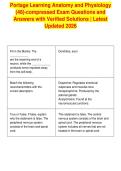
Portage Learning Anatomy and Physiology
(48)-compressed Exam Questions and
Answers with Verified Solutions | Latest
Updated 2026
Fill in the Blanks: The Dendrites; axon
____________
are the receiving end of a
neuron, while the ____________
conducts nerve impulses away
from the cell body.
Match the following Dopamine: Regulates emotional
neurotransmitters with the responses and muscles tone.
correct description. Norepinephrine: Produced by the
adrenal glands.
Acetylcholine: Found at the
neuromuscular junctions.
True or False: If false, explain This statement is false. The central
why the statement is false. The nervous system consists of the brain and
peripheral nervous system spinal cord. The peripheral nervous
consists of the brain and spinal system includes all nerves that are not
cord. located in the brain or spinal cord.
, Match the following lobes of Temporal: Contains sensory areas for
the brain with the correct hearing and smelling.
function. Frontal: Controls higher level executive
functions.
Parietal: Receives sensory information
from body receptors.
Occipital: Interprets visual input.
Which of the following Dorsal root ganglion
structures of the spinal cord
contains the cell bodies of
afferent neurons?
Describe the function of the The sympathetic nervous system (SNS) is
sympathetic nervous system often referred to as the "fight or flight"
when a threat is present. system. When in immediate danger,
muscles require a steady, increased
supply of glucose and oxygen for
muscular contraction. The SNS
accelerates the heartbeat, dilates the
bronchi, and increases the respiratory
rate. This supplies the increased need for
oxygen throughout the body. The SNS
also causes the liver to deliver more
glucose for the body's increased
metabolic needs. Sympathetic activation
inhibits the digestive tract because
digestion is not an immediate necessity
when in danger or under attack.
(48)-compressed Exam Questions and
Answers with Verified Solutions | Latest
Updated 2026
Fill in the Blanks: The Dendrites; axon
____________
are the receiving end of a
neuron, while the ____________
conducts nerve impulses away
from the cell body.
Match the following Dopamine: Regulates emotional
neurotransmitters with the responses and muscles tone.
correct description. Norepinephrine: Produced by the
adrenal glands.
Acetylcholine: Found at the
neuromuscular junctions.
True or False: If false, explain This statement is false. The central
why the statement is false. The nervous system consists of the brain and
peripheral nervous system spinal cord. The peripheral nervous
consists of the brain and spinal system includes all nerves that are not
cord. located in the brain or spinal cord.
, Match the following lobes of Temporal: Contains sensory areas for
the brain with the correct hearing and smelling.
function. Frontal: Controls higher level executive
functions.
Parietal: Receives sensory information
from body receptors.
Occipital: Interprets visual input.
Which of the following Dorsal root ganglion
structures of the spinal cord
contains the cell bodies of
afferent neurons?
Describe the function of the The sympathetic nervous system (SNS) is
sympathetic nervous system often referred to as the "fight or flight"
when a threat is present. system. When in immediate danger,
muscles require a steady, increased
supply of glucose and oxygen for
muscular contraction. The SNS
accelerates the heartbeat, dilates the
bronchi, and increases the respiratory
rate. This supplies the increased need for
oxygen throughout the body. The SNS
also causes the liver to deliver more
glucose for the body's increased
metabolic needs. Sympathetic activation
inhibits the digestive tract because
digestion is not an immediate necessity
when in danger or under attack.


