

Portage Learning Anatomy and Physiology
(40)-compressed Exam Questions and
Answers with Verified Solutions | Latest
Updated 2026
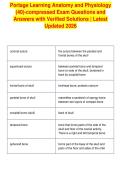
coronal suture the suture between the parietal and
frontal bones of the skull
squamosal suture between parietal bone and temporal
bone on side of the skull, bordered in
back by occipital bone
frontal bone of skull forehead bone; protects cranium
parietal bone of skull resembles a sandwich of spongy bone
between two layers of compact bone
occipital bone (skull) back of skull
temporal bone bone that forms parts of the side of the
skull and floor of the cranial activity.
There is a right and left temporal bone.
sphenoid bone forms part of the base of the skull and
parts of the floor and sides of the orbit
, ethmoid bone forms part of the posterior portion of the
nose, the orbit, and the floor of the
cranium
Zygomatic bone the arch of bone beneath the eye that
forms the prominence of the cheek
Maxilla upper jaw bone
Mandible lower jaw bone
Vomer forms the inferior portion of the nasal
septum
palatine bone either of two irregularly shaped bones
that form the back of the hard palate and
helps to form the nasal cavity and the
floor of the orbits
hyoid bone U-shaped bone at the base of the tongue
that supports the tongue and its muscles.
Cervical Vertebrae (C1-C7) first set of seven bones, forming the neck
Thoracic Vertebrae (T1-T12) second set of 12 vertebrae; they
articulate with the 12 pairs of ribs to form
the outward curve of the spine
(40)-compressed Exam Questions and
Answers with Verified Solutions | Latest
Updated 2026
coronal suture the suture between the parietal and
frontal bones of the skull
squamosal suture between parietal bone and temporal
bone on side of the skull, bordered in
back by occipital bone
frontal bone of skull forehead bone; protects cranium
parietal bone of skull resembles a sandwich of spongy bone
between two layers of compact bone
occipital bone (skull) back of skull
temporal bone bone that forms parts of the side of the
skull and floor of the cranial activity.
There is a right and left temporal bone.
sphenoid bone forms part of the base of the skull and
parts of the floor and sides of the orbit
, ethmoid bone forms part of the posterior portion of the
nose, the orbit, and the floor of the
cranium
Zygomatic bone the arch of bone beneath the eye that
forms the prominence of the cheek
Maxilla upper jaw bone
Mandible lower jaw bone
Vomer forms the inferior portion of the nasal
septum
palatine bone either of two irregularly shaped bones
that form the back of the hard palate and
helps to form the nasal cavity and the
floor of the orbits
hyoid bone U-shaped bone at the base of the tongue
that supports the tongue and its muscles.
Cervical Vertebrae (C1-C7) first set of seven bones, forming the neck
Thoracic Vertebrae (T1-T12) second set of 12 vertebrae; they
articulate with the 12 pairs of ribs to form
the outward curve of the spine


