

PNB 2265 EXAM 2 Questions and Answers
with Verified Solutions | Latest Updated 2026
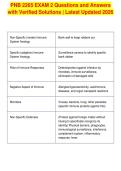
Non-Specific (innate) Immune Bank wall to keep robbers out
System Analogy
Specific (adaptive) Immune Surveillance camera to identify specific
System Analogy bank robber
Role of Immune Responses Defend/protect against infection by
microbes, immune surveillance,
elimination of damaged cells
Negative Aspect of Immune Allergies/hypersensitivity, autoimmune
diseases, and organ transplant reactions
Microbes Viruses, bacteria, fungi, other parasites
(specific immune protects against this)
Non-Specific Defenses (Protect against foreign matter without
having to specifically recognize its
identity) Physical barriers, phagocytes,
immunological surveillance, interferons,
complement system, inflammatory
response, fever
, Physical Barriers Prevent approach and deny access to
pathogens (epithelium, secretions, duct of
sweat gland, hair, skin and mucous
membranes, variety of protective
chemicals, ciliated mucosa, acidity of the
skin, gastric HCl, enzymes, lysozyme of
saliva
Phagocytes Remove debris and pathogens (fixed
macrophage, neutrophil, free
macrophage, eosinophil, monocyte)
Immunological Surveillance Destroys abnormal cells, for example NK
cells attach to abnormal cells and lyse
them
Interferons Increase resistance of cells to viral
infection (slow/INTERFERE with the
spread of a disease),
-interferons are released by activated
lymphocytes, macrophages, or virus-
infected cells
Complement System (Series of enzymes( Attacks and breaks
down cell walls, attracts phagocytes
-For ex, a bunch of complement attaches
to the cell wall of a pathogen and then
lyses it
with Verified Solutions | Latest Updated 2026
Non-Specific (innate) Immune Bank wall to keep robbers out
System Analogy
Specific (adaptive) Immune Surveillance camera to identify specific
System Analogy bank robber
Role of Immune Responses Defend/protect against infection by
microbes, immune surveillance,
elimination of damaged cells
Negative Aspect of Immune Allergies/hypersensitivity, autoimmune
diseases, and organ transplant reactions
Microbes Viruses, bacteria, fungi, other parasites
(specific immune protects against this)
Non-Specific Defenses (Protect against foreign matter without
having to specifically recognize its
identity) Physical barriers, phagocytes,
immunological surveillance, interferons,
complement system, inflammatory
response, fever
, Physical Barriers Prevent approach and deny access to
pathogens (epithelium, secretions, duct of
sweat gland, hair, skin and mucous
membranes, variety of protective
chemicals, ciliated mucosa, acidity of the
skin, gastric HCl, enzymes, lysozyme of
saliva
Phagocytes Remove debris and pathogens (fixed
macrophage, neutrophil, free
macrophage, eosinophil, monocyte)
Immunological Surveillance Destroys abnormal cells, for example NK
cells attach to abnormal cells and lyse
them
Interferons Increase resistance of cells to viral
infection (slow/INTERFERE with the
spread of a disease),
-interferons are released by activated
lymphocytes, macrophages, or virus-
infected cells
Complement System (Series of enzymes( Attacks and breaks
down cell walls, attracts phagocytes
-For ex, a bunch of complement attaches
to the cell wall of a pathogen and then
lyses it


