

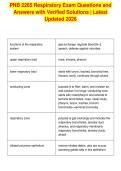
PNB 2265 Respiratory Exam Questions and
Answers with Verified Solutions | Latest
Updated 2026
functions of the respiratory gas exchange, regulate blood [H+],
system speech, defense against microbes
upper respiratory tract nose, sinuses, pharynx
lower respiratory tract starts with larynx, trachea, bronchial tree,
thoracic cavity, continues through alveoli.
conducting zone purpose is to filter, warm, and moisten air,
and conduct it to lungs. conducting zone
starts with nose/pharynx and extends to
terminal bronchioles. nose, nasal cavity,
pharynx, larynx, trachea, bronchi,
bronchioles->terminal broncioles
respiratory zone purpose is gas exchange and includes the
respiratory bronchioles, alveolar duct,
alveolus, and respiratory membrane.
respiratory bronchioles, alveolar ducts,
alveoli
ciliated columnar epithelium remove inhaled debris. also are mucus-
secreting goblet cells in this epithelium
, bronchial tree transition from conducting to respiratory
zone
pleural membranes double serous membrane that encases
the lung
Boyle's Law with a closer container and a fixed # of
gas molecules: inverse relationship b/w
pressure and volume
bulk flow F= ∆P/R, where ∆P= pressure difference
and R= resistance
ventilation F= Palv - Patm/R
the amount of gas reaching specific
alveoli
Dalton's Law of Partial the pressure each gas exerts is
Pressures independent of the pressure the others
exert. Total pressure of the mixture is the
sum of the individual gas pressures.
Henry's Law a gas dissolves into and out of liquid in
proportion to its partial pressure
emphysema affects -thickness of respiratory membrane ->
increased
-surface area for exchange -> decreased
cooperative binding affinity of Hb for O2 varies with oxygen
saturation
Answers with Verified Solutions | Latest
Updated 2026
functions of the respiratory gas exchange, regulate blood [H+],
system speech, defense against microbes
upper respiratory tract nose, sinuses, pharynx
lower respiratory tract starts with larynx, trachea, bronchial tree,
thoracic cavity, continues through alveoli.
conducting zone purpose is to filter, warm, and moisten air,
and conduct it to lungs. conducting zone
starts with nose/pharynx and extends to
terminal bronchioles. nose, nasal cavity,
pharynx, larynx, trachea, bronchi,
bronchioles->terminal broncioles
respiratory zone purpose is gas exchange and includes the
respiratory bronchioles, alveolar duct,
alveolus, and respiratory membrane.
respiratory bronchioles, alveolar ducts,
alveoli
ciliated columnar epithelium remove inhaled debris. also are mucus-
secreting goblet cells in this epithelium
, bronchial tree transition from conducting to respiratory
zone
pleural membranes double serous membrane that encases
the lung
Boyle's Law with a closer container and a fixed # of
gas molecules: inverse relationship b/w
pressure and volume
bulk flow F= ∆P/R, where ∆P= pressure difference
and R= resistance
ventilation F= Palv - Patm/R
the amount of gas reaching specific
alveoli
Dalton's Law of Partial the pressure each gas exerts is
Pressures independent of the pressure the others
exert. Total pressure of the mixture is the
sum of the individual gas pressures.
Henry's Law a gas dissolves into and out of liquid in
proportion to its partial pressure
emphysema affects -thickness of respiratory membrane ->
increased
-surface area for exchange -> decreased
cooperative binding affinity of Hb for O2 varies with oxygen
saturation


