

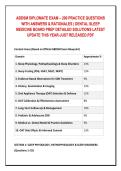
ABDSM DIPLOMATE EXAM – 200 PRACTICE QUESTIONS
WITH ANSWERS & RATIONALES | DENTAL SLEEP
MEDICINE BOARD PREP DETAILED SOLUTIONS LATEST
UPDATE THIS YEAR-JUST RELEASED.PDF
Content Areas (Based on Official ABDSM Exam Blueprint)
Domain Approximate %
1. Sleep Physiology, Pathophysiology & Sleep Disorders 13%
2. Sleep Testing (PSG, HSAT, MSLT, MWT) 13%
3. Evidence-Based Alternatives for SDB Treatment 9%
4. History, Examination & Imaging 13%
5. Oral Appliance Therapy (OAT) Selection & Delivery 12%
6. OAT Calibration & Effectiveness Assessment 8%
7. Long-Term Follow-Up & Management 10%
8. Pediatric & Adolescent SDB 9%
9. Medical vs. Dental Model & Practice Guidelines 9%
10. OAT Side Effects & Informed Consent 13%
SECTION 1: SLEEP PHYSIOLOGY, PATHOPHYSIOLOGY & SLEEP DISORDERS
(Questions 1–25)
,Question 1
pts
In the pathophysiology of sleep apnea, airway patency and stability is promoted
by which factor?
A) Increased lung volume
B) Shorter mandible
C) Increased parapharyngeal fat deposition
D) Negative inspiratory pressure
E) Reduced pharyngeal muscle dilator activity
Answer: A) Increased lung volume
Increased lung volume exerts a caudal traction force on the upper airway, which
increases airway patency and stability. This is why lung volume plays a role in
maintaining airway openness during sleep. A shorter mandible, increased
parapharyngeal fat, and reduced dilator muscle activity all contribute to airway
collapsibility .
Question 2
pts
Which of the following statements is true regarding a modified Mallampati
classification of the oral pharynx?
A) Mallampati II allows visualization of only the hard palate
B) Mallampati III allows visualization of only the hard palate
,C) Mallampati classifications are taken with the patient sedated and reclined
D) Mallampati classifications of IV have greater odds ratio than Mallampati
classifications of I for severe OSA
Answer: D) Mallampati classifications of IV have greater odds ratio than
Mallampati classifications of I for severe OSA
The Mallampati classification is performed with the patient sitting upright with
the mouth open and tongue protruded. Mallampati IV indicates only the hard
palate is visible, and higher classifications (III and IV) are associated with greater
risk for OSA .
Question 3
pts
What 8-item questionnaire was developed to perioperatively screen for risk of
OSA?
A) ESS (Epworth Sleepiness Scale)
B) STOP-BANG
C) MSLT (Multiple Sleep Latency Test)
D) Berlin Questionnaire
Answer: B) STOP-BANG
STOP-BANG is an 8-item screening tool used to identify patients at risk for OSA,
particularly in the perioperative setting. It includes Snoring, Tiredness, Observed
apnea, high blood Pressure, BMI >35, Age >50, Neck circumference >40 cm, and
Gender male .
, Question 4
pts
Across a general population, what is the most common sleep disorder?
A) Restless Legs Syndrome (RLS)
B) Narcolepsy
C) Delayed sleep phase syndrome
D) Insomnia
E) Obstructive Sleep Apnea
Answer: D) Insomnia
Insomnia is the most common sleep disorder in the general population. It is
characterized by difficulty initiating or maintaining sleep despite adequate
opportunity for sleep .
Question 5
pts
Measurement has shown that patients with sleep apnea have smaller upper
airways than those without sleep apnea but manage to keep an open airway
during wakefulness by:
A) Mouth breathing
B) Increased muscle tone on inspiration
C) Increased blood flow to the soft tissue
D) Frequent bruxing
WITH ANSWERS & RATIONALES | DENTAL SLEEP
MEDICINE BOARD PREP DETAILED SOLUTIONS LATEST
UPDATE THIS YEAR-JUST RELEASED.PDF
Content Areas (Based on Official ABDSM Exam Blueprint)
Domain Approximate %
1. Sleep Physiology, Pathophysiology & Sleep Disorders 13%
2. Sleep Testing (PSG, HSAT, MSLT, MWT) 13%
3. Evidence-Based Alternatives for SDB Treatment 9%
4. History, Examination & Imaging 13%
5. Oral Appliance Therapy (OAT) Selection & Delivery 12%
6. OAT Calibration & Effectiveness Assessment 8%
7. Long-Term Follow-Up & Management 10%
8. Pediatric & Adolescent SDB 9%
9. Medical vs. Dental Model & Practice Guidelines 9%
10. OAT Side Effects & Informed Consent 13%
SECTION 1: SLEEP PHYSIOLOGY, PATHOPHYSIOLOGY & SLEEP DISORDERS
(Questions 1–25)
,Question 1
pts
In the pathophysiology of sleep apnea, airway patency and stability is promoted
by which factor?
A) Increased lung volume
B) Shorter mandible
C) Increased parapharyngeal fat deposition
D) Negative inspiratory pressure
E) Reduced pharyngeal muscle dilator activity
Answer: A) Increased lung volume
Increased lung volume exerts a caudal traction force on the upper airway, which
increases airway patency and stability. This is why lung volume plays a role in
maintaining airway openness during sleep. A shorter mandible, increased
parapharyngeal fat, and reduced dilator muscle activity all contribute to airway
collapsibility .
Question 2
pts
Which of the following statements is true regarding a modified Mallampati
classification of the oral pharynx?
A) Mallampati II allows visualization of only the hard palate
B) Mallampati III allows visualization of only the hard palate
,C) Mallampati classifications are taken with the patient sedated and reclined
D) Mallampati classifications of IV have greater odds ratio than Mallampati
classifications of I for severe OSA
Answer: D) Mallampati classifications of IV have greater odds ratio than
Mallampati classifications of I for severe OSA
The Mallampati classification is performed with the patient sitting upright with
the mouth open and tongue protruded. Mallampati IV indicates only the hard
palate is visible, and higher classifications (III and IV) are associated with greater
risk for OSA .
Question 3
pts
What 8-item questionnaire was developed to perioperatively screen for risk of
OSA?
A) ESS (Epworth Sleepiness Scale)
B) STOP-BANG
C) MSLT (Multiple Sleep Latency Test)
D) Berlin Questionnaire
Answer: B) STOP-BANG
STOP-BANG is an 8-item screening tool used to identify patients at risk for OSA,
particularly in the perioperative setting. It includes Snoring, Tiredness, Observed
apnea, high blood Pressure, BMI >35, Age >50, Neck circumference >40 cm, and
Gender male .
, Question 4
pts
Across a general population, what is the most common sleep disorder?
A) Restless Legs Syndrome (RLS)
B) Narcolepsy
C) Delayed sleep phase syndrome
D) Insomnia
E) Obstructive Sleep Apnea
Answer: D) Insomnia
Insomnia is the most common sleep disorder in the general population. It is
characterized by difficulty initiating or maintaining sleep despite adequate
opportunity for sleep .
Question 5
pts
Measurement has shown that patients with sleep apnea have smaller upper
airways than those without sleep apnea but manage to keep an open airway
during wakefulness by:
A) Mouth breathing
B) Increased muscle tone on inspiration
C) Increased blood flow to the soft tissue
D) Frequent bruxing


