
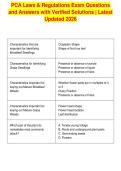
PCA Laws & Regulations Exam Questions
and Answers with Verified Solutions | Latest
Updated 2026
Characteristics that are Cotyledon Shape
important for Identifying Shape of first true leaf
Broadleaf Seedlings
Characteristics for Identifying Presence or absence of auricle
Grass Seedlings Presence or absence of ligule
Presence or absence of hairs
Characteristics important for Whether flower parts are in multiples of 4
keying out Mature Broadleaf or 5
Weeds Ovary Position
Presence or absence of hairs
Characteristics important for Flower head shape
keying out Mature Grass Flower head location
Weeds Leaf distribution
Which part of the plant do A. Tender young foliage
nematodes most commonly B. Roots and underground plant parts
attack? C. Germinating seeds
D. Flowers
,Plants that are capable of A. Monocots
reproducing from B. Biennials
overwintering storage organs C. Perennials
such as bulbs, tubers, and D. Dicots
rhizomes are called.
Which of the following insect A. Orthoptera (Crickets and
orders includes species known Grasshoppers)
to transmit disease in humans? B. Thysanura (Firebrats and Silverfish)
C. Blatodea (Cockroaches)
D. Thysanoptera (Thrips)
Pest nematode species A. Sucking plant sap
damage plants by: B. Preventing fruit and flower formation
C. Impairing water and nutrient uptake
capacity
D. Transmitting several bacterial diseases
Honey bees belong to the A. Coleoptera
following insect order B. Diptera
C. Hymenoptera
D. Lepidoptera
Perennial weeds are generally A. They produce more seeds than other
the most difficult to control types of plants
because: B. They can reproduce and spread from
storage organs such as rhizomes and
tubers
C. Their seeds remain viable for longer
than biennials and annuals
D. They produce deep tap roots that are
more resistant to mechanical control and
herbicides
, Which of the following types A. Bacterial diseases such as
of plant disorders cannot be Psuedomonas
transmitted? B. Fungal diseases such as powdery
mildew
C. Diseases caused by viruses, viroids,
and mycoplasmas
D. Water stress and other abiotic
problems
Which of the following insect A. Isoptera (Termites)
orders includes several B. Thysanura (Firebrats and Silverfish)
species of agricultural pests? C. Blatodea (Cockroaches)
D. Heteroptera (True Bugs)
Which of the following is not a A. Some weeds are noxious and
characteristic of weeds? endanger livestock
B. Weeds interfere with the safety or use
of roads, utilities, and waterways
C. Most weeds produce a large number
of seeds even under adverse conditions
D. Weeds enhance the growth of
agricultural crops
Which organism is not an A. Snail
invertebrate pest? B. Caterpilar
C. House Mouse
D. Garden Spider
and Answers with Verified Solutions | Latest
Updated 2026
Characteristics that are Cotyledon Shape
important for Identifying Shape of first true leaf
Broadleaf Seedlings
Characteristics for Identifying Presence or absence of auricle
Grass Seedlings Presence or absence of ligule
Presence or absence of hairs
Characteristics important for Whether flower parts are in multiples of 4
keying out Mature Broadleaf or 5
Weeds Ovary Position
Presence or absence of hairs
Characteristics important for Flower head shape
keying out Mature Grass Flower head location
Weeds Leaf distribution
Which part of the plant do A. Tender young foliage
nematodes most commonly B. Roots and underground plant parts
attack? C. Germinating seeds
D. Flowers
,Plants that are capable of A. Monocots
reproducing from B. Biennials
overwintering storage organs C. Perennials
such as bulbs, tubers, and D. Dicots
rhizomes are called.
Which of the following insect A. Orthoptera (Crickets and
orders includes species known Grasshoppers)
to transmit disease in humans? B. Thysanura (Firebrats and Silverfish)
C. Blatodea (Cockroaches)
D. Thysanoptera (Thrips)
Pest nematode species A. Sucking plant sap
damage plants by: B. Preventing fruit and flower formation
C. Impairing water and nutrient uptake
capacity
D. Transmitting several bacterial diseases
Honey bees belong to the A. Coleoptera
following insect order B. Diptera
C. Hymenoptera
D. Lepidoptera
Perennial weeds are generally A. They produce more seeds than other
the most difficult to control types of plants
because: B. They can reproduce and spread from
storage organs such as rhizomes and
tubers
C. Their seeds remain viable for longer
than biennials and annuals
D. They produce deep tap roots that are
more resistant to mechanical control and
herbicides
, Which of the following types A. Bacterial diseases such as
of plant disorders cannot be Psuedomonas
transmitted? B. Fungal diseases such as powdery
mildew
C. Diseases caused by viruses, viroids,
and mycoplasmas
D. Water stress and other abiotic
problems
Which of the following insect A. Isoptera (Termites)
orders includes several B. Thysanura (Firebrats and Silverfish)
species of agricultural pests? C. Blatodea (Cockroaches)
D. Heteroptera (True Bugs)
Which of the following is not a A. Some weeds are noxious and
characteristic of weeds? endanger livestock
B. Weeds interfere with the safety or use
of roads, utilities, and waterways
C. Most weeds produce a large number
of seeds even under adverse conditions
D. Weeds enhance the growth of
agricultural crops
Which organism is not an A. Snail
invertebrate pest? B. Caterpilar
C. House Mouse
D. Garden Spider


