

PACU Exam Questions and Answers with
Verified Solutions | Latest Updated 2026
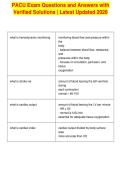
what is hemodynamic monitoring monitoring blood flow and pressure within
the
body
- balance between blood flow, resistance,
and
pressures within the body
- focuses on circulation, perfusion, and
tissue
oxygenation
what is stroke vol amount of blood leaving the left ventricle
during
each contraction
normal = 60-100
what is cardiac output amount of blood leaving the LV per minute
- HR x SV
- normal is 4-6L/min
essential for adequate tissue oxygenation
what is cardiac index cardiac output divided by body surface
area
more accurate than CO
, what is ejection fraction % of blood ejected from the ventricles with
each
beat
- 55-70%
what is contractility force of the contraction
- frank-starling law = the bigger the stretch
=
bigger the contraction
what is preload vol. of blood of blood in ventricle at the end
of
diastole
what is afterload resistance/pressure the ventricle must
overcome to
eject blood during systole
what is hemodynamic monitoring - aids in diagnosis
for - assist in guiding therapies and tx
- evaluate pts response to current
therapies and tx
what're the indications for to assess
hemodynamic monitoring - heart function
- fluid balance
- effects of drugs that effect CO
what're we monitor for esp in situations w/ unstable BP
hemodynamic monitoring
Verified Solutions | Latest Updated 2026
what is hemodynamic monitoring monitoring blood flow and pressure within
the
body
- balance between blood flow, resistance,
and
pressures within the body
- focuses on circulation, perfusion, and
tissue
oxygenation
what is stroke vol amount of blood leaving the left ventricle
during
each contraction
normal = 60-100
what is cardiac output amount of blood leaving the LV per minute
- HR x SV
- normal is 4-6L/min
essential for adequate tissue oxygenation
what is cardiac index cardiac output divided by body surface
area
more accurate than CO
, what is ejection fraction % of blood ejected from the ventricles with
each
beat
- 55-70%
what is contractility force of the contraction
- frank-starling law = the bigger the stretch
=
bigger the contraction
what is preload vol. of blood of blood in ventricle at the end
of
diastole
what is afterload resistance/pressure the ventricle must
overcome to
eject blood during systole
what is hemodynamic monitoring - aids in diagnosis
for - assist in guiding therapies and tx
- evaluate pts response to current
therapies and tx
what're the indications for to assess
hemodynamic monitoring - heart function
- fluid balance
- effects of drugs that effect CO
what're we monitor for esp in situations w/ unstable BP
hemodynamic monitoring


