

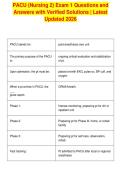
PACU (Nursing 2) Exam 1 Questions and
Answers with Verified Solutions | Latest
Updated 2026
PACU stands for: post-anesthesia care unit
The primary purpose of the PACU ongoing critical evaluation and stabilization
is: of pt.
Upon admission, the pt must be: placed on/with EKG, pulse ox, BP cuff, and
oxygen
When a pt arrives in PACU, the CRNA/Anesth.
___
gives report.
Phase 1: Intense monitoring, preparing pt for d/c or
inpatient unit
Phase 2: Preparing pt for Phase III, home, or rehab
facility
Phase 3: Preparing pt for self care, observation,
rehab
Fast tracking: Pt admitted to PACU after local or regional
anesthesia
, Intraoperative management while what anesthesia was used, meds given,
giving admission report: EBL, fluid
replacement totals, urine output
Intraoperative course while giving unexpected anesthetic events/reactions,
admission report: VS,
monitoring trends, lab results
PACU assessment priority: Adequacy of airway (rate, rhythm,
accessory
muscles, breath sounds, O2 sat)
Pts at higher risk in PACU: those that received general, elderly,
smokers/lung
disease, obese, pts that went under
thoracic/airway/abd surgery
Obese pts are at a higher risk in adipose tissue absorbing anesthesia and
PACU due to: slowly
releasing over time, they're harder to wake
Reasons for airway obstruction: blockage (usually tongue), supine position,
extremely sleepiness, laryngospasm
(throat close),
retained secretions, laryngeal edema (from
neck
surgery)
The most common cause of atelectasis
postop
hypoxemia:
Answers with Verified Solutions | Latest
Updated 2026
PACU stands for: post-anesthesia care unit
The primary purpose of the PACU ongoing critical evaluation and stabilization
is: of pt.
Upon admission, the pt must be: placed on/with EKG, pulse ox, BP cuff, and
oxygen
When a pt arrives in PACU, the CRNA/Anesth.
___
gives report.
Phase 1: Intense monitoring, preparing pt for d/c or
inpatient unit
Phase 2: Preparing pt for Phase III, home, or rehab
facility
Phase 3: Preparing pt for self care, observation,
rehab
Fast tracking: Pt admitted to PACU after local or regional
anesthesia
, Intraoperative management while what anesthesia was used, meds given,
giving admission report: EBL, fluid
replacement totals, urine output
Intraoperative course while giving unexpected anesthetic events/reactions,
admission report: VS,
monitoring trends, lab results
PACU assessment priority: Adequacy of airway (rate, rhythm,
accessory
muscles, breath sounds, O2 sat)
Pts at higher risk in PACU: those that received general, elderly,
smokers/lung
disease, obese, pts that went under
thoracic/airway/abd surgery
Obese pts are at a higher risk in adipose tissue absorbing anesthesia and
PACU due to: slowly
releasing over time, they're harder to wake
Reasons for airway obstruction: blockage (usually tongue), supine position,
extremely sleepiness, laryngospasm
(throat close),
retained secretions, laryngeal edema (from
neck
surgery)
The most common cause of atelectasis
postop
hypoxemia:


