
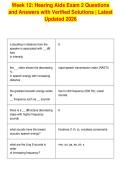
Week 12: Hearing Aids Exam 2 Questions
and Answers with Verified Solutions | Latest
Updated 2026
a doubling in distance from the 6
speaker is associated with __ dB
loss
in intensity
the __ index shows the decreasing rapid speech transmission index (RASTI)
%
in speech energy with increasing
distance
the greatest acoustic energy exists low to mid frequency (500 Hz); vowel
at sounds
__ frequency such as __ sounds
there is a __ dB/octave decreasing 6
slope with higher frequency
sounds
what sounds have the lowest fricatives (f, th, s), voiceless consonants
acoustic speech energy?
what are the Ling 6 sounds in mm, oo, aa, ee, sh, s
order
of increasing frequency?
, what are some physical - smaller ears and ear canals
differences - more pliable ear canals
in DHH children that influence - horizontal ET (more OM)
hearing aid fittings? - ears are growing and changing shape
rapidly
children need a __ SNR to higher
perceive
speech compared to adults
what are 3 tests of hearing for ABR, behavioral observation, OAE
infants/children that aid in hearing
aid fittings?
what earmold material should we softer; vinyl or silicone
use for infants?
how can we create a vent on an drill groove/slit on the side
earmold that is too small?
what is different about the otoblock less deep otoblock placement (due to
placement of infant earmold? pliable,
shorter canals)
we should make earmolds __ for monthly
0-6
months of age
we should make earmolds __ for bimonthly
6-12
months of age
and Answers with Verified Solutions | Latest
Updated 2026
a doubling in distance from the 6
speaker is associated with __ dB
loss
in intensity
the __ index shows the decreasing rapid speech transmission index (RASTI)
%
in speech energy with increasing
distance
the greatest acoustic energy exists low to mid frequency (500 Hz); vowel
at sounds
__ frequency such as __ sounds
there is a __ dB/octave decreasing 6
slope with higher frequency
sounds
what sounds have the lowest fricatives (f, th, s), voiceless consonants
acoustic speech energy?
what are the Ling 6 sounds in mm, oo, aa, ee, sh, s
order
of increasing frequency?
, what are some physical - smaller ears and ear canals
differences - more pliable ear canals
in DHH children that influence - horizontal ET (more OM)
hearing aid fittings? - ears are growing and changing shape
rapidly
children need a __ SNR to higher
perceive
speech compared to adults
what are 3 tests of hearing for ABR, behavioral observation, OAE
infants/children that aid in hearing
aid fittings?
what earmold material should we softer; vinyl or silicone
use for infants?
how can we create a vent on an drill groove/slit on the side
earmold that is too small?
what is different about the otoblock less deep otoblock placement (due to
placement of infant earmold? pliable,
shorter canals)
we should make earmolds __ for monthly
0-6
months of age
we should make earmolds __ for bimonthly
6-12
months of age


