

TBS PHASE 3 EXAM WITH CORRECT ACTUAL
QUESTIONS AND CORRECTLY WELL DEFINED
ANSWERS LATEST ALREADY GRADED A+ 2026
Save
Terms in this set (79)
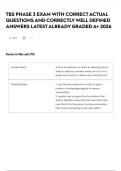
Frontal Attack A form of maneuver in which an attacking force
seeks to destroy a weaker enemy force or fix a
larger enemy force in place over a broad front.
Flanking Attack 1. uses fire and maneuver in order to gain a
position of advantage against an enemy
vulnerability.
2. usually uses a support by fire position that
diverts attention away from the main effort and
uses fires to fix the enemy in place, preventing
them from reorienting on the main effort.
,Classification of Offensive Fires -Fires in support of maneuver-the MG unit will
suppress the maneuver unit's immediate objective
to allow the unit to move into position to conduct
the final assault.
-Fires in support of isolation- the MG unit will
suppress any enemy unit that can interfere with
the maneuver elements advance.
-Fires in support of assault- the MG unit will
suppress the maneuver unit's immediate
objective.
-Fires in support of consolidation- enemy
counterattack should be expected following
seizure of objective. MG's are used to protect the
unit's consolidation and reorganization.
Types of Attacks Deliberate
Hasty
Priority of Recon o Confirm location of enemy defense CSW,
obstacles and security.
o Identify the EN CV
o Identify the assault position that will best allow
the ME to assault the enemy
o Identify the best support by fire position
o Identify routes and TCM's
Occupying Support By Fire -Stealth
-Force
, Eight Principles of Machine Gun Pairs
Employment, PICMDEEP Interlocking fires
coordination of fires
Mutual Suport
Defilade
Enfilade
Economy of fires
Protection
Principal Direction of Fire the weapons primary focus is covering a likely
avenue of approach, key piece of terrain, or
whatever object of interest that unit leader
assigns it. Weapon will left and right lateral limits.
Final Protective Line the weapon is primarily in a position to employ
grazing fires (center of the cone of fire does not
pass 1 meter off the deck) across a unit's frontage
as a last effort to defend the lines.
7 Steps of Engagement Area 1. Identify all likely enemy avenues of approach
Development 2. Determine likely enemy schemes of maneuver
3. Determine where to kill the enemy
4. Emplace weapon systems
5. Plan and integrate obstacles
6. Plan and integrate indirect fires
7. Conduct EA rehearsals
Types of Defensive Positions Primary
Supplementary
Alternate
Subsequent
Primary Positon is the best place to accomplish the assigned
mission.
QUESTIONS AND CORRECTLY WELL DEFINED
ANSWERS LATEST ALREADY GRADED A+ 2026
Save
Terms in this set (79)
Frontal Attack A form of maneuver in which an attacking force
seeks to destroy a weaker enemy force or fix a
larger enemy force in place over a broad front.
Flanking Attack 1. uses fire and maneuver in order to gain a
position of advantage against an enemy
vulnerability.
2. usually uses a support by fire position that
diverts attention away from the main effort and
uses fires to fix the enemy in place, preventing
them from reorienting on the main effort.
,Classification of Offensive Fires -Fires in support of maneuver-the MG unit will
suppress the maneuver unit's immediate objective
to allow the unit to move into position to conduct
the final assault.
-Fires in support of isolation- the MG unit will
suppress any enemy unit that can interfere with
the maneuver elements advance.
-Fires in support of assault- the MG unit will
suppress the maneuver unit's immediate
objective.
-Fires in support of consolidation- enemy
counterattack should be expected following
seizure of objective. MG's are used to protect the
unit's consolidation and reorganization.
Types of Attacks Deliberate
Hasty
Priority of Recon o Confirm location of enemy defense CSW,
obstacles and security.
o Identify the EN CV
o Identify the assault position that will best allow
the ME to assault the enemy
o Identify the best support by fire position
o Identify routes and TCM's
Occupying Support By Fire -Stealth
-Force
, Eight Principles of Machine Gun Pairs
Employment, PICMDEEP Interlocking fires
coordination of fires
Mutual Suport
Defilade
Enfilade
Economy of fires
Protection
Principal Direction of Fire the weapons primary focus is covering a likely
avenue of approach, key piece of terrain, or
whatever object of interest that unit leader
assigns it. Weapon will left and right lateral limits.
Final Protective Line the weapon is primarily in a position to employ
grazing fires (center of the cone of fire does not
pass 1 meter off the deck) across a unit's frontage
as a last effort to defend the lines.
7 Steps of Engagement Area 1. Identify all likely enemy avenues of approach
Development 2. Determine likely enemy schemes of maneuver
3. Determine where to kill the enemy
4. Emplace weapon systems
5. Plan and integrate obstacles
6. Plan and integrate indirect fires
7. Conduct EA rehearsals
Types of Defensive Positions Primary
Supplementary
Alternate
Subsequent
Primary Positon is the best place to accomplish the assigned
mission.


