
NSG 3800 Exam Questions and Answers with
Verified Solutions | Latest Updated 2026
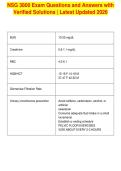
BUN 10-20 mg/dL
Creatinine 0.6-1.1 mg/dL
RBC 4.2-6.1
HGB/HCT 12-16 F 14-18 M
37-47 F 42-52 M
Glomerular Filtration Rate
Urinary incontinence prevention Avoid caffeine, carbonation, alcohol, or
artificial
sweetener
Consume adequate fluid intake in a small
increments
Establish a voiding schedule
PELVIC FLOOR EXERCISES
VOID ABOUT EVERY 2-3 HOURS
,Urinary Incontinence nursing care Provide support and education (verbal and
in
writing)
Educate the use of a log or diary
describing details
surrounding incontinent event
Causes of transient incontinence Atrophic vaginitis, urethritis, prostatitis
Delirium or confusion
UTI
Excessive urine production (increased
intake,
diabetes, diabetic ketoacidosis)
Limited or restricted activity
Pharmacologic agents (anticholinergic
agents,
sedatives, alcohol, analgesic agents,
diuretics,
muscle relaxants, adrenergic agents)
Psychological factors (depression,
regression)
Stool impaction or constipation
Fluid management Adequate fluid intake (50-60
oz/1500-1600ml)
Limit caffeine, alcohol, etc.
Pts need to discuss their daily fluid limit
with their
provider if they have HF or end-stage
kidney
disease
, Is incontinence a normal age NO!
related Ask about UTI, infection, constipation,
change? decreased
fluid intake, and change in chronic disease
pattern
to determine why they have incontinence.
Stress incontinence Is the involuntary loss of urine through an
intact
urethra as a result of sneezing, coughing,
or
changing position
More common in women who have had
vaginal
deliveries or other gyno procedures
In men it is often experienced after radical
prostatectomy due to loss of urethral
compression
that the prostate had supplied before the
surgery
Urge incontinence Involuntary loss of urine associated with a
strong
urge to void that cannot be suppressed
The patient is aware of the need to void
but is
unable to reach a toilet in time.
This can occur in a patient with
NEUROLOGICAL
DYSFUNCTION.
Verified Solutions | Latest Updated 2026
BUN 10-20 mg/dL
Creatinine 0.6-1.1 mg/dL
RBC 4.2-6.1
HGB/HCT 12-16 F 14-18 M
37-47 F 42-52 M
Glomerular Filtration Rate
Urinary incontinence prevention Avoid caffeine, carbonation, alcohol, or
artificial
sweetener
Consume adequate fluid intake in a small
increments
Establish a voiding schedule
PELVIC FLOOR EXERCISES
VOID ABOUT EVERY 2-3 HOURS
,Urinary Incontinence nursing care Provide support and education (verbal and
in
writing)
Educate the use of a log or diary
describing details
surrounding incontinent event
Causes of transient incontinence Atrophic vaginitis, urethritis, prostatitis
Delirium or confusion
UTI
Excessive urine production (increased
intake,
diabetes, diabetic ketoacidosis)
Limited or restricted activity
Pharmacologic agents (anticholinergic
agents,
sedatives, alcohol, analgesic agents,
diuretics,
muscle relaxants, adrenergic agents)
Psychological factors (depression,
regression)
Stool impaction or constipation
Fluid management Adequate fluid intake (50-60
oz/1500-1600ml)
Limit caffeine, alcohol, etc.
Pts need to discuss their daily fluid limit
with their
provider if they have HF or end-stage
kidney
disease
, Is incontinence a normal age NO!
related Ask about UTI, infection, constipation,
change? decreased
fluid intake, and change in chronic disease
pattern
to determine why they have incontinence.
Stress incontinence Is the involuntary loss of urine through an
intact
urethra as a result of sneezing, coughing,
or
changing position
More common in women who have had
vaginal
deliveries or other gyno procedures
In men it is often experienced after radical
prostatectomy due to loss of urethral
compression
that the prostate had supplied before the
surgery
Urge incontinence Involuntary loss of urine associated with a
strong
urge to void that cannot be suppressed
The patient is aware of the need to void
but is
unable to reach a toilet in time.
This can occur in a patient with
NEUROLOGICAL
DYSFUNCTION.


