UTA NURS 5315 PACKAGED EXAMS EXAM
SCRIPT TESTED QUESTIONS WITH VERIFIED
ANSWERS PRACTICE SOLUTION GRADED
A+
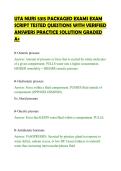
⩥ Osmotic pressure
Answer: Amount of pressure or force that is exerted by solute molecules
of a given compartment. PULLS water into a higher concentration.
HIGHER osmolality = HIGHER osmotic pressure
⩥ Hydrostatic pressure
Answer: Force within a fluid compartment. PUSHES fluid outside of
compartment (OPPOSES OSMOSIS).
Ex. blood pressure
⩥ Oncotic pressure
Answer: Force that KEEPS water/fluid within a compartment. PULLS.
⩥ Antidiuretic hormone
Answer: VASOPRESSIN. Secreted by pituitary gland in response to
water deficit, sodium excess, or low BP. Causes kidneys to reabsorb
water thus increasing intervascular/plasma fluid.
, ⩥ Renin Angiotensin Aldosterone System (RAAS)
Answer: Activated by low blood volume. Low blood volume --> renin --
> angiotensinogen --> angiotensin 1 --> ACE (angiotensin converting
enzyme) converts angiotensin 1 to angiotensin 2 -->causes arterial
vasoconstriction --> release of aldosterone --> renal Na+ and H2O
reabsorption and K+ excretion.
Produces LESS urine and blood volume INCREASES.
Manages BP - when body constricts, BP increases
⩥ Normal plasma osmolality
Answer: 280-295 mOsm/kg
⩥ Natriuretic hormones
Answer: ANP and BNP. Hormones released from the heart to decrease
blood volume by promoting urinary excretion of Na+ and H2O.
Decreases blood volume. Opposite of RAAS.
⩥ How does a hypertonic solution alter osmolality?
Answer: Increases solute concentration, causing INCREASED
osmolality. Causes cells to SHRINK.
⩥ How does a hypotonic solution alter osmolality?
SCRIPT TESTED QUESTIONS WITH VERIFIED
ANSWERS PRACTICE SOLUTION GRADED
A+
⩥ Osmotic pressure
Answer: Amount of pressure or force that is exerted by solute molecules
of a given compartment. PULLS water into a higher concentration.
HIGHER osmolality = HIGHER osmotic pressure
⩥ Hydrostatic pressure
Answer: Force within a fluid compartment. PUSHES fluid outside of
compartment (OPPOSES OSMOSIS).
Ex. blood pressure
⩥ Oncotic pressure
Answer: Force that KEEPS water/fluid within a compartment. PULLS.
⩥ Antidiuretic hormone
Answer: VASOPRESSIN. Secreted by pituitary gland in response to
water deficit, sodium excess, or low BP. Causes kidneys to reabsorb
water thus increasing intervascular/plasma fluid.
, ⩥ Renin Angiotensin Aldosterone System (RAAS)
Answer: Activated by low blood volume. Low blood volume --> renin --
> angiotensinogen --> angiotensin 1 --> ACE (angiotensin converting
enzyme) converts angiotensin 1 to angiotensin 2 -->causes arterial
vasoconstriction --> release of aldosterone --> renal Na+ and H2O
reabsorption and K+ excretion.
Produces LESS urine and blood volume INCREASES.
Manages BP - when body constricts, BP increases
⩥ Normal plasma osmolality
Answer: 280-295 mOsm/kg
⩥ Natriuretic hormones
Answer: ANP and BNP. Hormones released from the heart to decrease
blood volume by promoting urinary excretion of Na+ and H2O.
Decreases blood volume. Opposite of RAAS.
⩥ How does a hypertonic solution alter osmolality?
Answer: Increases solute concentration, causing INCREASED
osmolality. Causes cells to SHRINK.
⩥ How does a hypotonic solution alter osmolality?