
NASM CES Textbook Chapter 10 Exam
Questions and Answers with Verified
Solutions | Latest Updated 2026
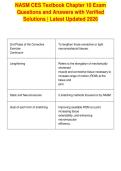
2nd Phase of the Corrective To lengthen those overactive or tight
Exercise neuromyofascial tissues.
Continuum
Lengthening Refers to the elongation of mechanically
shortened
muscle and connective tissue necessary to
increase range of motion (ROM) at the
tissue and
joint.
Static and Neuromuscular 2 stretching methods focused on by NASM
Goal of each form of stretching Improving available ROM at a joint
increasing tissue
extensibility, and enhancing
neuromuscular
efficiency.
, Static stretching The most common flexibility training
technique
used by health and fitness professionals. It
is used
to increase the extensibility muscle and
connective
tissue (lengthening) and thus ROM at a
joint.
Mechanical and Neural Products of static stretching that result in
adaptations increased
ROM
Viscoelastic component Mechanically, static stretching affects this
part of
neuromyofascial tissue.
Decrease in the passive This occurs in a muscle in regards to a
resistance stretch force
throughout most of the ROM and not the
rate at
which the muscle-tendon unit increases its
stiffness.
Not as resistant to being stretched Allowing for better extensibility
Rate of increase in stiffness in The ability to respond to a stretch force
response to stimuli
Questions and Answers with Verified
Solutions | Latest Updated 2026
2nd Phase of the Corrective To lengthen those overactive or tight
Exercise neuromyofascial tissues.
Continuum
Lengthening Refers to the elongation of mechanically
shortened
muscle and connective tissue necessary to
increase range of motion (ROM) at the
tissue and
joint.
Static and Neuromuscular 2 stretching methods focused on by NASM
Goal of each form of stretching Improving available ROM at a joint
increasing tissue
extensibility, and enhancing
neuromuscular
efficiency.
, Static stretching The most common flexibility training
technique
used by health and fitness professionals. It
is used
to increase the extensibility muscle and
connective
tissue (lengthening) and thus ROM at a
joint.
Mechanical and Neural Products of static stretching that result in
adaptations increased
ROM
Viscoelastic component Mechanically, static stretching affects this
part of
neuromyofascial tissue.
Decrease in the passive This occurs in a muscle in regards to a
resistance stretch force
throughout most of the ROM and not the
rate at
which the muscle-tendon unit increases its
stiffness.
Not as resistant to being stretched Allowing for better extensibility
Rate of increase in stiffness in The ability to respond to a stretch force
response to stimuli


