
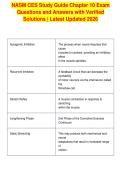
NASM CES Study Guide Chapter 10 Exam
Questions and Answers with Verified
Solutions | Latest Updated 2026
Autogentic Inhibition The process when neural impulses that
cause
muscles to contract, providing an inhibitory
effect
to the muscle spindles.
Recurrent Inhibition A feedback circuit that can decrease the
excitability
of motor neurons via the interneuron called
the
Renshaw cell.
Stretch Reflex A muscle contraction in response to
stretching
within the muscle.
Lengthening Phase 2nd Phase of the Corrective Exercise
Continuum
Static Stretching This may produce both mechanical and
neural
adaptations that result in increased range
of
motion.
, Lowest risk for injury and deemed The ability of an individual to perform static
safest to use stretching without assistance and the
slow-minimal
to no motion required has led this form of
flexibility
training to be associated with these
qualities:
Neurological effects of static This appears to decrease motor neuron
stretching neuromyofascial tissue excitability,
to possibly through the inhibitory effects from
end ROM the
Golgi tendon organs (autogenic inhibition)
as well
as possible contribution from the Renshaw
recurrent loop (recurrent inhibition).
Mechanical effects of static This appears to affect the viscoelastic
stretching component
of neuromyofascial tissue, decreasing the
passive
resistance a muscle has to a stretch force
throughout most of the range of motion.
20-30s The time it takes for static stretching to
cause an
acute viscoelastic stress relaxation
response
allowing for an immediate increase in
range of
motion.
Questions and Answers with Verified
Solutions | Latest Updated 2026
Autogentic Inhibition The process when neural impulses that
cause
muscles to contract, providing an inhibitory
effect
to the muscle spindles.
Recurrent Inhibition A feedback circuit that can decrease the
excitability
of motor neurons via the interneuron called
the
Renshaw cell.
Stretch Reflex A muscle contraction in response to
stretching
within the muscle.
Lengthening Phase 2nd Phase of the Corrective Exercise
Continuum
Static Stretching This may produce both mechanical and
neural
adaptations that result in increased range
of
motion.
, Lowest risk for injury and deemed The ability of an individual to perform static
safest to use stretching without assistance and the
slow-minimal
to no motion required has led this form of
flexibility
training to be associated with these
qualities:
Neurological effects of static This appears to decrease motor neuron
stretching neuromyofascial tissue excitability,
to possibly through the inhibitory effects from
end ROM the
Golgi tendon organs (autogenic inhibition)
as well
as possible contribution from the Renshaw
recurrent loop (recurrent inhibition).
Mechanical effects of static This appears to affect the viscoelastic
stretching component
of neuromyofascial tissue, decreasing the
passive
resistance a muscle has to a stretch force
throughout most of the range of motion.
20-30s The time it takes for static stretching to
cause an
acute viscoelastic stress relaxation
response
allowing for an immediate increase in
range of
motion.


