
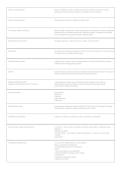
What is mental health? State of wellbeing • Able to realize his/her own potential• Cope with normal
stressors of life• Work productively• Contribute to the community
What is mental illness? All psychiatric disorders• Significant dysfunction
The mental health continuum Mental health--(occasional to mild distress with no impairment)--(mild to moderate
distress/mild to moderate impairment)--(Marked distress, moderate to disabling,
chronic impairment, inpatient/suicidal)--Mental Illness
Mental illness risk factors biological, genetics, social, economic, culture, environmental
Resilience the ability and capacity for people to secure resources needed for well-being. Does
not mean they are unaffected by stress.
Diathesis-stress model suggests that a person may be predisposed for a mental disorder that remains
unexpressed until triggered by stress
DSM-5 Classifies Schizophrenia Spectrum Disorders• Depressive Disorders• Trauma and
Stressor-Related Disorders• Feeding and Eating Disorders
QSEN COMPETENCIES • All healthcare workers must:• Provide patient-centered care• Work in
Quality and Safety Education for Nurses interdisciplinary teams• Employ evidence-based practice• Apply quality
improvement• Utilize informatics
Nursing Process Assessment
Diagnosis
Planning
Implementation
Evaluation
Mental Status Exam • Appearance• Behavior• Speech• Mood• D/O of the form of thought• Perceptual
Disturbances• Cognition• Ideas of Harming Self or others
SOAPIE documentation subjective, objective, assessment, plan, intervention, evaluation
documentation legal considerations • Do Chart - Timely, facts, descriptive, pertinent observations, Subjective data
(patient's
feelings, thoughts)
• Do NOT chart - your opinion, false documentation, no blanks, do not chart
"incident
report filed"
Therapeutic Relationship • Focus of the relationship is on the patient's
ideas, experience and feelings.
• Consistently focused on the patient's
needs
• Clear boundaries are established
• Help the patient developing new coping
mechanisms
• Supports behavioral change
• Roles do not shift
, Boundaries Boundaries exist to protect the patient. Well established boundaries allow for a safe
environment where the patient can explore feelings and treatment concerns
Blurred roles: Transference pt transfers feelings & behaviors onto the nurse related to significant figures in the
patient's past
Blurred roles: Countertransference Nurse transfers feelings and behaviors onto the patient related to significant figures
in the nurse's past
Peplau's Model of the Nurse-Patient Relationship The nurse-patient relationship "facilitates forward movement"
4 phases:
• Preorientation Phase
• Orientation Phase
• Working Phase
• Termination Phase
The communication process Stimulus - someone has a need to communicate
Sender - the person sending the message
Message - information send or expressed
Channel - auditory, visual, tactile, olfactory or a combination
Receiver - person receiving the message
Feedback - validates the accuracy of the sender's message and is EXTREMELY
IMPORTANT
Nonverbal communication Tone, Facial expression, Body language
THERAPEUTIC COMMUNICATION TECHNIQUES Using silence, Active listening, Clarifying techniques: paraphrasing, restating,
reflecting, exploring
NONTHERAPEUTIC COMMUNICATION TECHNIQUES Excessive questioning
Giving approval or disapproval
Giving advice
Asking "why" questions
Cultural considerations Communication Style
Use of Eye Contact
Perception of Touch
Cultural Filters
Process recording -Written record of a segment of the nurse-patient session that reflects as closely as
possible the verbal and nonverbal behaviors of both patient and nurse
-Useful tool for identifying communication patterns
FREUD Believed majority of mental issues were the result of from issues unresolved in
childhood
FREUD Personality Structure • Id - unconscious and impulsive (Screaming
infant)
• Ego - problem solver and reality tester
• Superego
FREUD defense mechanisms • Unconscious (except suppression)
• Deny, falsify or distort reality
• Defense mechanisms can help or maladaptive
stressors of life• Work productively• Contribute to the community
What is mental illness? All psychiatric disorders• Significant dysfunction
The mental health continuum Mental health--(occasional to mild distress with no impairment)--(mild to moderate
distress/mild to moderate impairment)--(Marked distress, moderate to disabling,
chronic impairment, inpatient/suicidal)--Mental Illness
Mental illness risk factors biological, genetics, social, economic, culture, environmental
Resilience the ability and capacity for people to secure resources needed for well-being. Does
not mean they are unaffected by stress.
Diathesis-stress model suggests that a person may be predisposed for a mental disorder that remains
unexpressed until triggered by stress
DSM-5 Classifies Schizophrenia Spectrum Disorders• Depressive Disorders• Trauma and
Stressor-Related Disorders• Feeding and Eating Disorders
QSEN COMPETENCIES • All healthcare workers must:• Provide patient-centered care• Work in
Quality and Safety Education for Nurses interdisciplinary teams• Employ evidence-based practice• Apply quality
improvement• Utilize informatics
Nursing Process Assessment
Diagnosis
Planning
Implementation
Evaluation
Mental Status Exam • Appearance• Behavior• Speech• Mood• D/O of the form of thought• Perceptual
Disturbances• Cognition• Ideas of Harming Self or others
SOAPIE documentation subjective, objective, assessment, plan, intervention, evaluation
documentation legal considerations • Do Chart - Timely, facts, descriptive, pertinent observations, Subjective data
(patient's
feelings, thoughts)
• Do NOT chart - your opinion, false documentation, no blanks, do not chart
"incident
report filed"
Therapeutic Relationship • Focus of the relationship is on the patient's
ideas, experience and feelings.
• Consistently focused on the patient's
needs
• Clear boundaries are established
• Help the patient developing new coping
mechanisms
• Supports behavioral change
• Roles do not shift
, Boundaries Boundaries exist to protect the patient. Well established boundaries allow for a safe
environment where the patient can explore feelings and treatment concerns
Blurred roles: Transference pt transfers feelings & behaviors onto the nurse related to significant figures in the
patient's past
Blurred roles: Countertransference Nurse transfers feelings and behaviors onto the patient related to significant figures
in the nurse's past
Peplau's Model of the Nurse-Patient Relationship The nurse-patient relationship "facilitates forward movement"
4 phases:
• Preorientation Phase
• Orientation Phase
• Working Phase
• Termination Phase
The communication process Stimulus - someone has a need to communicate
Sender - the person sending the message
Message - information send or expressed
Channel - auditory, visual, tactile, olfactory or a combination
Receiver - person receiving the message
Feedback - validates the accuracy of the sender's message and is EXTREMELY
IMPORTANT
Nonverbal communication Tone, Facial expression, Body language
THERAPEUTIC COMMUNICATION TECHNIQUES Using silence, Active listening, Clarifying techniques: paraphrasing, restating,
reflecting, exploring
NONTHERAPEUTIC COMMUNICATION TECHNIQUES Excessive questioning
Giving approval or disapproval
Giving advice
Asking "why" questions
Cultural considerations Communication Style
Use of Eye Contact
Perception of Touch
Cultural Filters
Process recording -Written record of a segment of the nurse-patient session that reflects as closely as
possible the verbal and nonverbal behaviors of both patient and nurse
-Useful tool for identifying communication patterns
FREUD Believed majority of mental issues were the result of from issues unresolved in
childhood
FREUD Personality Structure • Id - unconscious and impulsive (Screaming
infant)
• Ego - problem solver and reality tester
• Superego
FREUD defense mechanisms • Unconscious (except suppression)
• Deny, falsify or distort reality
• Defense mechanisms can help or maladaptive


