

NURS 4465 MODULE 1 QUIZ| QUESTIONS AND CORRECT ANSWERS | 2026 UPDATE | 100% CORRECT.
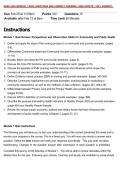
Due Feb 29 at 11:59pm Points 100 Questions 15
Available after Feb 13 at 8am Time Limit 20 Minutes
Instructions
Module 1 Quiz Review: Perspectives and Observation Skills for Community and Public Health
1. Define and apply the steps of the nursing process to a community and provide examples, (pages
5-8).
2. Differentiate Community-based and Community focused nursing and provide examples, (pages
11-16).
3. Broadly define and describe PH and provide examples, (page 6).
4. Discuss the Core PH functions and provide examples for each, (pages 6-10).
5. Discuss the specialty of PHN (nursing and PH sciences) and influences which impact the
provision of care and provide examples, (pages 10-11).
6. Define Evidence based practice (EBP) in nursing and provide examples, (pages 343-352).
7. Describe Community Assessment and provide examples, including steps in conducting a
community assessment, as well as the methods of data collection, (pages 401, 408-419).
8. Differentiate between Primary Care and the Primary Health care system and provide examples,
(pages 53-54).
9. Discuss WHO’s definition of community and provide examples, (page 398).
0. Describe the purpose and leading health Indicators of Healthy People 2020 and provide examples
(page 404) and Healthy People Website.
1. Review the various social, economic, political and military forces that have influenced the
development of public health nursing, (Chapter 2, pages 23- 27.)
Module 1 Quiz Instructions
The following quiz will allow you to test your understanding of the content presented this week and to
monitor your progress in the course. This is a timed quiz. You will have one minute to answer each
question. Select the best answer and mark your response accordingly. This quiz does not allow
backtracking. Changes to the question answer after submission of each question is prohibited.
Complete this quiz by 23:59 Saturday of Module 1. You will be able to review rationales within the
allotted time for the quiz. Following quiz closure, Coaches and faculty are available by email should
, students have specific questions from the quiz. Note: it is considered academic dishonesty to
capture screen shots using any method.
By submitting this quiz, "I certify these responses are entirely my own work. I have not copied the
work of any other student (past or present) or collaborated with anyone on this quiz. In addition, I will
not share the questions or answers from this quiz with other students. I understand that academic
dishonesty is grounds for dismissal from the program.
You have a time limit of 20 minutes.
Attempt History
Attempt Time Score
LATEST Attempt 1 5 minutes 97.78 out of 100
! Correct answers are hidden.
Score for this quiz: 97.78 out of 100
Submitted Feb 28 at 8:51pm
This attempt took 5 minutes.
Question 1 6..67 pts
The World Health Organization has defined a community as: (Select
all that apply)
a. a group of people with the same annual per capita income
b. a group of people with the same community health issues
c. a group of people often living in a defined geographical area, who
may share a common culture, values, and norms
Due Feb 29 at 11:59pm Points 100 Questions 15
Available after Feb 13 at 8am Time Limit 20 Minutes
Instructions
Module 1 Quiz Review: Perspectives and Observation Skills for Community and Public Health
1. Define and apply the steps of the nursing process to a community and provide examples, (pages
5-8).
2. Differentiate Community-based and Community focused nursing and provide examples, (pages
11-16).
3. Broadly define and describe PH and provide examples, (page 6).
4. Discuss the Core PH functions and provide examples for each, (pages 6-10).
5. Discuss the specialty of PHN (nursing and PH sciences) and influences which impact the
provision of care and provide examples, (pages 10-11).
6. Define Evidence based practice (EBP) in nursing and provide examples, (pages 343-352).
7. Describe Community Assessment and provide examples, including steps in conducting a
community assessment, as well as the methods of data collection, (pages 401, 408-419).
8. Differentiate between Primary Care and the Primary Health care system and provide examples,
(pages 53-54).
9. Discuss WHO’s definition of community and provide examples, (page 398).
0. Describe the purpose and leading health Indicators of Healthy People 2020 and provide examples
(page 404) and Healthy People Website.
1. Review the various social, economic, political and military forces that have influenced the
development of public health nursing, (Chapter 2, pages 23- 27.)
Module 1 Quiz Instructions
The following quiz will allow you to test your understanding of the content presented this week and to
monitor your progress in the course. This is a timed quiz. You will have one minute to answer each
question. Select the best answer and mark your response accordingly. This quiz does not allow
backtracking. Changes to the question answer after submission of each question is prohibited.
Complete this quiz by 23:59 Saturday of Module 1. You will be able to review rationales within the
allotted time for the quiz. Following quiz closure, Coaches and faculty are available by email should
, students have specific questions from the quiz. Note: it is considered academic dishonesty to
capture screen shots using any method.
By submitting this quiz, "I certify these responses are entirely my own work. I have not copied the
work of any other student (past or present) or collaborated with anyone on this quiz. In addition, I will
not share the questions or answers from this quiz with other students. I understand that academic
dishonesty is grounds for dismissal from the program.
You have a time limit of 20 minutes.
Attempt History
Attempt Time Score
LATEST Attempt 1 5 minutes 97.78 out of 100
! Correct answers are hidden.
Score for this quiz: 97.78 out of 100
Submitted Feb 28 at 8:51pm
This attempt took 5 minutes.
Question 1 6..67 pts
The World Health Organization has defined a community as: (Select
all that apply)
a. a group of people with the same annual per capita income
b. a group of people with the same community health issues
c. a group of people often living in a defined geographical area, who
may share a common culture, values, and norms


