

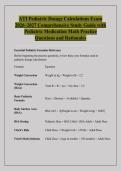
ATI Pediatric Dosage Calculations Exam
2026–2027 Comprehensive Study Guide with
Pediatric Medication Math Practice
Questions and Rationales
Essential Pediatric Formulas Reference
Before beginning the practice questions, review these core formulas used in
pediatric dosage calculations:
Formula Equation
Weight Conversion Weight in kg = Weight in lb ÷ 2.2
Weight Conversion
Total lb = lb + (oz ÷ 16); then ÷ 2.2
(lb/oz)
Basic Pediatric
Dose = (Desired ÷ Available) × Quantity
Formula
Body Surface Area
BSA (m²) = √[(Height in cm × Weight in kg) ÷ 3600]
(BSA)
BSA Dosing Pediatric Dose = BSA Child ÷ BSA Adult × Adult Dose
Clark's Rule Child Dose = (Weight in lb ÷ 150 lb) × Adult Dose
Fried's Rule (Infants) Child Dose = (Age in months ÷ 150 months) × Adult Dose
,Formula Equation
IV Fluid 100 mL/kg for first 10 kg + 50 mL/kg for next 10 kg + 20 mL/kg for each additional kg
Maintenance
Safe Dose Range Compare ordered dose to recommended range in mg/kg/day
Rounding Rules for Pediatric Calculations:
• If answer is < 1, round to the nearest hundredth (e.g., 0.547 → 0.55)
• If answer is ≥ 1, round to the nearest tenth (e.g., 1.34 → 1.3)
• Weight: Always convert to kg, round to nearest hundredth (two decimal
places)
• Doses: Round according to standard rules above
• IV rates: Round to nearest tenth (e.g., 12.34 mL/hr → 12.3 mL/hr)
Important Pediatric Safety Reminders
High-Alert Medications in Pediatrics: Always double-check calculations for:
• Heparin, Insulin, Morphine, Digoxin
• IV medications requiring reconstitution
• Any medication with a narrow therapeutic range
The "Rule of 3" Safety Check:
1. Is the ordered dose within the safe recommended range?
2. Does the dose make sense for the child's weight?
3. Was the calculation verified by a second nurse?
,Question 1
A pediatric provider orders amoxicillin 20 mg/kg/day PO divided every 8 hours for
a child weighing 33 lb. What is the dose per administration?
A. 75 mg
B. 100 mg
C. 125 mg
D. 150 mg
Rationale: Step 1: Convert weight: 33 lb ÷ 2.2 = 15 kg. Step 2: Total daily dose =
20 mg/kg × 15 kg = 300 mg/day. Step 3: Divide by 3 doses (every 8 hours): 300 ÷
3 = 100 mg per dose. Always convert pounds to kilograms first in pediatric
calculations.
Question 2
A provider orders cefdinir 14 mg/kg/day PO divided in 2 equal doses for a child
weighing 22 lb. What is the dose per administration?
A. 70 mg
B. 140 mg
C. 210 mg
D. 280 mg
Rationale: Weight: 22 lb ÷ 2.2 = 10 kg. Total daily dose = 14 mg/kg × 10 kg =
140 mg/day. Divide by 2 doses = 70 mg per dose.
Question 3
A provider orders gentamicin 6 mg/kg/day IV divided every 8 hours for a pediatric
patient weighing 8 kg. What is the dose per administration?
A. 8 mg
B. 12 mg
C. 16 mg
D. 24 mg
, Rationale: Total daily dose = 6 mg/kg × 8 kg = 48 mg/day. Divide by 3 doses
(every 8 hours): 48 ÷ 3 = 16 mg per dose. Gentamicin requires careful monitoring
of peak and trough levels.
Question 4
A provider orders ondansetron 0.15 mg/kg IV for a child weighing 15 kg.
Available is 2 mg/mL. How many mL should the nurse administer?
A. 0.75 mL
B. 1.13 mL
C. 1.5 mL
D. 2.25 mL
Rationale: Step 1: Dose = 0.15 mg/kg × 15 kg = 2.25 mg. Step 2: Volume = 2.25
mg ÷ 2 mg/mL = 1.125 mL. Round to nearest hundredth (< 1): 1.13 mL.
Question 5
A provider orders furosemide 1 mg/kg IV for a child weighing 22 lb. Available is
10 mg/mL. How many mL should the nurse administer?
A. 1 mL
B. 2 mL
C. 3 mL
D. 4 mL
Rationale: Weight: 22 lb ÷ 2.2 = 10 kg. Dose = 1 mg/kg × 10 kg = 10 mg. Volume
= 10 mg ÷ 10 mg/mL = 1 mL. Furosemide is a high-alert medication requiring
verification.
Question 6
A provider orders acetaminophen 15 mg/kg/dose PO every 6 hours for a child
weighing 44 lb. Available is 160 mg/5 mL. How many mL should the nurse
administer per dose?
2026–2027 Comprehensive Study Guide with
Pediatric Medication Math Practice
Questions and Rationales
Essential Pediatric Formulas Reference
Before beginning the practice questions, review these core formulas used in
pediatric dosage calculations:
Formula Equation
Weight Conversion Weight in kg = Weight in lb ÷ 2.2
Weight Conversion
Total lb = lb + (oz ÷ 16); then ÷ 2.2
(lb/oz)
Basic Pediatric
Dose = (Desired ÷ Available) × Quantity
Formula
Body Surface Area
BSA (m²) = √[(Height in cm × Weight in kg) ÷ 3600]
(BSA)
BSA Dosing Pediatric Dose = BSA Child ÷ BSA Adult × Adult Dose
Clark's Rule Child Dose = (Weight in lb ÷ 150 lb) × Adult Dose
Fried's Rule (Infants) Child Dose = (Age in months ÷ 150 months) × Adult Dose
,Formula Equation
IV Fluid 100 mL/kg for first 10 kg + 50 mL/kg for next 10 kg + 20 mL/kg for each additional kg
Maintenance
Safe Dose Range Compare ordered dose to recommended range in mg/kg/day
Rounding Rules for Pediatric Calculations:
• If answer is < 1, round to the nearest hundredth (e.g., 0.547 → 0.55)
• If answer is ≥ 1, round to the nearest tenth (e.g., 1.34 → 1.3)
• Weight: Always convert to kg, round to nearest hundredth (two decimal
places)
• Doses: Round according to standard rules above
• IV rates: Round to nearest tenth (e.g., 12.34 mL/hr → 12.3 mL/hr)
Important Pediatric Safety Reminders
High-Alert Medications in Pediatrics: Always double-check calculations for:
• Heparin, Insulin, Morphine, Digoxin
• IV medications requiring reconstitution
• Any medication with a narrow therapeutic range
The "Rule of 3" Safety Check:
1. Is the ordered dose within the safe recommended range?
2. Does the dose make sense for the child's weight?
3. Was the calculation verified by a second nurse?
,Question 1
A pediatric provider orders amoxicillin 20 mg/kg/day PO divided every 8 hours for
a child weighing 33 lb. What is the dose per administration?
A. 75 mg
B. 100 mg
C. 125 mg
D. 150 mg
Rationale: Step 1: Convert weight: 33 lb ÷ 2.2 = 15 kg. Step 2: Total daily dose =
20 mg/kg × 15 kg = 300 mg/day. Step 3: Divide by 3 doses (every 8 hours): 300 ÷
3 = 100 mg per dose. Always convert pounds to kilograms first in pediatric
calculations.
Question 2
A provider orders cefdinir 14 mg/kg/day PO divided in 2 equal doses for a child
weighing 22 lb. What is the dose per administration?
A. 70 mg
B. 140 mg
C. 210 mg
D. 280 mg
Rationale: Weight: 22 lb ÷ 2.2 = 10 kg. Total daily dose = 14 mg/kg × 10 kg =
140 mg/day. Divide by 2 doses = 70 mg per dose.
Question 3
A provider orders gentamicin 6 mg/kg/day IV divided every 8 hours for a pediatric
patient weighing 8 kg. What is the dose per administration?
A. 8 mg
B. 12 mg
C. 16 mg
D. 24 mg
, Rationale: Total daily dose = 6 mg/kg × 8 kg = 48 mg/day. Divide by 3 doses
(every 8 hours): 48 ÷ 3 = 16 mg per dose. Gentamicin requires careful monitoring
of peak and trough levels.
Question 4
A provider orders ondansetron 0.15 mg/kg IV for a child weighing 15 kg.
Available is 2 mg/mL. How many mL should the nurse administer?
A. 0.75 mL
B. 1.13 mL
C. 1.5 mL
D. 2.25 mL
Rationale: Step 1: Dose = 0.15 mg/kg × 15 kg = 2.25 mg. Step 2: Volume = 2.25
mg ÷ 2 mg/mL = 1.125 mL. Round to nearest hundredth (< 1): 1.13 mL.
Question 5
A provider orders furosemide 1 mg/kg IV for a child weighing 22 lb. Available is
10 mg/mL. How many mL should the nurse administer?
A. 1 mL
B. 2 mL
C. 3 mL
D. 4 mL
Rationale: Weight: 22 lb ÷ 2.2 = 10 kg. Dose = 1 mg/kg × 10 kg = 10 mg. Volume
= 10 mg ÷ 10 mg/mL = 1 mL. Furosemide is a high-alert medication requiring
verification.
Question 6
A provider orders acetaminophen 15 mg/kg/dose PO every 6 hours for a child
weighing 44 lb. Available is 160 mg/5 mL. How many mL should the nurse
administer per dose?


