

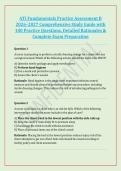
ATI Fundamentals Practice Assessment B
2026–2027 Comprehensive Study Guide with
100 Practice Questions, Detailed Rationales &
Complete Exam Preparation
Question 1
A nurse is preparing to perform a sterile dressing change for a client who has
a surgical wound. Which of the following actions should the nurse take FIRST?
A) Open the sterile package and apply sterile gloves
B) Perform hand hygiene
C) Don a mask and protective eyewear
D) Assess the client's wound
Rationale: Hand hygiene is the single most important infection control
measure and should always be performed before any procedure, including
sterile dressing changes. This reduces the risk of introducing pathogens to the
wound.
Question 2
A nurse is caring for a client who is at risk for falls. Which of the following
interventions should the nurse include in the plan of care?
A) Place the client's bed in the lowest position with the side rails up
B) Keep the client's room dimly lit to promote sleep
C) Encourage the client to walk without assistance
D) Place all personal items out of the client's reach
Rationale: Placing the bed in the lowest position reduces injury risk if the
client attempts to get out of bed. Side rails should be raised according to
facility policy and client assessment.
,Question 3
A nurse is assessing a client's vital signs. Which of the following findings
should the nurse report to the provider?
A) Temperature 36.8°C (98.2°F)
B) Apical pulse 88/min
C) Respiratory rate 28/min
D) Blood pressure 118/76 mm Hg
Rationale: Normal respiratory rate for an adult is 12–20 breaths/min. A rate
of 28/min is tachypneic and may indicate respiratory distress, infection, or
other underlying conditions requiring further evaluation.
Question 4
A nurse is calculating a client's intake and output. The client consumed 240
mL of water, 120 mL of milk, and 180 mL of juice. The client also received 500
mL of IV fluids. What is the client's total intake?
A) 540 mL
B) 740 mL
C) 1,040 mL
D) 1,540 mL
Rationale: Total intake includes both oral and IV fluids. Oral intake: 240 +
120 + 180 = 540 mL. IV intake: 500 mL. Total: 540 + 500 = 1,040 mL.
Question 5
A nurse is preparing to administer a medication via a nasogastric tube. Which
of the following actions should the nurse take FIRST?
A) Flush the tube with 30 mL of water
B) Verify the tube placement by checking the pH of the aspirate
C) Crush all medications before administration
D) Administer the medication using a syringe with a plunger
,Rationale: Verification of NG tube placement is essential before
administering any medication or feeding to prevent aspiration. Checking the
pH of gastric aspirate (typically ≤ 5) confirms gastric placement.
Question 6
A nurse is providing oral care for a client who is unconscious. Which of the
following actions should the nurse take?
A) Position the client on their side with the head turned to the side
B) Place the client in a supine position
C) Use firm pressure when brushing the teeth
D) Apply petroleum jelly to the client's lips after care
Rationale: Positioning the unconscious client on their side with the head
turned prevents aspiration of fluids or secretions during oral care. This is a
critical safety measure.
Question 7
A nurse is caring for a client who has a prescription for a 24-hour urine
collection. Which of the following actions should the nurse take?
A) Discard the first voiding and begin the collection
B) Begin the collection with the first voiding and save all urine
C) Collect the urine in a standard bedpan
D) Keep the collected urine at room temperature
Rationale: For a 24-hour urine collection, the client should void completely,
discard that first specimen, and then collect all subsequent urine for 24 hours.
The collection should be kept refrigerated or on ice.
Question 8
A nurse is assessing a client who is 2 days postoperative. Which of the
following findings should the nurse report to the provider?
, A) Wound edges approximated
B) Purulent drainage from the incision site
C) Serosanguineous drainage on the dressing
D) Mild erythema around the incision
Rationale: Purulent drainage indicates infection and requires immediate
reporting to the provider. Serosanguineous drainage and mild erythema are
expected findings in the early postoperative period.
Question 9
A nurse is preparing to transfer a client from the bed to a wheelchair. Which of
the following actions should the nurse take?
A) Lock the wheels of the wheelchair before the transfer
B) Position the wheelchair at a 90-degree angle to the bed
C) Transfer the client without using a gait belt
D) Have the client stand with their feet together
Rationale: Locking the wheelchair wheels prevents movement during
transfer and ensures client safety. The wheelchair should be positioned at a
45-degree angle to the bed.
Question 10
A nurse is administering an intramuscular injection to a client. Which of the
following actions should the nurse take?
A) Use the Z-track technique for injections that are irritating to tissues
B) Aspirate for blood return before all IM injections
C) Massage the site vigorously after injection
D) Use the deltoid muscle for all IM injections
Rationale: The Z-track technique is recommended for irritating medications
to prevent tracking of the medication into subcutaneous tissues and reduce
pain. Aspiration is no longer recommended for most IM injections.
2026–2027 Comprehensive Study Guide with
100 Practice Questions, Detailed Rationales &
Complete Exam Preparation
Question 1
A nurse is preparing to perform a sterile dressing change for a client who has
a surgical wound. Which of the following actions should the nurse take FIRST?
A) Open the sterile package and apply sterile gloves
B) Perform hand hygiene
C) Don a mask and protective eyewear
D) Assess the client's wound
Rationale: Hand hygiene is the single most important infection control
measure and should always be performed before any procedure, including
sterile dressing changes. This reduces the risk of introducing pathogens to the
wound.
Question 2
A nurse is caring for a client who is at risk for falls. Which of the following
interventions should the nurse include in the plan of care?
A) Place the client's bed in the lowest position with the side rails up
B) Keep the client's room dimly lit to promote sleep
C) Encourage the client to walk without assistance
D) Place all personal items out of the client's reach
Rationale: Placing the bed in the lowest position reduces injury risk if the
client attempts to get out of bed. Side rails should be raised according to
facility policy and client assessment.
,Question 3
A nurse is assessing a client's vital signs. Which of the following findings
should the nurse report to the provider?
A) Temperature 36.8°C (98.2°F)
B) Apical pulse 88/min
C) Respiratory rate 28/min
D) Blood pressure 118/76 mm Hg
Rationale: Normal respiratory rate for an adult is 12–20 breaths/min. A rate
of 28/min is tachypneic and may indicate respiratory distress, infection, or
other underlying conditions requiring further evaluation.
Question 4
A nurse is calculating a client's intake and output. The client consumed 240
mL of water, 120 mL of milk, and 180 mL of juice. The client also received 500
mL of IV fluids. What is the client's total intake?
A) 540 mL
B) 740 mL
C) 1,040 mL
D) 1,540 mL
Rationale: Total intake includes both oral and IV fluids. Oral intake: 240 +
120 + 180 = 540 mL. IV intake: 500 mL. Total: 540 + 500 = 1,040 mL.
Question 5
A nurse is preparing to administer a medication via a nasogastric tube. Which
of the following actions should the nurse take FIRST?
A) Flush the tube with 30 mL of water
B) Verify the tube placement by checking the pH of the aspirate
C) Crush all medications before administration
D) Administer the medication using a syringe with a plunger
,Rationale: Verification of NG tube placement is essential before
administering any medication or feeding to prevent aspiration. Checking the
pH of gastric aspirate (typically ≤ 5) confirms gastric placement.
Question 6
A nurse is providing oral care for a client who is unconscious. Which of the
following actions should the nurse take?
A) Position the client on their side with the head turned to the side
B) Place the client in a supine position
C) Use firm pressure when brushing the teeth
D) Apply petroleum jelly to the client's lips after care
Rationale: Positioning the unconscious client on their side with the head
turned prevents aspiration of fluids or secretions during oral care. This is a
critical safety measure.
Question 7
A nurse is caring for a client who has a prescription for a 24-hour urine
collection. Which of the following actions should the nurse take?
A) Discard the first voiding and begin the collection
B) Begin the collection with the first voiding and save all urine
C) Collect the urine in a standard bedpan
D) Keep the collected urine at room temperature
Rationale: For a 24-hour urine collection, the client should void completely,
discard that first specimen, and then collect all subsequent urine for 24 hours.
The collection should be kept refrigerated or on ice.
Question 8
A nurse is assessing a client who is 2 days postoperative. Which of the
following findings should the nurse report to the provider?
, A) Wound edges approximated
B) Purulent drainage from the incision site
C) Serosanguineous drainage on the dressing
D) Mild erythema around the incision
Rationale: Purulent drainage indicates infection and requires immediate
reporting to the provider. Serosanguineous drainage and mild erythema are
expected findings in the early postoperative period.
Question 9
A nurse is preparing to transfer a client from the bed to a wheelchair. Which of
the following actions should the nurse take?
A) Lock the wheels of the wheelchair before the transfer
B) Position the wheelchair at a 90-degree angle to the bed
C) Transfer the client without using a gait belt
D) Have the client stand with their feet together
Rationale: Locking the wheelchair wheels prevents movement during
transfer and ensures client safety. The wheelchair should be positioned at a
45-degree angle to the bed.
Question 10
A nurse is administering an intramuscular injection to a client. Which of the
following actions should the nurse take?
A) Use the Z-track technique for injections that are irritating to tissues
B) Aspirate for blood return before all IM injections
C) Massage the site vigorously after injection
D) Use the deltoid muscle for all IM injections
Rationale: The Z-track technique is recommended for irritating medications
to prevent tracking of the medication into subcutaneous tissues and reduce
pain. Aspiration is no longer recommended for most IM injections.


