

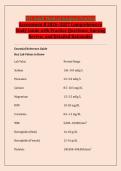
ATI Adult Medical Surgical Practice
Assessment B 2026–2027 Comprehensive
Study Guide with Practice Questions, Nursing
Review, and Detailed Rationales
Essential Reference Guide
Key Lab Values to Know
Lab Value Normal Range
Sodium 136–145 mEq/L
Potassium 3.5–5.0 mEq/L
Calcium 8.5–10.5 mg/dL
Magnesium 1.5–2.5 mEq/L
BUN 10–20 mg/dL
Creatinine 0.6–1.2 mg/dL
WBC 5,000–10,000/mm³
Hemoglobin (Male) 14–18 g/dL
Hemoglobin (Female) 12–16 g/dL
Platelets 150,000–400,000/mm³
,Lab Value Normal Range
INR 0.8–1.1 (therapeutic 2–3)
aPTT 25–35 sec (therapeutic 60–80)
Priority Frameworks
Framework Application
ABCs Airway, Breathing, Circulation — always assess first
Maslow's
Physiological needs before safety, love, esteem
Hierarchy
Nursing Process Assessment → Diagnosis → Planning → Implementation → Evaluation
Safety & Infection
First priority in any clinical scenario
Control
Question 1
A nurse is caring for a client with heart failure who reports sudden onset of
dyspnea and coughing up pink, frothy sputum. Which of the following actions
should the nurse take first?
A. Administer oxygen via non-rebreather mask
B. Place the client in high-Fowler's position
C. Administer furosemide IV push
D. Notify the provider
Rationale: The client is exhibiting signs of acute pulmonary edema, a life-
threatening complication of heart failure. While oxygen and positioning are
,important, the priority intervention is to reduce preload with a loop diuretic
like furosemide. The nurse should place the client in high-Fowler's position
simultaneously to facilitate breathing. Remember the ABC framework—
airway and breathing are compromised, but the underlying cause is fluid
overload requiring immediate pharmacological intervention.
Question 2
A nurse is assessing a client who has peripheral arterial disease (PAD). Which
of the following findings should the nurse expect?
A. Diminished or absent peripheral pulses
B. Brownish discoloration of the lower extremities
C. Bilateral lower extremity edema
D. Warm, erythematous skin
Rationale: PAD is characterized by narrowed peripheral arteries, leading to
decreased blood flow to the extremities. Diminished or absent pulses, cool
skin, hair loss on the extremities, and pale or cyanotic skin are classic findings.
Brownish discoloration and edema are more consistent with venous
insufficiency. Warm, erythematous skin suggests inflammation or infection.
Question 3
A nurse is providing discharge teaching to a client who has hypertension.
Which of the following statements by the client indicates an understanding of
the teaching?
A. "I will check my blood pressure only when I feel dizzy."
B. "I will take my medication at the same time every day."
C. "I can stop my medication when my blood pressure is normal."
D. "I will limit my sodium intake to 5 grams per day."
Rationale: Consistent adherence to antihypertensive medication is crucial for
blood pressure control. Taking medication at the same time daily helps
maintain therapeutic levels. Clients should monitor blood pressure regularly,
not just when symptomatic. Antihypertensives must be taken consistently, not
, stopped when readings are normal. Sodium should be limited to less than 2
grams (2,000 mg) per day.
Question 4
A nurse is caring for a client who has unstable angina. Which of the following
medications should the nurse anticipate administering?
A. Warfarin
B. Nitroglycerin sublingual
C. Digoxin
D. Amiodarone
Rationale: Nitroglycerin sublingual is the first-line treatment for acute angina
episodes. It causes vasodilation, reducing preload and afterload, which
decreases myocardial oxygen demand. Warfarin is an anticoagulant used for
atrial fibrillation or DVT prophylaxis. Digoxin is used for heart failure and
atrial fibrillation. Amiodarone is an antiarrhythmic.
Question 5
A nurse is assessing a client who is 1 day post-cardiac catheterization via the
femoral artery. Which of the following findings should the nurse report to the
provider?
A. Large, expanding hematoma at the insertion site
B. Pain rated 2 on a 0–10 scale at the insertion site
C. Pedal pulses +2 bilaterally
D. Urine output of 40 mL/hr
Rationale: A large, expanding hematoma at the insertion site indicates active
bleeding or hematoma formation, a serious complication of cardiac
catheterization. This requires immediate provider notification. Mild pain at
the insertion site is expected. Pedal pulses +2 bilaterally indicate adequate
perfusion. Urine output of 40 mL/hr is within normal range (≥30 mL/hr).
Question 6
Assessment B 2026–2027 Comprehensive
Study Guide with Practice Questions, Nursing
Review, and Detailed Rationales
Essential Reference Guide
Key Lab Values to Know
Lab Value Normal Range
Sodium 136–145 mEq/L
Potassium 3.5–5.0 mEq/L
Calcium 8.5–10.5 mg/dL
Magnesium 1.5–2.5 mEq/L
BUN 10–20 mg/dL
Creatinine 0.6–1.2 mg/dL
WBC 5,000–10,000/mm³
Hemoglobin (Male) 14–18 g/dL
Hemoglobin (Female) 12–16 g/dL
Platelets 150,000–400,000/mm³
,Lab Value Normal Range
INR 0.8–1.1 (therapeutic 2–3)
aPTT 25–35 sec (therapeutic 60–80)
Priority Frameworks
Framework Application
ABCs Airway, Breathing, Circulation — always assess first
Maslow's
Physiological needs before safety, love, esteem
Hierarchy
Nursing Process Assessment → Diagnosis → Planning → Implementation → Evaluation
Safety & Infection
First priority in any clinical scenario
Control
Question 1
A nurse is caring for a client with heart failure who reports sudden onset of
dyspnea and coughing up pink, frothy sputum. Which of the following actions
should the nurse take first?
A. Administer oxygen via non-rebreather mask
B. Place the client in high-Fowler's position
C. Administer furosemide IV push
D. Notify the provider
Rationale: The client is exhibiting signs of acute pulmonary edema, a life-
threatening complication of heart failure. While oxygen and positioning are
,important, the priority intervention is to reduce preload with a loop diuretic
like furosemide. The nurse should place the client in high-Fowler's position
simultaneously to facilitate breathing. Remember the ABC framework—
airway and breathing are compromised, but the underlying cause is fluid
overload requiring immediate pharmacological intervention.
Question 2
A nurse is assessing a client who has peripheral arterial disease (PAD). Which
of the following findings should the nurse expect?
A. Diminished or absent peripheral pulses
B. Brownish discoloration of the lower extremities
C. Bilateral lower extremity edema
D. Warm, erythematous skin
Rationale: PAD is characterized by narrowed peripheral arteries, leading to
decreased blood flow to the extremities. Diminished or absent pulses, cool
skin, hair loss on the extremities, and pale or cyanotic skin are classic findings.
Brownish discoloration and edema are more consistent with venous
insufficiency. Warm, erythematous skin suggests inflammation or infection.
Question 3
A nurse is providing discharge teaching to a client who has hypertension.
Which of the following statements by the client indicates an understanding of
the teaching?
A. "I will check my blood pressure only when I feel dizzy."
B. "I will take my medication at the same time every day."
C. "I can stop my medication when my blood pressure is normal."
D. "I will limit my sodium intake to 5 grams per day."
Rationale: Consistent adherence to antihypertensive medication is crucial for
blood pressure control. Taking medication at the same time daily helps
maintain therapeutic levels. Clients should monitor blood pressure regularly,
not just when symptomatic. Antihypertensives must be taken consistently, not
, stopped when readings are normal. Sodium should be limited to less than 2
grams (2,000 mg) per day.
Question 4
A nurse is caring for a client who has unstable angina. Which of the following
medications should the nurse anticipate administering?
A. Warfarin
B. Nitroglycerin sublingual
C. Digoxin
D. Amiodarone
Rationale: Nitroglycerin sublingual is the first-line treatment for acute angina
episodes. It causes vasodilation, reducing preload and afterload, which
decreases myocardial oxygen demand. Warfarin is an anticoagulant used for
atrial fibrillation or DVT prophylaxis. Digoxin is used for heart failure and
atrial fibrillation. Amiodarone is an antiarrhythmic.
Question 5
A nurse is assessing a client who is 1 day post-cardiac catheterization via the
femoral artery. Which of the following findings should the nurse report to the
provider?
A. Large, expanding hematoma at the insertion site
B. Pain rated 2 on a 0–10 scale at the insertion site
C. Pedal pulses +2 bilaterally
D. Urine output of 40 mL/hr
Rationale: A large, expanding hematoma at the insertion site indicates active
bleeding or hematoma formation, a serious complication of cardiac
catheterization. This requires immediate provider notification. Mild pain at
the insertion site is expected. Pedal pulses +2 bilaterally indicate adequate
perfusion. Urine output of 40 mL/hr is within normal range (≥30 mL/hr).
Question 6


