

Millwright - 2nd Year: Non-Destructive testing
Exam Questions and Answers with Verified
Solutions | Latest Updated 2026
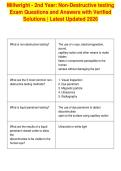
What is non-destructive testing? The use of x-rays, electromagnetism,
sound,
capillary action and other means to make
hidden
flaws in components perceptible to the
human
senses without damaging the part
What are the 5 most common non- 1. Visual Inspection
destructive testing methods? 2. Dye penetrant
3. Magnetic particle
4. Ultrasonics
5. Radiography
What is liquid penetrant testing? The use of dye penetrant to detect
discontinuities
open to the surface using capillary action
What are the results of a liquid Ultraviolet or white light
penetrant viewed under to allow
the
discontinuities to be visible to the
human eye?
,What are the advantages of liquid 1. Used on a wide variety of materials
penetrant testing? 2. Portable
3. Can be applied on small or large
surfaces
4. Simple and inexpensive
5. Arrangement of discontinuity is not a
factor
What are some of the limitations of 1. Can only detect flaws open to the
liquid dye penetrant testing? surface
2. Extreme roughness or porous surfaces
are likely
to produce false indications
3. Temperature sensitive
When liquid penetrant testing, the 25mm (1 inch)
surface must be free of oil, water
or
other contaminants for at least
___________________ beyond
the inspection
area.
What are the 3 general 1. Water-washable
classifications 2. Post-emulsifiable
of liquid penetrant systems? 3. Solvent-removable
What is a water-washable liquid A penetrant dye that rinses of with water
penetrant? without
the use of other solvents or chemicals
, What is the post-emulsifiable liquid Penetrants that require the application of
penetrant system? an
emulsifier in order to make the penetrant
soluble in
water, so that they may be rinsed off.
What must be carefully controlled The emulsification time
so
that the surface penetrant
becomes
water-soluble, but the penetrant in
the flaws does not?
What is a solvent-removable A penetrant that can be removed with a
penetrant system? solvent
instead of water
What are the two types of liquid 1. Fluorescent
penetrant? 2. Visible
What are the 3 sensitivities of 1. Regular or normal
fluorescent penetrant? 2. High
3. Ultrahigh
How does visible penetrant usually A vivid red penetrant that produces
work? indications in
contrast with the light background of the
applied
developer under visible light
Exam Questions and Answers with Verified
Solutions | Latest Updated 2026
What is non-destructive testing? The use of x-rays, electromagnetism,
sound,
capillary action and other means to make
hidden
flaws in components perceptible to the
human
senses without damaging the part
What are the 5 most common non- 1. Visual Inspection
destructive testing methods? 2. Dye penetrant
3. Magnetic particle
4. Ultrasonics
5. Radiography
What is liquid penetrant testing? The use of dye penetrant to detect
discontinuities
open to the surface using capillary action
What are the results of a liquid Ultraviolet or white light
penetrant viewed under to allow
the
discontinuities to be visible to the
human eye?
,What are the advantages of liquid 1. Used on a wide variety of materials
penetrant testing? 2. Portable
3. Can be applied on small or large
surfaces
4. Simple and inexpensive
5. Arrangement of discontinuity is not a
factor
What are some of the limitations of 1. Can only detect flaws open to the
liquid dye penetrant testing? surface
2. Extreme roughness or porous surfaces
are likely
to produce false indications
3. Temperature sensitive
When liquid penetrant testing, the 25mm (1 inch)
surface must be free of oil, water
or
other contaminants for at least
___________________ beyond
the inspection
area.
What are the 3 general 1. Water-washable
classifications 2. Post-emulsifiable
of liquid penetrant systems? 3. Solvent-removable
What is a water-washable liquid A penetrant dye that rinses of with water
penetrant? without
the use of other solvents or chemicals
, What is the post-emulsifiable liquid Penetrants that require the application of
penetrant system? an
emulsifier in order to make the penetrant
soluble in
water, so that they may be rinsed off.
What must be carefully controlled The emulsification time
so
that the surface penetrant
becomes
water-soluble, but the penetrant in
the flaws does not?
What is a solvent-removable A penetrant that can be removed with a
penetrant system? solvent
instead of water
What are the two types of liquid 1. Fluorescent
penetrant? 2. Visible
What are the 3 sensitivities of 1. Regular or normal
fluorescent penetrant? 2. High
3. Ultrahigh
How does visible penetrant usually A vivid red penetrant that produces
work? indications in
contrast with the light background of the
applied
developer under visible light


