

MGT 103 - Chapters 21-22 Exam Questions
and Answers with Verified Solutions | Latest
Updated 2026
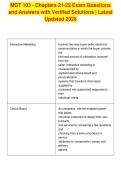
Interactive Marketing Involves two-way buyer-seller electronic
communication in which the buyer controls
the
kind and amount of information received
from the
seller. Interactive marketing is
characterized by
sophisticated choice-board and
personalization
systems that transform information
supplied by
customers into customized responses to
their
individual needs.
Choice Board An interactive, internet-enabled system
that allows
individual customers to design their own
products
and services by answering a few questions
and
choosing from a menu of product or
service
attributes (or components), prices, and
delivery
options.
,Collaborative Filtering A process that automatically groups
people with
similar buying intentions, preferences, and
behaviors and predicts future purchases.
Personalization Is the consumer-initiated practice of
generating
content on a marketer's website that is
custom
tailored to an individual's specific needs
and
preferences.
Permission Marketing The solicitation of a consumer's consent
(called
opt-in) to receive e-mail and advertising
based on
personal data supplied by the consumer.
Permission marketing is a proven vehicle
for
building and maintaining customer
relationships,
provided it is properly used.
Seven Website Design Elements 1. Context
2. Content
3. Community
4. Customization
5. Communication
6. Connection
7. Commerce
, Context Refers to a website's aesthetic appeal and
the
functional look and feel of the site's layout
and
visual design. A functionally oriented
website
focuses largely on the company's offering,
be it
products, services, or information.
Content Applies to all digital information on a
website,
including the presentation form-text, video,
audio,
and graphics. Content quality and
presentation
along with context dimensions combine to
engage
a website visitor and provide a platform for
the five
remaining design elements.
Website Customization The ability of a site to modify itself to, or be
modified by and for, each individual user.
and Answers with Verified Solutions | Latest
Updated 2026
Interactive Marketing Involves two-way buyer-seller electronic
communication in which the buyer controls
the
kind and amount of information received
from the
seller. Interactive marketing is
characterized by
sophisticated choice-board and
personalization
systems that transform information
supplied by
customers into customized responses to
their
individual needs.
Choice Board An interactive, internet-enabled system
that allows
individual customers to design their own
products
and services by answering a few questions
and
choosing from a menu of product or
service
attributes (or components), prices, and
delivery
options.
,Collaborative Filtering A process that automatically groups
people with
similar buying intentions, preferences, and
behaviors and predicts future purchases.
Personalization Is the consumer-initiated practice of
generating
content on a marketer's website that is
custom
tailored to an individual's specific needs
and
preferences.
Permission Marketing The solicitation of a consumer's consent
(called
opt-in) to receive e-mail and advertising
based on
personal data supplied by the consumer.
Permission marketing is a proven vehicle
for
building and maintaining customer
relationships,
provided it is properly used.
Seven Website Design Elements 1. Context
2. Content
3. Community
4. Customization
5. Communication
6. Connection
7. Commerce
, Context Refers to a website's aesthetic appeal and
the
functional look and feel of the site's layout
and
visual design. A functionally oriented
website
focuses largely on the company's offering,
be it
products, services, or information.
Content Applies to all digital information on a
website,
including the presentation form-text, video,
audio,
and graphics. Content quality and
presentation
along with context dimensions combine to
engage
a website visitor and provide a platform for
the five
remaining design elements.
Website Customization The ability of a site to modify itself to, or be
modified by and for, each individual user.


