

MGT 103 - Chapters 13-14 Exam Questions
and Answers with Verified Solutions | Latest
Updated 2026
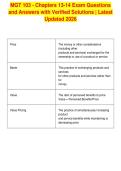
Price The money or other considerations
(including other
products and services) exchanged for the
ownership or use of a product or service
Barter This practice of exchanging products and
services
for other products and services rather than
for
money
Value The ratio of perceived benefits to price
Value = Perceived Benefits/Price
Value Pricing The practice of simultaneously increasing
product
and service benefits while maintaining or
decreasing price
, Profits Pricing is a critical decision made by a
marketing
executive because price has a direct effect
on a
firm's profits
Profit = Total revenue − Total cost= (Unit
price ×
Quantity sold) − (Fixed cost + Variable
cost)
Steps in Setting Prices 1. Identify pricing objectives and
constraints
2. Estimate demand and revenue
3. Determine cost, volume, and profit
relationships
4. Select an approximate price level
5. Set list or quoted price
6. Make special adjustments to list or
quoted price
Pricing Objectives Involve specifying the role of price in an
organization's marketing and strategic
plans
Market Share The ratio of the firm's sales revenues or
unit sales to
those of the industry (competitors plus the
firm
itself)
Unit Volume The quantity produced or sold, as a pricing
objective
and Answers with Verified Solutions | Latest
Updated 2026
Price The money or other considerations
(including other
products and services) exchanged for the
ownership or use of a product or service
Barter This practice of exchanging products and
services
for other products and services rather than
for
money
Value The ratio of perceived benefits to price
Value = Perceived Benefits/Price
Value Pricing The practice of simultaneously increasing
product
and service benefits while maintaining or
decreasing price
, Profits Pricing is a critical decision made by a
marketing
executive because price has a direct effect
on a
firm's profits
Profit = Total revenue − Total cost= (Unit
price ×
Quantity sold) − (Fixed cost + Variable
cost)
Steps in Setting Prices 1. Identify pricing objectives and
constraints
2. Estimate demand and revenue
3. Determine cost, volume, and profit
relationships
4. Select an approximate price level
5. Set list or quoted price
6. Make special adjustments to list or
quoted price
Pricing Objectives Involve specifying the role of price in an
organization's marketing and strategic
plans
Market Share The ratio of the firm's sales revenues or
unit sales to
those of the industry (competitors plus the
firm
itself)
Unit Volume The quantity produced or sold, as a pricing
objective


