

MGT 103 Quiz 2 Exam Questions and
Answers with Verified Solutions | Latest
Updated 2026
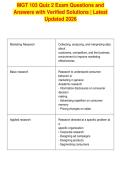
Marketing Research Collecting, analyzing, and interpreting data
about
customers, competitors, and the business
environment to improve marketing
effectiveness
Basic research Research to understand consumer
behavior or
marketing in general
Academic research
- Information disclosures on consumer
decision
making
- Advertising repetition on consumer
memory
- Pricing changes on sales
Applied research Research directed at a specific problem at
a
specific organization
• Corporate research
- Designing ad campaigns
- Designing products
- Segmenting consumers
, Marketing research Process 1. Define research problem
2. Determine research design
3. Choose the Method to collect primary
data
4. Design sample
5. Collect the Data
6. Analyze and interpret the data
7. Prepare the research report
Primary Data • Collected specifically for current purpose
• Could be internally or externally collected
• Examples: Experiments, Test Markets,
Focus
Groups, Surveys, Observations
Secondary Data • Collected for some other purpose
• External (census, Gallup poll, etc.)
• Internal (company records, sales data)
Advantages of secondary data: Time savings, Low costs
Disadvantages of secondary data: - May be out of date
- Definitions or categories might not be
what
you're looking for
- Might not be specific enough for your
project
General rule of thumb Collect secondary data first, then turn to
primary
data
Answers with Verified Solutions | Latest
Updated 2026
Marketing Research Collecting, analyzing, and interpreting data
about
customers, competitors, and the business
environment to improve marketing
effectiveness
Basic research Research to understand consumer
behavior or
marketing in general
Academic research
- Information disclosures on consumer
decision
making
- Advertising repetition on consumer
memory
- Pricing changes on sales
Applied research Research directed at a specific problem at
a
specific organization
• Corporate research
- Designing ad campaigns
- Designing products
- Segmenting consumers
, Marketing research Process 1. Define research problem
2. Determine research design
3. Choose the Method to collect primary
data
4. Design sample
5. Collect the Data
6. Analyze and interpret the data
7. Prepare the research report
Primary Data • Collected specifically for current purpose
• Could be internally or externally collected
• Examples: Experiments, Test Markets,
Focus
Groups, Surveys, Observations
Secondary Data • Collected for some other purpose
• External (census, Gallup poll, etc.)
• Internal (company records, sales data)
Advantages of secondary data: Time savings, Low costs
Disadvantages of secondary data: - May be out of date
- Definitions or categories might not be
what
you're looking for
- Might not be specific enough for your
project
General rule of thumb Collect secondary data first, then turn to
primary
data


