

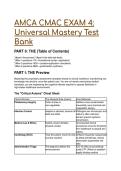
AMCA CMAC EXAM 4:
Universal Mastery Test
Bank
PART 0: THE (Table of Contents)
*(#part-i-the-preview) *(#part-ii-the-elite-test-bank)
*(#tier-1-questions-115---foundational-syntax--application)
*(#tier-2-questions-1635---complex-application--simulation)
*(#tier-3-questions-3660---grandmaster-synthesis)
PART I: THE Preview
Mastering this proprietary assessment translates directly to clinical excellence, transforming raw
knowledge into decisive, error-free patient care. You are not merely memorizing medical
standards; you are engineering the cognitive reflexes required to operate flawlessly in
high-stakes healthcare environments.
The "Critical Axioms" Cheat Sheet
Clinical Domain The Absolute Rule (Axiom) Core Rationale
Phlebotomy Integrity Order of draw is Additive cross-contamination
non-negotiable. irreversibly ruins chemical and
coagulation assays.
Infection Control Asepsis is absolute; assume all Pathogens are microscopic and
fluids are lethal. status is often unknown;
barriers prevent systemic
transmission.
Medical Law & Ethics Explicit consent dictates Unconsented clinical
physical contact. procedures cross the threshold
from healthcare to assault and
battery.
Cardiology (ECG) Treat the patient, trace the wire, Artifacts frequently masquerade
trust the machine. as lethal arrhythmias; clinical
observation supersedes raw
data.
Administrative Triage The diagnosis defines the ICD-10 (Why) must perfectly
reimbursement. justify CPT (What) to establish
legally binding medical
,Clinical Domain The Absolute Rule (Axiom) Core Rationale
necessity.
PART II: THE ELITE TEST BANK
Tier 1 (Questions 1–15) - Foundational Syntax & Application
Q1: A clinical medical assistant is preparing a patient for a routine urinalysis to verify a
suspected early-stage pregnancy. Based on the principles of endocrinology, which hormone is
the PRIMARY target of this diagnostic test? A) Luteinizing hormone B) Potassium oxalate C)
Human chorionic gonadotropin (HCG) D) Oxytocin
● The Answer: C (Human chorionic gonadotropin (HCG))
● Distractor Analysis:
○ A is incorrect: Luteinizing hormone triggers ovulation within the menstrual cycle, not
pregnancy confirmation.
○ B is incorrect: Potassium oxalate is a chemical anticoagulant used in specific blood
collection tubes, not a biological hormone.
○ D is incorrect: Oxytocin stimulates uterine contractions during labor and milk
ejection, not initial implantation.
The Mentor's Analysis: Pregnancy detection hinges on the presence of specific biological
markers secreted post-implantation by the developing placenta. When facing early pregnancy
diagnostics, the immediate priority is identifying this unique trophoblastic hormone. By utilizing
Human chorionic gonadotropin (HCG) testing, you bypass the common trap of testing for
standard menstrual cycle hormones. Professional/Academic Intuition: HCG is the definitive
biochemical signature of embryonic implantation.
Q2: A physician orders a bacteriological culture on a patient suspected of having a lower urinary
tract infection. Based on standard infection control protocols, which instruction is the MOST
APPROPRIATE for the patient to ensure a viable sample? A) Collect a 24-hour specimen in a
large plastic basin. B) Void the entire specimen directly into a sterile cup. C) Void a specimen
midstream into a sterile cup. D) Void a specimen midstream into a clean cup.
● The Answer: C (Void a specimen midstream into a sterile cup.)
● Distractor Analysis:
○ A is incorrect: 24-hour collections assess quantitative kidney function (e.g.,
creatinine clearance), not bacterial cultures.
○ B is incorrect: Voiding the entire initial specimen introduces normal dermal flora
from the distal urethra, contaminating the culture.
○ D is incorrect: A "clean" cup is not microbiologically sterile; cultures require an
absolute absence of external microbial interference to prevent false positives.
The Mentor's Analysis: Cultures require an uncontaminated sample representing the bladder's
true internal state. When facing a potential UTI, the immediate priority is flushing the distal
urethra before collection. By utilizing the midstream clean-catch method into a strictly sterile
container, you bypass the common trap of culturing normal, harmless skin flora.
Professional/Academic Intuition: Midstream flushes the pipes; sterile cups protect the
evidence.
Q3: The primary purpose for anchoring a vein during a routine venipuncture procedure is to
achieve which of the following mechanical outcomes? Based on the principles of phlebotomy,
which is the MOST ACCURATE conclusion? A) To prevent the vein from collapsing under
intense vacuum pressure. B) To keep the patient comfortable and reduce localized nerve pain.
, C) To prevent the vein from rolling away from the needle bevel. D) To prevent blood specimen
leakage into surrounding subcutaneous tissue.
● The Answer: C (To prevent the vein from rolling away from the needle bevel.)
● Distractor Analysis:
○ A is incorrect: Collapsing veins are prevented by using smaller tubes or syringes to
reduce vacuum drag, not by dermal anchoring.
○ B is incorrect: While technically necessary, anchoring does not inherently
anesthetize or significantly reduce the sharp pain of the dermal puncture.
○ D is incorrect: Subcutaneous leakage (hematoma) is prevented by applying proper,
sustained pressure post-draw, not by anchoring prior to entry.
The Mentor's Analysis: Veins, particularly in geriatric or dehydrated patients, lack surrounding
supportive connective tissue and are highly mobile under the skin. When facing a mobile target,
the immediate priority is applying downward dermal traction to lock the vessel in place. By
utilizing venous anchoring, you bypass the common trap of missing the vessel and causing a
painful, traumatic double-puncture. Professional/Academic Intuition: Anchor the skin tight, or
the vein takes flight.
Q4: A patient is undergoing an electrocardiogram (ECG). The medical assistant understands
that the heart's unique physiological ability to generate its own electrical impulses without
external neurological triggers is referred to as what? Based on cardiac electrophysiology, which
term is MOST ACCURATE? A) Contractility B) Automaticity C) Conductivity D) Excitability
● The Answer: B (Automaticity)
● Distractor Analysis:
○ A is incorrect: Contractility is the mechanical shortening of the myocardial muscle
fibers, not the electrical generation.
○ C is incorrect: Conductivity is the tissue's ability to transmit the generated impulse
to adjacent cells.
○ D is incorrect: Excitability is the cellular ability to respond to an external stimulus,
not generate one spontaneously.
The Mentor's Analysis: The sinoatrial (SA) node functions autonomously from the central
nervous system, ensuring the heart beats even if neurological pathways are severed. When
studying cardiac electrophysiology, the immediate priority is understanding the true origin of the
beat. By utilizing the concept of automaticity, you bypass the common trap of confusing the
generation of the impulse with its physical transmission. Professional/Academic Intuition:
Automaticity is the spark; conductivity is the wire.
Q5: During a review of the chain of infection, a clinical medical assistant is asked to identify the
specific pathogen responsible for initiating an infectious disease. Based on epidemiological
frameworks, this vital component is BEST classified as the: A) Reservoir B) Portal of Entry C)
Agent D) Susceptible Host
● The Answer: C (Agent)
● Distractor Analysis:
○ A is incorrect: The reservoir is the environment or organism where the pathogen
lives and multiplies, not the pathogen itself.
○ B is incorrect: The portal of entry is the anatomical route (e.g., mucous membranes)
the pathogen takes to enter the host.
○ D is incorrect: The susceptible host is the organism that eventually contracts the
disease due to compromised immunity.
The Mentor's Analysis: Infection cannot exist without a biological instigator. When facing
infection control protocols, the immediate priority is identifying the specific biological hazard
Universal Mastery Test
Bank
PART 0: THE (Table of Contents)
*(#part-i-the-preview) *(#part-ii-the-elite-test-bank)
*(#tier-1-questions-115---foundational-syntax--application)
*(#tier-2-questions-1635---complex-application--simulation)
*(#tier-3-questions-3660---grandmaster-synthesis)
PART I: THE Preview
Mastering this proprietary assessment translates directly to clinical excellence, transforming raw
knowledge into decisive, error-free patient care. You are not merely memorizing medical
standards; you are engineering the cognitive reflexes required to operate flawlessly in
high-stakes healthcare environments.
The "Critical Axioms" Cheat Sheet
Clinical Domain The Absolute Rule (Axiom) Core Rationale
Phlebotomy Integrity Order of draw is Additive cross-contamination
non-negotiable. irreversibly ruins chemical and
coagulation assays.
Infection Control Asepsis is absolute; assume all Pathogens are microscopic and
fluids are lethal. status is often unknown;
barriers prevent systemic
transmission.
Medical Law & Ethics Explicit consent dictates Unconsented clinical
physical contact. procedures cross the threshold
from healthcare to assault and
battery.
Cardiology (ECG) Treat the patient, trace the wire, Artifacts frequently masquerade
trust the machine. as lethal arrhythmias; clinical
observation supersedes raw
data.
Administrative Triage The diagnosis defines the ICD-10 (Why) must perfectly
reimbursement. justify CPT (What) to establish
legally binding medical
,Clinical Domain The Absolute Rule (Axiom) Core Rationale
necessity.
PART II: THE ELITE TEST BANK
Tier 1 (Questions 1–15) - Foundational Syntax & Application
Q1: A clinical medical assistant is preparing a patient for a routine urinalysis to verify a
suspected early-stage pregnancy. Based on the principles of endocrinology, which hormone is
the PRIMARY target of this diagnostic test? A) Luteinizing hormone B) Potassium oxalate C)
Human chorionic gonadotropin (HCG) D) Oxytocin
● The Answer: C (Human chorionic gonadotropin (HCG))
● Distractor Analysis:
○ A is incorrect: Luteinizing hormone triggers ovulation within the menstrual cycle, not
pregnancy confirmation.
○ B is incorrect: Potassium oxalate is a chemical anticoagulant used in specific blood
collection tubes, not a biological hormone.
○ D is incorrect: Oxytocin stimulates uterine contractions during labor and milk
ejection, not initial implantation.
The Mentor's Analysis: Pregnancy detection hinges on the presence of specific biological
markers secreted post-implantation by the developing placenta. When facing early pregnancy
diagnostics, the immediate priority is identifying this unique trophoblastic hormone. By utilizing
Human chorionic gonadotropin (HCG) testing, you bypass the common trap of testing for
standard menstrual cycle hormones. Professional/Academic Intuition: HCG is the definitive
biochemical signature of embryonic implantation.
Q2: A physician orders a bacteriological culture on a patient suspected of having a lower urinary
tract infection. Based on standard infection control protocols, which instruction is the MOST
APPROPRIATE for the patient to ensure a viable sample? A) Collect a 24-hour specimen in a
large plastic basin. B) Void the entire specimen directly into a sterile cup. C) Void a specimen
midstream into a sterile cup. D) Void a specimen midstream into a clean cup.
● The Answer: C (Void a specimen midstream into a sterile cup.)
● Distractor Analysis:
○ A is incorrect: 24-hour collections assess quantitative kidney function (e.g.,
creatinine clearance), not bacterial cultures.
○ B is incorrect: Voiding the entire initial specimen introduces normal dermal flora
from the distal urethra, contaminating the culture.
○ D is incorrect: A "clean" cup is not microbiologically sterile; cultures require an
absolute absence of external microbial interference to prevent false positives.
The Mentor's Analysis: Cultures require an uncontaminated sample representing the bladder's
true internal state. When facing a potential UTI, the immediate priority is flushing the distal
urethra before collection. By utilizing the midstream clean-catch method into a strictly sterile
container, you bypass the common trap of culturing normal, harmless skin flora.
Professional/Academic Intuition: Midstream flushes the pipes; sterile cups protect the
evidence.
Q3: The primary purpose for anchoring a vein during a routine venipuncture procedure is to
achieve which of the following mechanical outcomes? Based on the principles of phlebotomy,
which is the MOST ACCURATE conclusion? A) To prevent the vein from collapsing under
intense vacuum pressure. B) To keep the patient comfortable and reduce localized nerve pain.
, C) To prevent the vein from rolling away from the needle bevel. D) To prevent blood specimen
leakage into surrounding subcutaneous tissue.
● The Answer: C (To prevent the vein from rolling away from the needle bevel.)
● Distractor Analysis:
○ A is incorrect: Collapsing veins are prevented by using smaller tubes or syringes to
reduce vacuum drag, not by dermal anchoring.
○ B is incorrect: While technically necessary, anchoring does not inherently
anesthetize or significantly reduce the sharp pain of the dermal puncture.
○ D is incorrect: Subcutaneous leakage (hematoma) is prevented by applying proper,
sustained pressure post-draw, not by anchoring prior to entry.
The Mentor's Analysis: Veins, particularly in geriatric or dehydrated patients, lack surrounding
supportive connective tissue and are highly mobile under the skin. When facing a mobile target,
the immediate priority is applying downward dermal traction to lock the vessel in place. By
utilizing venous anchoring, you bypass the common trap of missing the vessel and causing a
painful, traumatic double-puncture. Professional/Academic Intuition: Anchor the skin tight, or
the vein takes flight.
Q4: A patient is undergoing an electrocardiogram (ECG). The medical assistant understands
that the heart's unique physiological ability to generate its own electrical impulses without
external neurological triggers is referred to as what? Based on cardiac electrophysiology, which
term is MOST ACCURATE? A) Contractility B) Automaticity C) Conductivity D) Excitability
● The Answer: B (Automaticity)
● Distractor Analysis:
○ A is incorrect: Contractility is the mechanical shortening of the myocardial muscle
fibers, not the electrical generation.
○ C is incorrect: Conductivity is the tissue's ability to transmit the generated impulse
to adjacent cells.
○ D is incorrect: Excitability is the cellular ability to respond to an external stimulus,
not generate one spontaneously.
The Mentor's Analysis: The sinoatrial (SA) node functions autonomously from the central
nervous system, ensuring the heart beats even if neurological pathways are severed. When
studying cardiac electrophysiology, the immediate priority is understanding the true origin of the
beat. By utilizing the concept of automaticity, you bypass the common trap of confusing the
generation of the impulse with its physical transmission. Professional/Academic Intuition:
Automaticity is the spark; conductivity is the wire.
Q5: During a review of the chain of infection, a clinical medical assistant is asked to identify the
specific pathogen responsible for initiating an infectious disease. Based on epidemiological
frameworks, this vital component is BEST classified as the: A) Reservoir B) Portal of Entry C)
Agent D) Susceptible Host
● The Answer: C (Agent)
● Distractor Analysis:
○ A is incorrect: The reservoir is the environment or organism where the pathogen
lives and multiplies, not the pathogen itself.
○ B is incorrect: The portal of entry is the anatomical route (e.g., mucous membranes)
the pathogen takes to enter the host.
○ D is incorrect: The susceptible host is the organism that eventually contracts the
disease due to compromised immunity.
The Mentor's Analysis: Infection cannot exist without a biological instigator. When facing
infection control protocols, the immediate priority is identifying the specific biological hazard


