
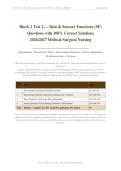
Block 2 Test 2 | Skin & Sensory Functions (SF) | 100% Correct Solutions | 2026/2027 40-Question Exam
Block 2 Test 2 — Skin & Sensory Functions (SF)
Questions with 100% Correct Solutions
2026/2027 Medical-Surgical Nursing
Integumentary • Wound Care • Burns • Dermatological Disorders • Sensory Impairments
40-Question Exam • 4 Sections
Skill: Skin, Integumentary, and Sensory Functions (SF); Wound Care; Burns; Dermatological Disorders; Sensory
Impairments
Domains: Skin Anatomy/Physiology/Assessment • Cellulitis/Impetigo/Psoriasis/Eczema/Skin Cancers • Burn
Classification, Rule of Nines, Parkland Formula, Pressure Injury Staging, NPWT, Bioengineered Skin Substitutes •
Glaucoma/AMD/Cataract/Ménière's/Hearing Loss • 2026/2027 Sensory Rehabilitation Updates
Sectio
Focus Items
n
1 Skin Anatomy, Physiology & Health Assessment Q1–Q10 (10)
2 Dermatological Disorders, Infections & Inflammatory Conditions Q11–Q20 (10)
3 Burns, Wound Care & Pressure Injury Management Q21–Q30 (10)
4 Sensory Functions (Vision, Hearing), Disorders & 2026 Updates Q31–Q40 (10)
Total 40 Items — Cognitive mix: 30% recall, 50% application, 20% analysis 40
Format: 75% scenario-based (calculating burn fluid resuscitation, prioritizing pressure-injury care, assessing acute
glaucoma); 25% direct (definitions, anatomical facts, staging criteria). Each item presents four options (A–D), one
keyed answer, and a step-by-step rationale identifying the correct clinical judgment and the specific flaw in each
distractor.
Page 1 | Block 2 Test 2 SF | 100 pct Correct Solutions Edition
, Block 2 Test 2 | Skin & Sensory Functions (SF) | 100% Correct Solutions | 2026/2027 40-Question Exam
Section 1: Skin Anatomy, Physiology, and Health Assessment (Q1–Q10)
1. Which layer of the epidermis is the deepest, containing the stem cells responsible for keratinocyte
regeneration?
A. Stratum corneum.
B. Stratum granulosum.
C. Stratum basale (stratum germinativum).
D. Stratum lucidum.
Correct Answer: C
Rationale: The stratum basale (germinativum) is the deepest epidermal layer and contains mitotically active stem
cells. Stratum corneum is the outermost dead-cell layer (A), stratum granulosum is mid-epidermis (B), and stratum
lucidum exists only in palms/soles (D). C is correct.
2. Which of the following is NOT a primary function of the integumentary system?
A. Protection from pathogens and UV radiation.
B. Thermoregulation through sweating and vasodilation.
C. Hematopoiesis (blood cell production).
D. Vitamin D synthesis upon UV exposure.
Correct Answer: C
Rationale: Hematopoiesis occurs in bone marrow, not skin. Protection, thermoregulation, and vitamin D synthesis
are core skin functions. C is the correct (NOT) answer.
3. When assessing a dark-skinned patient for early pressure injury, which technique is most appropriate?
A. Rely solely on the presence of erythema (redness).
B. Palpate for warmth, induration, and firmness, and observe for changes in skin tone, shininess, or
persistent non-blanching discoloration.
C. Apply ice to elicit blanching.
D. Use a pulse oximeter on the skin surface.
Correct Answer: B
Rationale: In darker skin tones, erythema may be absent or appear as a deepening of pigmentation; assessment relies
on palpation (warmth, induration, firmness) and tone/shininess changes rather than redness. Ice (C) and pulse
oximetry (D) are not assessment techniques; relying on erythema (A) misses early injury. B is correct.
4. A Wood's lamp examination is most useful in diagnosing which condition?
A. Tinea capitis (fungal infection) with fluorescent hues.
B. Stage 4 pressure injury depth.
C. Burn depth classification.
D. Intraocular pressure in glaucoma.
Correct Answer: A
Rationale: A Wood's lamp (UV light) helps identify certain fungal infections (e.g., tinea capitis with blue-green
fluorescence) and pigmentary disorders. It is not used for pressure injury depth (B), burn depth (C), or intraocular
pressure (D — that is tonometry). A is correct.
Page 2 | Block 2 Test 2 SF | 100 pct Correct Solutions Edition
Block 2 Test 2 — Skin & Sensory Functions (SF)
Questions with 100% Correct Solutions
2026/2027 Medical-Surgical Nursing
Integumentary • Wound Care • Burns • Dermatological Disorders • Sensory Impairments
40-Question Exam • 4 Sections
Skill: Skin, Integumentary, and Sensory Functions (SF); Wound Care; Burns; Dermatological Disorders; Sensory
Impairments
Domains: Skin Anatomy/Physiology/Assessment • Cellulitis/Impetigo/Psoriasis/Eczema/Skin Cancers • Burn
Classification, Rule of Nines, Parkland Formula, Pressure Injury Staging, NPWT, Bioengineered Skin Substitutes •
Glaucoma/AMD/Cataract/Ménière's/Hearing Loss • 2026/2027 Sensory Rehabilitation Updates
Sectio
Focus Items
n
1 Skin Anatomy, Physiology & Health Assessment Q1–Q10 (10)
2 Dermatological Disorders, Infections & Inflammatory Conditions Q11–Q20 (10)
3 Burns, Wound Care & Pressure Injury Management Q21–Q30 (10)
4 Sensory Functions (Vision, Hearing), Disorders & 2026 Updates Q31–Q40 (10)
Total 40 Items — Cognitive mix: 30% recall, 50% application, 20% analysis 40
Format: 75% scenario-based (calculating burn fluid resuscitation, prioritizing pressure-injury care, assessing acute
glaucoma); 25% direct (definitions, anatomical facts, staging criteria). Each item presents four options (A–D), one
keyed answer, and a step-by-step rationale identifying the correct clinical judgment and the specific flaw in each
distractor.
Page 1 | Block 2 Test 2 SF | 100 pct Correct Solutions Edition
, Block 2 Test 2 | Skin & Sensory Functions (SF) | 100% Correct Solutions | 2026/2027 40-Question Exam
Section 1: Skin Anatomy, Physiology, and Health Assessment (Q1–Q10)
1. Which layer of the epidermis is the deepest, containing the stem cells responsible for keratinocyte
regeneration?
A. Stratum corneum.
B. Stratum granulosum.
C. Stratum basale (stratum germinativum).
D. Stratum lucidum.
Correct Answer: C
Rationale: The stratum basale (germinativum) is the deepest epidermal layer and contains mitotically active stem
cells. Stratum corneum is the outermost dead-cell layer (A), stratum granulosum is mid-epidermis (B), and stratum
lucidum exists only in palms/soles (D). C is correct.
2. Which of the following is NOT a primary function of the integumentary system?
A. Protection from pathogens and UV radiation.
B. Thermoregulation through sweating and vasodilation.
C. Hematopoiesis (blood cell production).
D. Vitamin D synthesis upon UV exposure.
Correct Answer: C
Rationale: Hematopoiesis occurs in bone marrow, not skin. Protection, thermoregulation, and vitamin D synthesis
are core skin functions. C is the correct (NOT) answer.
3. When assessing a dark-skinned patient for early pressure injury, which technique is most appropriate?
A. Rely solely on the presence of erythema (redness).
B. Palpate for warmth, induration, and firmness, and observe for changes in skin tone, shininess, or
persistent non-blanching discoloration.
C. Apply ice to elicit blanching.
D. Use a pulse oximeter on the skin surface.
Correct Answer: B
Rationale: In darker skin tones, erythema may be absent or appear as a deepening of pigmentation; assessment relies
on palpation (warmth, induration, firmness) and tone/shininess changes rather than redness. Ice (C) and pulse
oximetry (D) are not assessment techniques; relying on erythema (A) misses early injury. B is correct.
4. A Wood's lamp examination is most useful in diagnosing which condition?
A. Tinea capitis (fungal infection) with fluorescent hues.
B. Stage 4 pressure injury depth.
C. Burn depth classification.
D. Intraocular pressure in glaucoma.
Correct Answer: A
Rationale: A Wood's lamp (UV light) helps identify certain fungal infections (e.g., tinea capitis with blue-green
fluorescence) and pigmentary disorders. It is not used for pressure injury depth (B), burn depth (C), or intraocular
pressure (D — that is tonometry). A is correct.
Page 2 | Block 2 Test 2 SF | 100 pct Correct Solutions Edition


