

NBCRNA Exam 2026-2027 | Actual Questions
National Board of Certification and Recertification for Nurse Anesthetists | Actual Q&A | CRNA
Candidates and Professionals
Introduction
This original NBCRNA exam-preparation question set is designed to reinforce nurse anesthesia certification
objectives for exam readiness. The questions cover Basic Sciences, Anesthesia Equipment and Monitoring, Clinical
Anesthesia for Surgical Procedures, Patient Assessment, Airway Management and Perioperative Care, and
Professional Roles, Ethics, and Patient Safety. Items emphasize advanced airway management, hemodynamic
monitoring, anesthetic pharmacology, regional anesthesia techniques, obstetric and pediatric anesthesia,
perioperative physiology, and crisis resource management. Use this document as original practice content alongside
NBCRNA materials and core anesthesia textbooks to build Advanced Clinical Anesthesia Mastery.
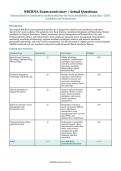
Content Area Overview
Content Area Questions Key Topics Weight
Basic Sciences (Anatomy, 50 Cellular physiology; 25%
Physiology, Pathophysiology, respiratory, cardiovascular,
Pharmacology) neurologic, renal, hepatic,
endocrine, and hematologic
physiology; anesthetic
pharmacology; applied
pathophysiology
Anesthesia Equipment, 30 Machine checks; gas delivery; 15%
Technology, and Monitoring vaporizers; circle systems;
ventilators; invasive and
noninvasive monitoring;
point-of-care testing; remote-
site technology
Clinical Anesthesia for 60 General, regional, obstetric, 30%
Surgical Procedures pediatric, thoracic, cardiac,
neuro, trauma, bariatric,
ambulatory, and remote-
location anesthesia
management
Patient Assessment, Airway 40 Preoperative evaluation; 20%
Management, and airway assessment; difficult
Perioperative Care airway algorithms;
intraoperative crisis
management; PACU recovery;
pain, PONV, and
postoperative complications
Professional Roles, Ethics, 20 Professional accountability; 10%
and Patient Safety informed consent; ethics;
documentation; medication
safety; crisis resource
management; quality
improvement; legal
standards; infection
prevention
Total 200 Five NBCRNA 100%
examination domains
NBCRNA Exam 2026-2027
,Domain: Basic Sciences (Anatomy, Physiology, Pathophysiology, Pharmacology)
Q1. In an anesthetized adult with stable carbon dioxide production, what is the expected effect of
doubling alveolar ventilation?
A. Arterial PaCO2 will decrease because PaCO2 is inversely related to alveolar ventilation.
B. Arterial PaCO2 will increase because more carbon dioxide is delivered to the lungs.
C. Arterial PaO2 will fall to zero because oxygen is removed faster.
D. The pH will remain unchanged because ventilation does not affect acid-base status.
Answer: A
Rationale: PaCO2 is determined primarily by carbon dioxide production divided by alveolar ventilation.
Increasing effective alveolar ventilation lowers PaCO2 and produces respiratory alkalosis if excessive.
Q2. Which condition shifts the oxyhemoglobin dissociation curve to the right?
A. Hypothermia, alkalosis, and decreased 2,3-DPG.
B. Increased temperature, increased PaCO2, acidosis, or increased 2,3-DPG.
C. Carbon monoxide binding with reduced oxygen content and left-shifted remaining sites.
D. Fetal hemoglobin predominance with high oxygen affinity.
Answer: B
Rationale: A right shift decreases hemoglobin oxygen affinity and facilitates unloading to tissues. Fever,
hypercarbia, acidosis, and increased 2,3-DPG are classic right-shifting conditions.
Q3. During one-lung ventilation, what is the physiologic purpose of hypoxic pulmonary
vasoconstriction?
A. It increases perfusion to collapsed lung regions to improve carbon dioxide removal.
B. It dilates pulmonary vessels in hypoxic regions to maximize shunt flow.
C. It diverts blood away from poorly ventilated alveoli to reduce shunt.
D. It abolishes pulmonary blood flow to both lungs.
Answer: C
Rationale: Hypoxic pulmonary vasoconstriction is a local pulmonary vascular response that redirects perfusion
away from hypoxic alveoli. This improves ventilation-perfusion matching during regional hypoventilation.
Q4. Why are obese, pregnant, and supine anesthetized patients prone to rapid desaturation during
apnea?
A. Hemoglobin concentration always doubles during induction.
B. Alveolar ventilation increases automatically during apnea.
C. The oxygen-hemoglobin curve shifts permanently to the right.
D. Functional residual capacity is reduced and may approach closing capacity, decreasing oxygen reserve.
Answer: D
Rationale: Reduced functional residual capacity decreases the oxygen reservoir available during apnea. When
closing capacity exceeds FRC, airway closure and atelectasis worsen gas exchange.
Q5. Coronary perfusion of the left ventricle occurs mainly during which phase and depends heavily
on what gradient?
A. Diastole, driven by aortic diastolic pressure minus left ventricular end-diastolic pressure.
B. Systole, driven only by pulmonary artery pressure.
C. Inspiration, driven by central venous pressure.
D. Platelet contraction, driven by serum potassium.
Answer: A
Rationale: Left ventricular coronary blood flow is greatest in diastole because systolic myocardial compression
limits flow. Low diastolic pressure or high LVEDP can reduce coronary perfusion.
Q6. A sudden drop in arterial pressure during anesthesia triggers which immediate baroreceptor
response?
A. Decreased sympathetic tone with profound bradycardia and vasodilation.
B. Increased sympathetic outflow with tachycardia and vasoconstriction.
C. Immediate renal excretion of all sodium.
D. Suppression of catecholamine release from the adrenal medulla.
Answer: B
NBCRNA Exam 2026-2027
,Rationale: Baroreceptor unloading in the carotid sinus and aortic arch increases sympathetic activity and
decreases parasympathetic tone. This raises heart rate, contractility, and vascular tone.
Q7. Within physiologic limits, how does increased ventricular end-diastolic volume affect stroke
volume?
A. It always decreases stroke volume to zero.
B. It prevents actin and myosin interaction.
C. It increases myocardial fiber stretch and can increase stroke volume.
D. It eliminates the effect of contractility.
Answer: C
Rationale: The Frank-Starling mechanism describes increased force of contraction with increased preload up to an
optimal range. Excessive distention or ventricular failure can blunt this response.
Q8. Which hemodynamic goal is most important in severe aortic stenosis?
A. Create profound vasodilation to reduce all afterload.
B. Allow sustained tachycardia to reduce systolic ejection time.
C. Use hypovolemia to keep the ventricle small.
D. Maintain sinus rhythm, preload, afterload, and coronary perfusion while avoiding tachycardia.
Answer: D
Rationale: Severe aortic stenosis creates fixed outflow obstruction and a hypertrophied ventricle dependent on
preload and diastolic coronary perfusion. Hypotension and tachycardia can be poorly tolerated.
Q9. A patient with significant mitral stenosis is most likely to decompensate with which change?
A. Tachycardia that shortens diastolic filling time and increases left atrial pressure.
B. Mild bradycardia with adequate blood pressure.
C. Maintenance of sinus rhythm and normovolemia.
D. Avoidance of pulmonary hypertension.
Answer: A
Rationale: Mitral stenosis obstructs left atrial emptying during diastole. Tachycardia reduces filling time, raises
left atrial and pulmonary pressures, and may precipitate pulmonary edema.
Q10. In pulmonary hypertension, which factor most directly worsens right ventricular afterload?
A. Mild oxygen supplementation and normocarbia.
B. Hypoxia, hypercarbia, acidosis, or high pulmonary vascular resistance.
C. Reduced airway pressure with adequate ventilation.
D. Maintenance of sinus rhythm and systemic pressure.
Answer: B
Rationale: The right ventricle is sensitive to acute increases in pulmonary vascular resistance. Hypoxia,
hypercarbia, acidosis, pain, and high airway pressures can worsen RV strain.
Q11. How is cerebral perfusion pressure calculated?
A. Systolic pressure plus end-tidal carbon dioxide.
B. Heart rate multiplied by tidal volume.
C. Mean arterial pressure minus intracranial pressure or central venous pressure, whichever is higher.
D. Alveolar pressure minus inspired oxygen concentration.
Answer: C
Rationale: Cerebral perfusion pressure reflects the pressure gradient driving cerebral blood flow. Elevated ICP or
CVP can reduce CPP even when MAP appears acceptable.
Q12. Within normal autoregulatory limits, what happens to cerebral blood flow when mean arterial
pressure changes?
A. Cerebral blood flow changes linearly with every small MAP change.
B. Autoregulation depends only on hemoglobin concentration.
C. Cerebral vessels cannot respond to pressure changes.
D. Cerebral vessels adjust resistance to maintain relatively constant blood flow.
Answer: D
Rationale: Cerebral autoregulation maintains flow across a range of perfusion pressures by vasoconstriction or
vasodilation. Chronic hypertension may shift the curve to higher pressures.
Q13. Why can hyperventilation temporarily reduce intracranial pressure?
A. Lower PaCO2 causes cerebral vasoconstriction and reduces cerebral blood volume.
NBCRNA Exam 2026-2027
, B. Lower PaCO2 causes immediate cerebral vasodilation.
C. Hyperventilation increases cerebrospinal fluid production.
D. Hyperventilation stops cerebral metabolism entirely.
Answer: A
Rationale: Carbon dioxide is a potent modulator of cerebral vascular tone. Acute hypocapnia causes
vasoconstriction, reducing cerebral blood volume and ICP, but prolonged or excessive use may reduce cerebral
perfusion.
Q14. Which mechanisms help maintain glomerular filtration over a range of perfusion pressures?
A. Pulmonary hypoxic vasoconstriction and surfactant release.
B. Afferent arteriolar myogenic responses and tubuloglomerular feedback.
C. Hepatic portal flow and bile secretion.
D. Neuromuscular acetylcholine release only.
Answer: B
Rationale: Renal autoregulation uses intrinsic arteriolar responses and macula densa feedback to stabilize GFR.
Severe hypotension, vasoconstriction, or nephrotoxins can still impair renal perfusion.
Q15. Which statement best describes hepatic blood supply relevant to anesthesia?
A. The liver receives blood only from the pulmonary artery.
B. Hepatic artery flow carries no oxygen.
C. The liver receives dual blood flow from the portal vein and hepatic artery.
D. Portal venous flow is independent of splanchnic perfusion.
Answer: C
Rationale: The liver has dual inflow: portal venous flow supplies most volume, and hepatic arterial flow supplies a
significant oxygen contribution. Hypotension and reduced splanchnic flow can impair hepatic oxygen delivery.
Q16. A patient with metabolic acidosis is expected to compensate initially through which
mechanism?
A. Complete renal bicarbonate excretion within seconds.
B. Immediate left shift of the oxyhemoglobin curve only.
C. Suppression of all respiratory drive.
D. Increased alveolar ventilation to lower PaCO2.
Answer: D
Rationale: Respiratory compensation for metabolic acidosis occurs through hyperventilation, reducing PaCO2.
Renal compensation is slower and depends on kidney function.
Q17. Why is hyperkalemia dangerous during anesthesia?
A. It can depolarize cardiac membranes and cause conduction abnormalities or malignant dysrhythmias.
B. It always improves neuromuscular transmission.
C. It eliminates the need for ECG monitoring.
D. It makes local anesthetics ineffective.
Answer: A
Rationale: Potassium strongly influences resting membrane potential. Hyperkalemia can produce peaked T waves,
conduction delay, ventricular dysrhythmias, or cardiac arrest.
Q18. Ionized calcium is clinically important because it directly supports which function?
A. Hemoglobin synthesis in erythrocytes only.
B. Excitation-contraction coupling and myocardial contractility.
C. Volatile anesthetic vaporization.
D. Nitrogen fixation in tissues.
Answer: B
Rationale: Calcium is essential for cardiac and smooth muscle contraction, neurotransmission, and coagulation.
Low ionized calcium can worsen hypotension and contractile dysfunction.
Q19. The common pathway of coagulation ultimately results in formation of what clot-stabilizing
protein?
A. Albumin.
B. Insulin.
C. Fibrin.
D. Acetylcholine.
NBCRNA Exam 2026-2027
National Board of Certification and Recertification for Nurse Anesthetists | Actual Q&A | CRNA
Candidates and Professionals
Introduction
This original NBCRNA exam-preparation question set is designed to reinforce nurse anesthesia certification
objectives for exam readiness. The questions cover Basic Sciences, Anesthesia Equipment and Monitoring, Clinical
Anesthesia for Surgical Procedures, Patient Assessment, Airway Management and Perioperative Care, and
Professional Roles, Ethics, and Patient Safety. Items emphasize advanced airway management, hemodynamic
monitoring, anesthetic pharmacology, regional anesthesia techniques, obstetric and pediatric anesthesia,
perioperative physiology, and crisis resource management. Use this document as original practice content alongside
NBCRNA materials and core anesthesia textbooks to build Advanced Clinical Anesthesia Mastery.
Content Area Overview
Content Area Questions Key Topics Weight
Basic Sciences (Anatomy, 50 Cellular physiology; 25%
Physiology, Pathophysiology, respiratory, cardiovascular,
Pharmacology) neurologic, renal, hepatic,
endocrine, and hematologic
physiology; anesthetic
pharmacology; applied
pathophysiology
Anesthesia Equipment, 30 Machine checks; gas delivery; 15%
Technology, and Monitoring vaporizers; circle systems;
ventilators; invasive and
noninvasive monitoring;
point-of-care testing; remote-
site technology
Clinical Anesthesia for 60 General, regional, obstetric, 30%
Surgical Procedures pediatric, thoracic, cardiac,
neuro, trauma, bariatric,
ambulatory, and remote-
location anesthesia
management
Patient Assessment, Airway 40 Preoperative evaluation; 20%
Management, and airway assessment; difficult
Perioperative Care airway algorithms;
intraoperative crisis
management; PACU recovery;
pain, PONV, and
postoperative complications
Professional Roles, Ethics, 20 Professional accountability; 10%
and Patient Safety informed consent; ethics;
documentation; medication
safety; crisis resource
management; quality
improvement; legal
standards; infection
prevention
Total 200 Five NBCRNA 100%
examination domains
NBCRNA Exam 2026-2027
,Domain: Basic Sciences (Anatomy, Physiology, Pathophysiology, Pharmacology)
Q1. In an anesthetized adult with stable carbon dioxide production, what is the expected effect of
doubling alveolar ventilation?
A. Arterial PaCO2 will decrease because PaCO2 is inversely related to alveolar ventilation.
B. Arterial PaCO2 will increase because more carbon dioxide is delivered to the lungs.
C. Arterial PaO2 will fall to zero because oxygen is removed faster.
D. The pH will remain unchanged because ventilation does not affect acid-base status.
Answer: A
Rationale: PaCO2 is determined primarily by carbon dioxide production divided by alveolar ventilation.
Increasing effective alveolar ventilation lowers PaCO2 and produces respiratory alkalosis if excessive.
Q2. Which condition shifts the oxyhemoglobin dissociation curve to the right?
A. Hypothermia, alkalosis, and decreased 2,3-DPG.
B. Increased temperature, increased PaCO2, acidosis, or increased 2,3-DPG.
C. Carbon monoxide binding with reduced oxygen content and left-shifted remaining sites.
D. Fetal hemoglobin predominance with high oxygen affinity.
Answer: B
Rationale: A right shift decreases hemoglobin oxygen affinity and facilitates unloading to tissues. Fever,
hypercarbia, acidosis, and increased 2,3-DPG are classic right-shifting conditions.
Q3. During one-lung ventilation, what is the physiologic purpose of hypoxic pulmonary
vasoconstriction?
A. It increases perfusion to collapsed lung regions to improve carbon dioxide removal.
B. It dilates pulmonary vessels in hypoxic regions to maximize shunt flow.
C. It diverts blood away from poorly ventilated alveoli to reduce shunt.
D. It abolishes pulmonary blood flow to both lungs.
Answer: C
Rationale: Hypoxic pulmonary vasoconstriction is a local pulmonary vascular response that redirects perfusion
away from hypoxic alveoli. This improves ventilation-perfusion matching during regional hypoventilation.
Q4. Why are obese, pregnant, and supine anesthetized patients prone to rapid desaturation during
apnea?
A. Hemoglobin concentration always doubles during induction.
B. Alveolar ventilation increases automatically during apnea.
C. The oxygen-hemoglobin curve shifts permanently to the right.
D. Functional residual capacity is reduced and may approach closing capacity, decreasing oxygen reserve.
Answer: D
Rationale: Reduced functional residual capacity decreases the oxygen reservoir available during apnea. When
closing capacity exceeds FRC, airway closure and atelectasis worsen gas exchange.
Q5. Coronary perfusion of the left ventricle occurs mainly during which phase and depends heavily
on what gradient?
A. Diastole, driven by aortic diastolic pressure minus left ventricular end-diastolic pressure.
B. Systole, driven only by pulmonary artery pressure.
C. Inspiration, driven by central venous pressure.
D. Platelet contraction, driven by serum potassium.
Answer: A
Rationale: Left ventricular coronary blood flow is greatest in diastole because systolic myocardial compression
limits flow. Low diastolic pressure or high LVEDP can reduce coronary perfusion.
Q6. A sudden drop in arterial pressure during anesthesia triggers which immediate baroreceptor
response?
A. Decreased sympathetic tone with profound bradycardia and vasodilation.
B. Increased sympathetic outflow with tachycardia and vasoconstriction.
C. Immediate renal excretion of all sodium.
D. Suppression of catecholamine release from the adrenal medulla.
Answer: B
NBCRNA Exam 2026-2027
,Rationale: Baroreceptor unloading in the carotid sinus and aortic arch increases sympathetic activity and
decreases parasympathetic tone. This raises heart rate, contractility, and vascular tone.
Q7. Within physiologic limits, how does increased ventricular end-diastolic volume affect stroke
volume?
A. It always decreases stroke volume to zero.
B. It prevents actin and myosin interaction.
C. It increases myocardial fiber stretch and can increase stroke volume.
D. It eliminates the effect of contractility.
Answer: C
Rationale: The Frank-Starling mechanism describes increased force of contraction with increased preload up to an
optimal range. Excessive distention or ventricular failure can blunt this response.
Q8. Which hemodynamic goal is most important in severe aortic stenosis?
A. Create profound vasodilation to reduce all afterload.
B. Allow sustained tachycardia to reduce systolic ejection time.
C. Use hypovolemia to keep the ventricle small.
D. Maintain sinus rhythm, preload, afterload, and coronary perfusion while avoiding tachycardia.
Answer: D
Rationale: Severe aortic stenosis creates fixed outflow obstruction and a hypertrophied ventricle dependent on
preload and diastolic coronary perfusion. Hypotension and tachycardia can be poorly tolerated.
Q9. A patient with significant mitral stenosis is most likely to decompensate with which change?
A. Tachycardia that shortens diastolic filling time and increases left atrial pressure.
B. Mild bradycardia with adequate blood pressure.
C. Maintenance of sinus rhythm and normovolemia.
D. Avoidance of pulmonary hypertension.
Answer: A
Rationale: Mitral stenosis obstructs left atrial emptying during diastole. Tachycardia reduces filling time, raises
left atrial and pulmonary pressures, and may precipitate pulmonary edema.
Q10. In pulmonary hypertension, which factor most directly worsens right ventricular afterload?
A. Mild oxygen supplementation and normocarbia.
B. Hypoxia, hypercarbia, acidosis, or high pulmonary vascular resistance.
C. Reduced airway pressure with adequate ventilation.
D. Maintenance of sinus rhythm and systemic pressure.
Answer: B
Rationale: The right ventricle is sensitive to acute increases in pulmonary vascular resistance. Hypoxia,
hypercarbia, acidosis, pain, and high airway pressures can worsen RV strain.
Q11. How is cerebral perfusion pressure calculated?
A. Systolic pressure plus end-tidal carbon dioxide.
B. Heart rate multiplied by tidal volume.
C. Mean arterial pressure minus intracranial pressure or central venous pressure, whichever is higher.
D. Alveolar pressure minus inspired oxygen concentration.
Answer: C
Rationale: Cerebral perfusion pressure reflects the pressure gradient driving cerebral blood flow. Elevated ICP or
CVP can reduce CPP even when MAP appears acceptable.
Q12. Within normal autoregulatory limits, what happens to cerebral blood flow when mean arterial
pressure changes?
A. Cerebral blood flow changes linearly with every small MAP change.
B. Autoregulation depends only on hemoglobin concentration.
C. Cerebral vessels cannot respond to pressure changes.
D. Cerebral vessels adjust resistance to maintain relatively constant blood flow.
Answer: D
Rationale: Cerebral autoregulation maintains flow across a range of perfusion pressures by vasoconstriction or
vasodilation. Chronic hypertension may shift the curve to higher pressures.
Q13. Why can hyperventilation temporarily reduce intracranial pressure?
A. Lower PaCO2 causes cerebral vasoconstriction and reduces cerebral blood volume.
NBCRNA Exam 2026-2027
, B. Lower PaCO2 causes immediate cerebral vasodilation.
C. Hyperventilation increases cerebrospinal fluid production.
D. Hyperventilation stops cerebral metabolism entirely.
Answer: A
Rationale: Carbon dioxide is a potent modulator of cerebral vascular tone. Acute hypocapnia causes
vasoconstriction, reducing cerebral blood volume and ICP, but prolonged or excessive use may reduce cerebral
perfusion.
Q14. Which mechanisms help maintain glomerular filtration over a range of perfusion pressures?
A. Pulmonary hypoxic vasoconstriction and surfactant release.
B. Afferent arteriolar myogenic responses and tubuloglomerular feedback.
C. Hepatic portal flow and bile secretion.
D. Neuromuscular acetylcholine release only.
Answer: B
Rationale: Renal autoregulation uses intrinsic arteriolar responses and macula densa feedback to stabilize GFR.
Severe hypotension, vasoconstriction, or nephrotoxins can still impair renal perfusion.
Q15. Which statement best describes hepatic blood supply relevant to anesthesia?
A. The liver receives blood only from the pulmonary artery.
B. Hepatic artery flow carries no oxygen.
C. The liver receives dual blood flow from the portal vein and hepatic artery.
D. Portal venous flow is independent of splanchnic perfusion.
Answer: C
Rationale: The liver has dual inflow: portal venous flow supplies most volume, and hepatic arterial flow supplies a
significant oxygen contribution. Hypotension and reduced splanchnic flow can impair hepatic oxygen delivery.
Q16. A patient with metabolic acidosis is expected to compensate initially through which
mechanism?
A. Complete renal bicarbonate excretion within seconds.
B. Immediate left shift of the oxyhemoglobin curve only.
C. Suppression of all respiratory drive.
D. Increased alveolar ventilation to lower PaCO2.
Answer: D
Rationale: Respiratory compensation for metabolic acidosis occurs through hyperventilation, reducing PaCO2.
Renal compensation is slower and depends on kidney function.
Q17. Why is hyperkalemia dangerous during anesthesia?
A. It can depolarize cardiac membranes and cause conduction abnormalities or malignant dysrhythmias.
B. It always improves neuromuscular transmission.
C. It eliminates the need for ECG monitoring.
D. It makes local anesthetics ineffective.
Answer: A
Rationale: Potassium strongly influences resting membrane potential. Hyperkalemia can produce peaked T waves,
conduction delay, ventricular dysrhythmias, or cardiac arrest.
Q18. Ionized calcium is clinically important because it directly supports which function?
A. Hemoglobin synthesis in erythrocytes only.
B. Excitation-contraction coupling and myocardial contractility.
C. Volatile anesthetic vaporization.
D. Nitrogen fixation in tissues.
Answer: B
Rationale: Calcium is essential for cardiac and smooth muscle contraction, neurotransmission, and coagulation.
Low ionized calcium can worsen hypotension and contractile dysfunction.
Q19. The common pathway of coagulation ultimately results in formation of what clot-stabilizing
protein?
A. Albumin.
B. Insulin.
C. Fibrin.
D. Acetylcholine.
NBCRNA Exam 2026-2027


