
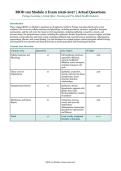
BIOD 102 Module 2 Exam 2026-2027 | Actual Questions
Portage Learning | Actual Q&A | Nursing and Pre-Allied Health Students
Introduction
These original BIOD 102 Module 2 questions are designed to reinforce Portage Learning objectives for exam
readiness. The set covers cellular anatomy and physiology, including membrane structure, organelles, transport
mechanisms, and the cell cycle; the tissue level of organization, including epithelial, connective, muscle, and
nervous tissue; the integumentary system, including the epidermis, dermis, hypodermis, accessory organs, and skin
functions; and membranes and tissue repair, including epithelial and connective tissue membranes, inflammation,
regeneration, fibrosis, and wound healing. Use this document as original practice content alongside official Portage
Learning BIOD 102 materials and Marieb & Hoehn to build Anatomical and Physiological Mastery.
Content Area Overview
Content Area Questions Key Topics Weight
Cellular Anatomy and 10 Cell membrane structure; 25%
Physiology organelles; diffusion,
osmosis, facilitated
diffusion, active transport;
vesicular transport; cell
cycle
Tissue Level of 10 Epithelial, connective, 25%
Organization muscle, and nervous tissue
classification; tissue
structure-function
relationships
Integumentary System 10 Epidermis, dermis, 25%
hypodermis, pigment cells,
glands, hair, nails,
thermoregulation, vitamin
D synthesis
Membranes and Tissue 10 Cutaneous, mucous, 25%
Repair serous, and synovial
membranes;
inflammation; hemostasis;
granulation; regeneration
and fibrosis
Total 40 Four evenly weighted 100%
Module 2 domains
BIOD 102 Module 2 Exam 2026-2027
, Domain: Cellular Anatomy and Physiology
Q1. Which description best explains why the plasma membrane is called a fluid mosaic?
A. It is a rigid wall made mainly of cellulose and structural proteins.
B. It is a phospholipid bilayer with moving lipids and embedded proteins arranged in a changing pattern.
C. It is a single layer of cholesterol molecules surrounding the cytoplasm.
D. It is a protein shell that prevents all substances from entering the cell.
Answer: B
Rationale: The fluid mosaic model describes a flexible phospholipid bilayer in which proteins, cholesterol, and
carbohydrates are distributed like a mosaic and can move laterally. This structure supports selective permeability
and membrane signaling.
Q2. A respiratory cell allows oxygen and carbon dioxide to cross the membrane rapidly without a
transport protein. Which membrane property explains this movement?
A. Large polar molecules always dissolve easily in the membrane core.
B. Charged ions move freely through the hydrophobic membrane interior.
C. Small nonpolar gases diffuse through the lipid portion of the phospholipid bilayer.
D. ATP pumps gases through membrane channels.
Answer: C
Rationale: Small nonpolar molecules such as O2 and CO2 can pass directly through the hydrophobic lipid core by
simple diffusion. Polar molecules and ions generally require channels, carriers, or pumps.
Q3. The sodium-potassium pump helps maintain resting membrane potential by doing which
action?
A. Moving three sodium ions out of the cell and two potassium ions into the cell using ATP.
B. Moving two sodium ions out and three potassium ions in without ATP.
C. Opening a water channel so osmosis can equalize ion concentration.
D. Allowing glucose to enter the cell down its concentration gradient.
Answer: A
Rationale: The Na+/K+ ATPase is a primary active transport pump that uses ATP to move 3 Na+ out of the cell
and 2 K+ into the cell. This preserves electrochemical gradients essential for excitable tissues.
Q4. A red blood cell is placed in a hypertonic saline solution. What is the most likely result?
A. Water moves into the cell, causing it to swell and burst.
B. No water movement occurs because red blood cells lack aquaporins.
C. Solute leaves the cell until both sides become isotonic.
D. Water moves out of the cell, causing the cell to shrink or crenate.
Answer: D
Rationale: A hypertonic solution has a higher solute concentration than the cell interior, so water moves out of the
cell by osmosis. Loss of water causes the red blood cell to shrink, a process called crenation.
Q5. Glucose enters many body cells through a membrane carrier protein without direct ATP use.
Which transport mechanism is this?
A. Primary active transport
B. Facilitated diffusion
C. Phagocytosis
D. Exocytosis
Answer: B
Rationale: Facilitated diffusion moves a substance down its concentration gradient through a specific carrier or
channel protein without direct energy input. Glucose transporters are a classic example.
Q6. A pancreatic cell that secretes digestive enzymes has abundant rough endoplasmic reticulum.
Why is this organelle especially important in that cell?
A. It stores calcium for muscle contraction only.
B. It produces ATP for ciliary movement.
C. It synthesizes and begins processing proteins destined for secretion or membranes.
D. It digests old organelles using hydrolytic enzymes.
Answer: C
Rationale: Rough ER is studded with ribosomes and is specialized for synthesizing proteins that will be secreted,
inserted into membranes, or packaged for lysosomes. Secretory cells typically contain extensive rough ER.
BIOD 102 Module 2 Exam 2026-2027
Portage Learning | Actual Q&A | Nursing and Pre-Allied Health Students
Introduction
These original BIOD 102 Module 2 questions are designed to reinforce Portage Learning objectives for exam
readiness. The set covers cellular anatomy and physiology, including membrane structure, organelles, transport
mechanisms, and the cell cycle; the tissue level of organization, including epithelial, connective, muscle, and
nervous tissue; the integumentary system, including the epidermis, dermis, hypodermis, accessory organs, and skin
functions; and membranes and tissue repair, including epithelial and connective tissue membranes, inflammation,
regeneration, fibrosis, and wound healing. Use this document as original practice content alongside official Portage
Learning BIOD 102 materials and Marieb & Hoehn to build Anatomical and Physiological Mastery.
Content Area Overview
Content Area Questions Key Topics Weight
Cellular Anatomy and 10 Cell membrane structure; 25%
Physiology organelles; diffusion,
osmosis, facilitated
diffusion, active transport;
vesicular transport; cell
cycle
Tissue Level of 10 Epithelial, connective, 25%
Organization muscle, and nervous tissue
classification; tissue
structure-function
relationships
Integumentary System 10 Epidermis, dermis, 25%
hypodermis, pigment cells,
glands, hair, nails,
thermoregulation, vitamin
D synthesis
Membranes and Tissue 10 Cutaneous, mucous, 25%
Repair serous, and synovial
membranes;
inflammation; hemostasis;
granulation; regeneration
and fibrosis
Total 40 Four evenly weighted 100%
Module 2 domains
BIOD 102 Module 2 Exam 2026-2027
, Domain: Cellular Anatomy and Physiology
Q1. Which description best explains why the plasma membrane is called a fluid mosaic?
A. It is a rigid wall made mainly of cellulose and structural proteins.
B. It is a phospholipid bilayer with moving lipids and embedded proteins arranged in a changing pattern.
C. It is a single layer of cholesterol molecules surrounding the cytoplasm.
D. It is a protein shell that prevents all substances from entering the cell.
Answer: B
Rationale: The fluid mosaic model describes a flexible phospholipid bilayer in which proteins, cholesterol, and
carbohydrates are distributed like a mosaic and can move laterally. This structure supports selective permeability
and membrane signaling.
Q2. A respiratory cell allows oxygen and carbon dioxide to cross the membrane rapidly without a
transport protein. Which membrane property explains this movement?
A. Large polar molecules always dissolve easily in the membrane core.
B. Charged ions move freely through the hydrophobic membrane interior.
C. Small nonpolar gases diffuse through the lipid portion of the phospholipid bilayer.
D. ATP pumps gases through membrane channels.
Answer: C
Rationale: Small nonpolar molecules such as O2 and CO2 can pass directly through the hydrophobic lipid core by
simple diffusion. Polar molecules and ions generally require channels, carriers, or pumps.
Q3. The sodium-potassium pump helps maintain resting membrane potential by doing which
action?
A. Moving three sodium ions out of the cell and two potassium ions into the cell using ATP.
B. Moving two sodium ions out and three potassium ions in without ATP.
C. Opening a water channel so osmosis can equalize ion concentration.
D. Allowing glucose to enter the cell down its concentration gradient.
Answer: A
Rationale: The Na+/K+ ATPase is a primary active transport pump that uses ATP to move 3 Na+ out of the cell
and 2 K+ into the cell. This preserves electrochemical gradients essential for excitable tissues.
Q4. A red blood cell is placed in a hypertonic saline solution. What is the most likely result?
A. Water moves into the cell, causing it to swell and burst.
B. No water movement occurs because red blood cells lack aquaporins.
C. Solute leaves the cell until both sides become isotonic.
D. Water moves out of the cell, causing the cell to shrink or crenate.
Answer: D
Rationale: A hypertonic solution has a higher solute concentration than the cell interior, so water moves out of the
cell by osmosis. Loss of water causes the red blood cell to shrink, a process called crenation.
Q5. Glucose enters many body cells through a membrane carrier protein without direct ATP use.
Which transport mechanism is this?
A. Primary active transport
B. Facilitated diffusion
C. Phagocytosis
D. Exocytosis
Answer: B
Rationale: Facilitated diffusion moves a substance down its concentration gradient through a specific carrier or
channel protein without direct energy input. Glucose transporters are a classic example.
Q6. A pancreatic cell that secretes digestive enzymes has abundant rough endoplasmic reticulum.
Why is this organelle especially important in that cell?
A. It stores calcium for muscle contraction only.
B. It produces ATP for ciliary movement.
C. It synthesizes and begins processing proteins destined for secretion or membranes.
D. It digests old organelles using hydrolytic enzymes.
Answer: C
Rationale: Rough ER is studded with ribosomes and is specialized for synthesizing proteins that will be secreted,
inserted into membranes, or packaged for lysosomes. Secretory cells typically contain extensive rough ER.
BIOD 102 Module 2 Exam 2026-2027


