Essentials of Human Anatomy and Physiology,
12e (Marieb) Chapter 3 Cells and Tissues
3.1 M u l t i p l e Choice Part I Questions
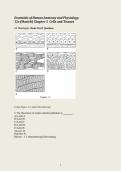
Using Figure 3.1, match the following:
1) The illustration of simple cuboidal epithelium is .
A) Label A
B) Label B
C) Label C
D) Label D
E) Label E
Answer: B
Page Ref: 91
Bloom's: 1-2: Remembering/Understanding
1
,2) The illustration of skeletal muscle tissue is .
A) Label A
B) Label B
C) Label C
D) Label D
E) Label E
Answer: E
Page Ref: 99
Bloom's: 1-2: Remembering/Understanding
3) The illustration of stratified squamous epithelium is .
A) Label A
B) Label B
C) Label C
D) Label D
E) Label E
Answer: D
Page Ref: 92
Bloom's: 1-2: Remembering/Understanding
4) The illustration of simple squamous epithelium is .
A) Label A
B) Label B
C) Label C
D) Label D
E) Label E
Answer: A
Page Ref: 91
Bloom's: 1-2: Remembering/Understanding
5) The illustration of cardiac muscle tissue is .
A) Label A
B) Label B
C) Label C
D) Label D
E) Label E
Answer: C
Page Ref: 99
Bloom's: 1-2: Remembering/Understanding
2
,6) Cellular material located outside the nucleus yet inside the plasma membrane is the .
A) nucleolus
B) cytoplasm
C) interstitial fluid
D) extracellular fluid
Answer: B
Page Ref: 67
Bloom's: 1-2: Remembering/Understanding
7) The specialized cellular compartments within the cytosol of the cell are collectively called
.
A) organelles
B) cilia
C) flagella
D) microvilli
Answer: A
Page Ref: 67
Bloom's: 1-2: Remembering/Understanding
8) , a type of cell junction, anchor adjacent cells together and prevent cells from being
pulled apart.
A) Tight junctions
B) Gap junctions
C) Desmosomes
D) Cytoplasm
Answer: C
Page Ref: 66
Bloom's: 1-2: Remembering/Understanding
9) The phospholipid tails are , which make the plasma membrane impermeable to
water.
A) water-loving
B) hydrophilic
C) polar
D) hydrophobic
Answer: D
Page Ref: 65
Bloom's: 1-2: Remembering/Understanding
10) The organelle responsible for making the majority of ATP in a cell is the .
A) Golgi apparatus
B) mitochondrion
C) rough endoplasmic reticulum
D) lysosome
Answer: B
Page Ref: 67
Bloom's: 1-2: Remembering/Understanding
3
, 11) The membrane connections that prevent the leaking of fluid between cells are called
.
A) gap junctions
B) tight junctions
C) desmosomes
D) microvilli
Answer: B
Page Ref: 66
Bloom's: 1-2: Remembering/Understanding
12) Place the following steps of protein synthesis and export from the cell in the proper order.
1. The protein folds into its functional shape.
2. The transport vesicle travels to the Golgi apparatus for further processing.
3. The protein is packaged in a transport vesicle.
4. The protein is synthesized on the ribosome as it migrates through the rough ER.
A) 1, 3, 2, 4
B) 4, 1, 2, 3
C) 1, 3, 4, 2
D) 4, 1, 3, 2
Answer: D
Page Ref: 69
Bloom's: 1-2: Remembering/Understanding
13) The passive process that involves the movement of water through aquaporins is .
A) facilitated diffusion
B) endocytosis
C) solute pumping
D) osmosis
Answer: D
Page Ref: 77
Bloom's: 1-2: Remembering/Understanding
14) What separates the intracellular fluid from the extracellular fluid?
A) nucleus
B) cytoskeleton
C) plasma membrane
D) mitochondrion
Answer: C
Page Ref: 76
Bloom's: 1-2: Remembering/Understanding
4
12e (Marieb) Chapter 3 Cells and Tissues
3.1 M u l t i p l e Choice Part I Questions
Using Figure 3.1, match the following:
1) The illustration of simple cuboidal epithelium is .
A) Label A
B) Label B
C) Label C
D) Label D
E) Label E
Answer: B
Page Ref: 91
Bloom's: 1-2: Remembering/Understanding
1
,2) The illustration of skeletal muscle tissue is .
A) Label A
B) Label B
C) Label C
D) Label D
E) Label E
Answer: E
Page Ref: 99
Bloom's: 1-2: Remembering/Understanding
3) The illustration of stratified squamous epithelium is .
A) Label A
B) Label B
C) Label C
D) Label D
E) Label E
Answer: D
Page Ref: 92
Bloom's: 1-2: Remembering/Understanding
4) The illustration of simple squamous epithelium is .
A) Label A
B) Label B
C) Label C
D) Label D
E) Label E
Answer: A
Page Ref: 91
Bloom's: 1-2: Remembering/Understanding
5) The illustration of cardiac muscle tissue is .
A) Label A
B) Label B
C) Label C
D) Label D
E) Label E
Answer: C
Page Ref: 99
Bloom's: 1-2: Remembering/Understanding
2
,6) Cellular material located outside the nucleus yet inside the plasma membrane is the .
A) nucleolus
B) cytoplasm
C) interstitial fluid
D) extracellular fluid
Answer: B
Page Ref: 67
Bloom's: 1-2: Remembering/Understanding
7) The specialized cellular compartments within the cytosol of the cell are collectively called
.
A) organelles
B) cilia
C) flagella
D) microvilli
Answer: A
Page Ref: 67
Bloom's: 1-2: Remembering/Understanding
8) , a type of cell junction, anchor adjacent cells together and prevent cells from being
pulled apart.
A) Tight junctions
B) Gap junctions
C) Desmosomes
D) Cytoplasm
Answer: C
Page Ref: 66
Bloom's: 1-2: Remembering/Understanding
9) The phospholipid tails are , which make the plasma membrane impermeable to
water.
A) water-loving
B) hydrophilic
C) polar
D) hydrophobic
Answer: D
Page Ref: 65
Bloom's: 1-2: Remembering/Understanding
10) The organelle responsible for making the majority of ATP in a cell is the .
A) Golgi apparatus
B) mitochondrion
C) rough endoplasmic reticulum
D) lysosome
Answer: B
Page Ref: 67
Bloom's: 1-2: Remembering/Understanding
3
, 11) The membrane connections that prevent the leaking of fluid between cells are called
.
A) gap junctions
B) tight junctions
C) desmosomes
D) microvilli
Answer: B
Page Ref: 66
Bloom's: 1-2: Remembering/Understanding
12) Place the following steps of protein synthesis and export from the cell in the proper order.
1. The protein folds into its functional shape.
2. The transport vesicle travels to the Golgi apparatus for further processing.
3. The protein is packaged in a transport vesicle.
4. The protein is synthesized on the ribosome as it migrates through the rough ER.
A) 1, 3, 2, 4
B) 4, 1, 2, 3
C) 1, 3, 4, 2
D) 4, 1, 3, 2
Answer: D
Page Ref: 69
Bloom's: 1-2: Remembering/Understanding
13) The passive process that involves the movement of water through aquaporins is .
A) facilitated diffusion
B) endocytosis
C) solute pumping
D) osmosis
Answer: D
Page Ref: 77
Bloom's: 1-2: Remembering/Understanding
14) What separates the intracellular fluid from the extracellular fluid?
A) nucleus
B) cytoskeleton
C) plasma membrane
D) mitochondrion
Answer: C
Page Ref: 76
Bloom's: 1-2: Remembering/Understanding
4