

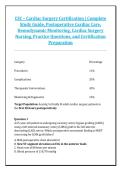
CSC – Cardiac Surgery Certification | Complete
Study Guide, Postoperative Cardiac Care,
Hemodynamic Monitoring, Cardiac Surgery
Nursing, Practice Questions, and Certification
Preparation
Category Percentage
Procedures 11%
Complications 33%
Therapeutic Interventions 43%
Monitoring & Diagnostics 13%
Target Population: Acutely/critically ill adult cardiac surgery patients in
the first 48 hours postoperatively.
Question 1
A 65-year-old patient is undergoing coronary artery bypass grafting (CABG)
using a left internal mammary artery (LIMA) graft to the left anterior
descending (LAD) artery. Which postoperative assessment finding is MOST
concerning for LIMA graft failure?
A. Mild postoperative chest discomfort
B. New ST-segment elevation on ECG in the anterior leads
C. Heart rate of 88 beats per minute
D. Blood pressure of 110/70 mmHg
,Rationale: New ST-segment elevation on ECG, particularly in the distribution
of the grafted vessel (anterior leads for LAD), is the most concerning sign of
graft failure or acute graft thrombosis. This indicates myocardial ischemia and
requires immediate intervention. While chest discomfort should be evaluated,
it is less specific than ECG changes. A heart rate of 88 and blood pressure of
110/70 are within acceptable ranges.
Question 2
A patient is scheduled for a minimally invasive cardiac surgical procedure.
Which statement BEST describes the primary advantage of this approach over
traditional sternotomy?
A. Reduced postoperative pain and faster recovery
B. Improved visualization of the surgical field
C. Lower risk of graft failure
D. Elimination of the need for cardiopulmonary bypass
Rationale: Minimally invasive cardiac surgery offers several advantages
including reduced postoperative pain, smaller incisions, less blood loss, faster
recovery, and shorter hospital stays. Visualization may actually be more
challenging. Graft failure risk is not necessarily lower. While some minimally
invasive procedures may avoid cardiopulmonary bypass, this is not the
primary advantage across all such procedures.
Question 3
A 72-year-old patient with severe aortic stenosis is scheduled for a
transcatheter aortic valve replacement (TAVR). Which assessment finding in
the postoperative period is MOST specific for a complication of this
procedure?
A. Incisional pain at the femoral access site
B. New-onset heart block requiring permanent pacemaker
C. Mild hypotension responsive to fluids
D. Transient confusion
Rationale: New-onset heart block requiring permanent pacemaker is a well-
recognized complication specific to TAVR, occurring in up to 10-15% of
,patients due to the proximity of the aortic valve to the conduction system.
Femoral access site pain is expected. Mild hypotension and transient
confusion are common postoperative findings but are not specific to TAVR
complications.
Question 4
A patient is being prepared for an open repair of a thoracic aortic aneurysm.
Which intraoperative intervention is CRITICAL for preventing spinal cord
ischemia?
A. Cerebrospinal fluid (CSF) drainage via lumbar drain
B. Administration of high-dose corticosteroids
C. Induced hypothermia to 28°C
D. Continuous EEG monitoring
Rationale: CSF drainage via a lumbar drain is critical for preventing spinal
cord ischemia during thoracic aortic aneurysm repair. CSF drainage lowers
intrathecal pressure, improving spinal cord perfusion pressure. While
hypothermia may be used in some cases, it is not the primary protective
strategy. Corticosteroids and EEG monitoring are not standard protective
measures for spinal cord ischemia.
Question 5
A 58-year-old patient is undergoing a Cox maze procedure in conjunction with
mitral valve surgery. What is the PRIMARY goal of this procedure?
A. Elimination of atrial fibrillation through targeted lesion creation
B. Revascularization of the coronary arteries
C. Repair of the mitral valve leaflets
D. Reduction of left ventricular size
Rationale: The Cox maze procedure (and its modifications) is designed to
eliminate atrial fibrillation by creating a pattern of scar tissue (lesions) that
blocks abnormal electrical impulses. It is often performed concurrently with
other cardiac surgeries such as valve repair. Revascularization, mitral valve
repair, and ventricular reduction are separate surgical goals.
, Question 6
A patient is recovering from an off-pump coronary artery bypass (OPCAB)
procedure. Compared to traditional on-pump CABG, which complication is
relatively LESS common with OPCAB?
A. Postoperative bleeding
B. Neurological complications and stroke
C. Graft failure
D. Wound infection
Rationale: Off-pump coronary artery bypass (OPCAB) is associated with a
lower incidence of neurological complications and stroke compared to on-
pump CABG because it avoids the use of cardiopulmonary bypass and the
associated microemboli and systemic inflammatory response. Bleeding, graft
failure, and wound infection rates are not significantly different or may be
slightly lower but not the primary advantage.
Question 7
A 66-year-old patient is undergoing surgical aortic valve replacement with a
mechanical valve. Which postoperative finding would indicate a potential
complication specific to a mechanical valve?
A. Mild systolic murmur
B. Absent or muffled valve click on auscultation
C. Heart rate of 92 beats per minute
D. Blood pressure of 130/80 mmHg
Rationale: Mechanical heart valves produce a distinct clicking sound on
auscultation. An absent or muffled valve click may indicate valve thrombosis
or malfunction and requires immediate evaluation. A mild systolic murmur
may be normal. Heart rate of 92 and blood pressure of 130/80 are within
acceptable ranges.
Study Guide, Postoperative Cardiac Care,
Hemodynamic Monitoring, Cardiac Surgery
Nursing, Practice Questions, and Certification
Preparation
Category Percentage
Procedures 11%
Complications 33%
Therapeutic Interventions 43%
Monitoring & Diagnostics 13%
Target Population: Acutely/critically ill adult cardiac surgery patients in
the first 48 hours postoperatively.
Question 1
A 65-year-old patient is undergoing coronary artery bypass grafting (CABG)
using a left internal mammary artery (LIMA) graft to the left anterior
descending (LAD) artery. Which postoperative assessment finding is MOST
concerning for LIMA graft failure?
A. Mild postoperative chest discomfort
B. New ST-segment elevation on ECG in the anterior leads
C. Heart rate of 88 beats per minute
D. Blood pressure of 110/70 mmHg
,Rationale: New ST-segment elevation on ECG, particularly in the distribution
of the grafted vessel (anterior leads for LAD), is the most concerning sign of
graft failure or acute graft thrombosis. This indicates myocardial ischemia and
requires immediate intervention. While chest discomfort should be evaluated,
it is less specific than ECG changes. A heart rate of 88 and blood pressure of
110/70 are within acceptable ranges.
Question 2
A patient is scheduled for a minimally invasive cardiac surgical procedure.
Which statement BEST describes the primary advantage of this approach over
traditional sternotomy?
A. Reduced postoperative pain and faster recovery
B. Improved visualization of the surgical field
C. Lower risk of graft failure
D. Elimination of the need for cardiopulmonary bypass
Rationale: Minimally invasive cardiac surgery offers several advantages
including reduced postoperative pain, smaller incisions, less blood loss, faster
recovery, and shorter hospital stays. Visualization may actually be more
challenging. Graft failure risk is not necessarily lower. While some minimally
invasive procedures may avoid cardiopulmonary bypass, this is not the
primary advantage across all such procedures.
Question 3
A 72-year-old patient with severe aortic stenosis is scheduled for a
transcatheter aortic valve replacement (TAVR). Which assessment finding in
the postoperative period is MOST specific for a complication of this
procedure?
A. Incisional pain at the femoral access site
B. New-onset heart block requiring permanent pacemaker
C. Mild hypotension responsive to fluids
D. Transient confusion
Rationale: New-onset heart block requiring permanent pacemaker is a well-
recognized complication specific to TAVR, occurring in up to 10-15% of
,patients due to the proximity of the aortic valve to the conduction system.
Femoral access site pain is expected. Mild hypotension and transient
confusion are common postoperative findings but are not specific to TAVR
complications.
Question 4
A patient is being prepared for an open repair of a thoracic aortic aneurysm.
Which intraoperative intervention is CRITICAL for preventing spinal cord
ischemia?
A. Cerebrospinal fluid (CSF) drainage via lumbar drain
B. Administration of high-dose corticosteroids
C. Induced hypothermia to 28°C
D. Continuous EEG monitoring
Rationale: CSF drainage via a lumbar drain is critical for preventing spinal
cord ischemia during thoracic aortic aneurysm repair. CSF drainage lowers
intrathecal pressure, improving spinal cord perfusion pressure. While
hypothermia may be used in some cases, it is not the primary protective
strategy. Corticosteroids and EEG monitoring are not standard protective
measures for spinal cord ischemia.
Question 5
A 58-year-old patient is undergoing a Cox maze procedure in conjunction with
mitral valve surgery. What is the PRIMARY goal of this procedure?
A. Elimination of atrial fibrillation through targeted lesion creation
B. Revascularization of the coronary arteries
C. Repair of the mitral valve leaflets
D. Reduction of left ventricular size
Rationale: The Cox maze procedure (and its modifications) is designed to
eliminate atrial fibrillation by creating a pattern of scar tissue (lesions) that
blocks abnormal electrical impulses. It is often performed concurrently with
other cardiac surgeries such as valve repair. Revascularization, mitral valve
repair, and ventricular reduction are separate surgical goals.
, Question 6
A patient is recovering from an off-pump coronary artery bypass (OPCAB)
procedure. Compared to traditional on-pump CABG, which complication is
relatively LESS common with OPCAB?
A. Postoperative bleeding
B. Neurological complications and stroke
C. Graft failure
D. Wound infection
Rationale: Off-pump coronary artery bypass (OPCAB) is associated with a
lower incidence of neurological complications and stroke compared to on-
pump CABG because it avoids the use of cardiopulmonary bypass and the
associated microemboli and systemic inflammatory response. Bleeding, graft
failure, and wound infection rates are not significantly different or may be
slightly lower but not the primary advantage.
Question 7
A 66-year-old patient is undergoing surgical aortic valve replacement with a
mechanical valve. Which postoperative finding would indicate a potential
complication specific to a mechanical valve?
A. Mild systolic murmur
B. Absent or muffled valve click on auscultation
C. Heart rate of 92 beats per minute
D. Blood pressure of 130/80 mmHg
Rationale: Mechanical heart valves produce a distinct clicking sound on
auscultation. An absent or muffled valve click may indicate valve thrombosis
or malfunction and requires immediate evaluation. A mild systolic murmur
may be normal. Heart rate of 92 and blood pressure of 130/80 are within
acceptable ranges.


