

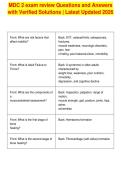
MDC 2 exam review Questions and Answers
with Verified Solutions | Latest Updated 2026
Front: What are risk factors that Back: DVT, osteoarthritis, osteoporosis,
affect mobility? fractures,
muscle weakness, neurologic disorders,
pain, fear
of falling, poor balance/vision, immobility
Front: What is Adult Failure to Back: A syndrome in older adults
Thrive? characterized by
weight loss, weakness, poor nutrition,
immobility,
depression, and cognitive decline
Front: What are the components of Back: Inspection, palpation, range of
a motion,
musculoskeletal assessment? muscle strength, gait, posture, joints, hips,
spine,
extremities
Front: What is the first stage of Back: Hematoma formation
bone
healing?
Front: What is the second stage of Back: Fibrocartilage (soft callus) formation
bone healing?
, Front: What is the third stage of Back: Bony callus formation
bone
healing?
Front: What is the fourth stage of Back: Bone remodeling
bone healing?
Front: What do osteoblasts do? Back: Build bone
Front: What do osteocytes do? Back: Maintain mature bone
Front: What do osteoclasts do? Back: Break down bone
Front: What is mineralization? Back: The process where bone matrix
hardens as
minerals bind to collagen
Front: What minerals are needed Back: Calcium and phosphate
for
bone formation?
Front: What are the three Back: Circulation, motion, sensation (CMS)
components of a neurovascular
assessment?
Front: Why are frequent Back: To detect early signs of
neurovascular assessments compartment
important? syndrome, nerve damage, or vascular
compromise
with Verified Solutions | Latest Updated 2026
Front: What are risk factors that Back: DVT, osteoarthritis, osteoporosis,
affect mobility? fractures,
muscle weakness, neurologic disorders,
pain, fear
of falling, poor balance/vision, immobility
Front: What is Adult Failure to Back: A syndrome in older adults
Thrive? characterized by
weight loss, weakness, poor nutrition,
immobility,
depression, and cognitive decline
Front: What are the components of Back: Inspection, palpation, range of
a motion,
musculoskeletal assessment? muscle strength, gait, posture, joints, hips,
spine,
extremities
Front: What is the first stage of Back: Hematoma formation
bone
healing?
Front: What is the second stage of Back: Fibrocartilage (soft callus) formation
bone healing?
, Front: What is the third stage of Back: Bony callus formation
bone
healing?
Front: What is the fourth stage of Back: Bone remodeling
bone healing?
Front: What do osteoblasts do? Back: Build bone
Front: What do osteocytes do? Back: Maintain mature bone
Front: What do osteoclasts do? Back: Break down bone
Front: What is mineralization? Back: The process where bone matrix
hardens as
minerals bind to collagen
Front: What minerals are needed Back: Calcium and phosphate
for
bone formation?
Front: What are the three Back: Circulation, motion, sensation (CMS)
components of a neurovascular
assessment?
Front: Why are frequent Back: To detect early signs of
neurovascular assessments compartment
important? syndrome, nerve damage, or vascular
compromise


