
Elite Universal Test Bank:
Nevada Traffic Safety &
Jurisprudence
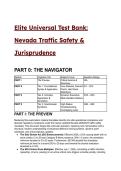
PART 0: THE NAVIGATOR
Section Cognitive Tier Subject Focus Question Range
PART I The Preview Critical Axioms & N/A
Directives
PART II Tier 1: Foundational Core Statutes, Demerit Q1 – Q15
Syntax & Application Points, Hard Deck
Definitions
PART II Tier 2: Complex Dynamic Scenarios, Q16 – Q35
Application & Multi-Variable Citations
Simulation
PART II Tier 3: Grandmaster High-Stakes Q36 – Q60
Synthesis Troubleshooting,
Overlapping Laws
PART I: THE PREVIEW
Mastering this examination material translates directly into elite operational competence and
absolute regulatory compliance under the heavily updated Nevada 2026/2027 traffic safety
mandates. This document forges elite vehicular operators, replacing rote memorization with a
structural, intuitive understanding of advanced defensive driving systems, dynamic point
schedules, and critical statutory updates.
● The Safe Streets Act (DUI Enhancements): Effective 2026, a DUI causing death with no
priors yields a 2 to 25-year Category B felony sentence. With 1-2 priors, the mandatory
minimum elevates to 5 to 25 years. Furthermore, SB 309 doubled the mandatory
minimum jail time for a second DUI to 20 days and lowered the alcohol evaluation
threshold to 0.16%.
● The AB 6 School Zone Multiplier: Effective July 1, 2026, committing a traffic infraction
(speeding, U-turns, passing) in an active school zone triggers a double penalty, including
, the doubling of Demerit Points.
● The SB 395 Move-Over Mandate: NRS 484B.607 mandates lane changes or significant
speed reduction for any stationary traffic incident, explicitly expanding protections to tow
trucks displaying non-flashing blue lights.
● The NRS 486.351 Filtering Ban: Both Lane Splitting (moving traffic) and Lane Filtering
(stopped traffic) are explicitly illegal in Nevada.
● The 12-Point Suspension Threshold: Accumulating 12 Demerit Points in any 12-month
period triggers an automatic 6-month license suspension. Completing a DMV-approved
traffic safety school removes 3 points, provided it is not part of a plea bargain.
PART II: THE ELITE TEST BANK
Q1: A driver is cited for traveling 15 mph over the posted speed limit. Three months later, they
receive a citation for tailgating (following too closely). Based on the principles of the Nevada
Demerit Point System, which action/conclusion is the MOST ACCURATE regarding their driving
record? A) The driver accrues 6 points total and faces an immediate 6-month license
suspension. B) The driver accrues 6 points total but can erase all points by attending traffic
school twice. C) The driver accrues 6 points total and is eligible to remove 3 points by attending
a DMV-approved traffic school once in a 12-month period. D) The driver accrues 0 points
because out-of-state citations do not transfer to Nevada.
● The Answer: C (The driver accrues 6 points total and is eligible to remove 3 points by
attending a DMV-approved traffic school once in a 12-month period.)
● Distractor Analysis: * A is incorrect: The 6-month suspension is triggered at a 12-point
threshold within 12 months, not 6 points.
○ B is incorrect: Traffic safety school can only be attended once per 12-month period
to remove exactly 3 points.
○ D is incorrect: The scenario does not state the citation was out-of-state, and
speeding 11-20 mph (2 points) plus tailgating (4 points) strictly equals 6 points.
The Mentor's Analysis: The demerit system tracks kinetic risk. When facing accumulated
violations, the immediate priority is active mitigation before reaching the suspension threshold.
By utilizing Traffic Safety School proactively, you bypass the common trap of waiting until the
12-point limit triggers an automatic withdrawal. Professional/Academic Intuition: Traffic
school removes exactly three points, exactly once a year, provided it is not
court-mandated.
Q2: An operator is driving a passenger vehicle at 65 mph on dry pavement. To maintain an
adequate Search and Evaluate safety envelope, the driver uses a fixed object to calculate
distance. Based on the principles of Nevada Defensive Driving, which action/conclusion is the
MOST ACCURATE? A) The driver should maintain a minimum 2-second following distance and
a 12-second visual scanning distance. B) The driver should maintain a minimum 4-second
following distance and look ahead at least 20 to 30 seconds for freeway speeds. C) The driver
should maintain a 12-second following distance to prevent all rear-end collisions. D) The driver
should focus exclusively on the vehicle immediately ahead to avoid distractions.
● The Answer: B (The driver should maintain a minimum 4-second following distance and
look ahead at least 20 to 30 seconds for freeway speeds.)
● Distractor Analysis: * A is incorrect: While a 12-second visual scan is standard for urban
30 mph driving, freeway speeds require a 20 to 30-second visual lead.
○ C is incorrect: A 12-second following distance is mathematically excessive and
, intended only for extreme ice or snow, not dry pavement.
○ D is incorrect: Target fixation on a single vehicle destroys peripheral hazard
recognition.
The Mentor's Analysis: Speed consumes space voraciously. When facing highway velocities,
the immediate priority is expanding the temporal buffer. By utilizing the Four-Second Rule
combined with a 20-30 second visual horizon, you bypass the common trap of overdriving your
braking capability. Professional/Academic Intuition: Following distance secures your front
bumper; scanning distance secures your situational awareness.
Q3: A tourist over the age of 21 is driving a rented sedan down the Las Vegas Strip. They hand
an unsealed, half-empty bottle of beer to a passenger in the back seat. The passenger holds the
bottle but does not drink. Based on the principles of NRS 484B.150 (Open Container Laws),
which action/conclusion is the MOST ACCURATE? A) The action is legal because Las Vegas
allows open containers on the Strip. B) The action is legal because the passenger was not
actively consuming the alcohol. C) The action is illegal and constitutes a misdemeanor for
possessing an open container in the passenger area of a motor vehicle. D) The action is illegal
only if the driver's Blood Alcohol Concentration (BAC) exceeds 0.08%.
● The Answer: C (The action is illegal and constitutes a misdemeanor for possessing an
open container in the passenger area of a motor vehicle.)
● Distractor Analysis: * A is incorrect: Open containers are legal on pedestrian sidewalks
on the Strip, but strictly forbidden inside moving or stationary non-exempt passenger
vehicles.
○ B is incorrect: The mere presence of an unsealed container in the passenger
compartment violates the statute, regardless of active consumption.
○ D is incorrect: Open container laws are enforced entirely independently of DUI
statutes; the driver's BAC is irrelevant to this specific charge.
The Mentor's Analysis: The passenger compartment must remain a sterile environment
regarding alcohol. When facing open container enforcement, the immediate priority is strict
isolation of broken-seal beverages in the trunk. By utilizing Absolute Compartment Compliance,
you bypass the trap of assuming passenger possession absolves the driver.
Professional/Academic Intuition: An unsealed bottle in the cabin is a violation, regardless
of who holds it or if the engine is running.
Q4: A parent is transporting their 5-year-old child, who weighs 50 pounds and is 50 inches tall.
Based on the principles of NRS 484B.157 (Child Restraint Systems), which action/conclusion is
the MOST ACCURATE? A) The child can use a standard adult seat belt because they exceed
40 pounds. B) The child must be secured in a federally approved child restraint system, such as
a forward-facing or booster seat. C) The child must remain in a rear-facing safety seat until age
six. D) The child is legally permitted to ride in the front seat if the airbags are deactivated.
● The Answer: B (The child must be secured in a federally approved child restraint system,
such as a forward-facing or booster seat.)
● Distractor Analysis: * A is incorrect: Nevada law strictly requires a child restraint for any
child under 6 years of age AND under 57 inches tall.
○ C is incorrect: Rear-facing seats are only statutorily mandated for children under 2
years of age.
○ D is incorrect: Front seat placement is highly discouraged and does not satisfy the
core requirement of using a dedicated child restraint system based on age/height
metrics.
The Mentor's Analysis: Pediatric skeletal structures cannot withstand adult seatbelt loads.
When facing child transport, the immediate priority is localized kinetic dampening via


