
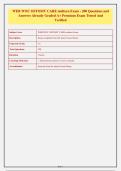
WEB WOC OSTOMY CARE midtern Exam - 200 Questions and
Answers Already Graded A+ Premium Exam Tested And
Verified
Subject Area WEB WOC OSTOMY CARE midtern Exam
Description Exam compiled from the shared exam library.
Expected Grade A+
Total Questions 200
Duration 3 hours
Learning Outcomes 1. Demonstrate mastery of core concepts
Accreditation Sourced from the shared exam library.
Page 1
,1. A nurse is reviewing the medication administration record for a client who is
2 days postoperative following abdominal surgery. Which of the following
medications places the client at risk for wound dehiscence?
Answer: Prednisone
Prednisone is a corticosteroid that impairs wound healing by suppressing
inflammation and collagen synthesis, increasing the risk of wound dehiscence.
The other options do not significantly impair wound healing.
2. A nurse is preparing to administer a gavage feeding via nasogastric tube to a
preterm newborn who is receiving supplemental oxygen. Which of the
following actions should the nurse take?
Answer: Measure the stomach aspirate prior to the feeding.
Measuring stomach aspirate prior to feeding helps assess gastric residual and
tolerance, reducing aspiration risk. The other options are incorrect: supine
positioning increases aspiration risk, feeding should be slower, and auscultation is
unreliable for tube placement verification.
3. Which of the following food choices by the client indicates an understanding
of the teaching?
Answer: Two poached eggs and a banana
For ostomy care, low-fiber foods like poached eggs and bananas are
recommended to reduce output and prevent blockage. Chili with beans and
spinach salad are high in fiber, which can cause gas or obstruction.
4. A patient with a history of chronic kidney disease stage 4 is admitted with
hyperkalemia (potassium 6.8 mEq/L). The cardiac monitor shows peaked T
waves. The nurse prepares to administer intravenous calcium gluconate.
Which of the following actions is most critical prior to administration?
Answer: Check the patient's digoxin level.
Calcium gluconate can potentiate digoxin toxicity, so checking the digoxin level is
critical. While verifying IV access and ECG are important, the most critical is
assessing digoxin level to avoid fatal arrhythmias. Serum calcium level is less
relevant.
Page 2
,5. According to the Dietary Guidelines for Americans, for which age group are
the heart-healthy dietary recommendations intended?
Answer: 2 years to adult
The Dietary Guidelines for Americans provide recommendations for individuals
aged 2 years and older to promote heart health and reduce chronic disease risk.
Options B, C, and D are incorrect because the guidelines start at age 2, not birth
or adulthood, and extend through all ages.
6. A nurse in the infectious disease division of the local health department is
caring for a client. Which of the following infections should the nurse identify
as requiring mandatory reporting to the health department?
Answer: Clostridium difficile
Clostridium difficile is a reportable infection due to its public health implications,
including outbreaks in healthcare settings and potential for severe disease. The
other options are common infections that are not typically subject to mandatory
reporting.
7. A nurse is teaching a group of clients about dietary needs to prevent
osteoporosis. Which of the following dietary choices should the nurse
recommend as having the highest calcium content?
Answer: 1 cup broccoli
Low-fat yogurt contains about 415 mg of calcium per cup, which is higher than
broccoli (62 mg), cooked spinach (245 mg), and whole milk (276 mg). Therefore,
it is the best choice for preventing osteoporosis.
8. A nurse is assessing a client with suspected mononucleosis. Which of the
following findings would support a diagnosis of mononucleosis?
Answer: cervical lymphadenopathy
Cervical lymphadenopathy is a classic finding in mononucleosis due to
Epstein-Barr virus infection, which typically causes tender, enlarged lymph nodes
in the neck. Other lymph node groups are less commonly involved, making
cervical lymphadenopathy the most supportive finding among the options.
Page 3
, 9. A client in the first stage of labor has a visible segment of the umbilical cord
at the vaginal opening after spontaneous rupture of membranes. Which action
should the nurse take?
Answer: Assist the client into a knee-chest position.
When cord prolapse occurs, the priority is to reduce pressure on the cord to
maintain fetal oxygenation. The knee-chest position uses gravity to shift the
presenting part off the cord, minimizing compression.
10. Refeeding syndrome is a potentially fatal complication of overfeeding. Why
is refeeding syndrome so dangerous?
Answer: There is an abrupt change from a catabolic state to an anabolic state
Refeeding syndrome is dangerous due to rapid electrolyte shifts, especially
hypophosphatemia, which can cause cardiac arrhythmias, respiratory failure,
and death. While option A describes the metabolic shift, the direct
life-threatening mechanism is electrolyte imbalance.
11. A nurse is providing teaching to a client who is experiencing preterm
contractions and dehydration. Which of the following statements should the
nurse make?
Answer: Dehydration can increase the risk for preterm labor.
Dehydration can lead to reduced blood volume and uterine irritability, which
may trigger preterm labor. The correct statement accurately reflects this risk,
while the distractors either dismiss the link, overstate the effect of hydration, or
misattribute the cause.
12. A nurse is preparing to administer an influenza vaccine to an adult client
who reports food allergies. Which of the following food allergies could place
the client at risk for a reaction?
Answer: Eggs
Influenza vaccines are often grown in eggs and may contain trace amounts of egg
protein, so clients with severe egg allergies are at risk for an allergic reaction.
Other common food allergies like peanuts, shellfish, or milk are not typically
associated with influenza vaccine reactions.
Page 4
Answers Already Graded A+ Premium Exam Tested And
Verified
Subject Area WEB WOC OSTOMY CARE midtern Exam
Description Exam compiled from the shared exam library.
Expected Grade A+
Total Questions 200
Duration 3 hours
Learning Outcomes 1. Demonstrate mastery of core concepts
Accreditation Sourced from the shared exam library.
Page 1
,1. A nurse is reviewing the medication administration record for a client who is
2 days postoperative following abdominal surgery. Which of the following
medications places the client at risk for wound dehiscence?
Answer: Prednisone
Prednisone is a corticosteroid that impairs wound healing by suppressing
inflammation and collagen synthesis, increasing the risk of wound dehiscence.
The other options do not significantly impair wound healing.
2. A nurse is preparing to administer a gavage feeding via nasogastric tube to a
preterm newborn who is receiving supplemental oxygen. Which of the
following actions should the nurse take?
Answer: Measure the stomach aspirate prior to the feeding.
Measuring stomach aspirate prior to feeding helps assess gastric residual and
tolerance, reducing aspiration risk. The other options are incorrect: supine
positioning increases aspiration risk, feeding should be slower, and auscultation is
unreliable for tube placement verification.
3. Which of the following food choices by the client indicates an understanding
of the teaching?
Answer: Two poached eggs and a banana
For ostomy care, low-fiber foods like poached eggs and bananas are
recommended to reduce output and prevent blockage. Chili with beans and
spinach salad are high in fiber, which can cause gas or obstruction.
4. A patient with a history of chronic kidney disease stage 4 is admitted with
hyperkalemia (potassium 6.8 mEq/L). The cardiac monitor shows peaked T
waves. The nurse prepares to administer intravenous calcium gluconate.
Which of the following actions is most critical prior to administration?
Answer: Check the patient's digoxin level.
Calcium gluconate can potentiate digoxin toxicity, so checking the digoxin level is
critical. While verifying IV access and ECG are important, the most critical is
assessing digoxin level to avoid fatal arrhythmias. Serum calcium level is less
relevant.
Page 2
,5. According to the Dietary Guidelines for Americans, for which age group are
the heart-healthy dietary recommendations intended?
Answer: 2 years to adult
The Dietary Guidelines for Americans provide recommendations for individuals
aged 2 years and older to promote heart health and reduce chronic disease risk.
Options B, C, and D are incorrect because the guidelines start at age 2, not birth
or adulthood, and extend through all ages.
6. A nurse in the infectious disease division of the local health department is
caring for a client. Which of the following infections should the nurse identify
as requiring mandatory reporting to the health department?
Answer: Clostridium difficile
Clostridium difficile is a reportable infection due to its public health implications,
including outbreaks in healthcare settings and potential for severe disease. The
other options are common infections that are not typically subject to mandatory
reporting.
7. A nurse is teaching a group of clients about dietary needs to prevent
osteoporosis. Which of the following dietary choices should the nurse
recommend as having the highest calcium content?
Answer: 1 cup broccoli
Low-fat yogurt contains about 415 mg of calcium per cup, which is higher than
broccoli (62 mg), cooked spinach (245 mg), and whole milk (276 mg). Therefore,
it is the best choice for preventing osteoporosis.
8. A nurse is assessing a client with suspected mononucleosis. Which of the
following findings would support a diagnosis of mononucleosis?
Answer: cervical lymphadenopathy
Cervical lymphadenopathy is a classic finding in mononucleosis due to
Epstein-Barr virus infection, which typically causes tender, enlarged lymph nodes
in the neck. Other lymph node groups are less commonly involved, making
cervical lymphadenopathy the most supportive finding among the options.
Page 3
, 9. A client in the first stage of labor has a visible segment of the umbilical cord
at the vaginal opening after spontaneous rupture of membranes. Which action
should the nurse take?
Answer: Assist the client into a knee-chest position.
When cord prolapse occurs, the priority is to reduce pressure on the cord to
maintain fetal oxygenation. The knee-chest position uses gravity to shift the
presenting part off the cord, minimizing compression.
10. Refeeding syndrome is a potentially fatal complication of overfeeding. Why
is refeeding syndrome so dangerous?
Answer: There is an abrupt change from a catabolic state to an anabolic state
Refeeding syndrome is dangerous due to rapid electrolyte shifts, especially
hypophosphatemia, which can cause cardiac arrhythmias, respiratory failure,
and death. While option A describes the metabolic shift, the direct
life-threatening mechanism is electrolyte imbalance.
11. A nurse is providing teaching to a client who is experiencing preterm
contractions and dehydration. Which of the following statements should the
nurse make?
Answer: Dehydration can increase the risk for preterm labor.
Dehydration can lead to reduced blood volume and uterine irritability, which
may trigger preterm labor. The correct statement accurately reflects this risk,
while the distractors either dismiss the link, overstate the effect of hydration, or
misattribute the cause.
12. A nurse is preparing to administer an influenza vaccine to an adult client
who reports food allergies. Which of the following food allergies could place
the client at risk for a reaction?
Answer: Eggs
Influenza vaccines are often grown in eggs and may contain trace amounts of egg
protein, so clients with severe egg allergies are at risk for an allergic reaction.
Other common food allergies like peanuts, shellfish, or milk are not typically
associated with influenza vaccine reactions.
Page 4


