
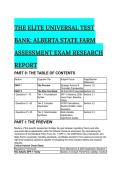
THE ELITE UNIVERSAL TEST
BANK: ALBERTA STATE FARM
ASSESSMENT EXAM RESEARCH
REPORT
PART 0: THE TABLE OF CONTENTS
Section Cognitive Tier Subject Focus Page/Section
Reference
PART I The Preview Strategic Axioms & Section 1.0
Formulaic Frameworks
PART II The Elite Test Bank 30-Point MCQ Gauntlet Section 2.0
- Questions 1–10 Tier 1: Foundational SPF-1 Anatomy, 2026 Section 2.1
Syntax Injury Caps, Baseline
Duties
- Questions 11–20 Tier 2: Complex DCPD Calculations, Section 2.2
Application Section B Math, Claim
Scenarios
- Questions 21–30 Tier 3: Grandmaster Multi-Variable Section 2.3
Synthesis Adjudication,
Algorithmic Audits
PART I: THE PREVIEW
Mastery of this specific assessment bridges the gap between regulatory theory and elite,
real-world claims adjudication within the Alberta insurance ecosystem. By internalizing the
mechanics of the Standard Policy Form No. 1 (SPF-1), the 2026 Minor Injury framework, and
State Farm’s proprietary handling standards, candidates transform from passive processors into
high-level analytical operators capable of navigating the most complex liability and property
disputes.
Critical Axioms Cheat Sheet:
Regulatory Framework Core Mechanism & 2026 Application Standard
The Alberta SPF-1 Trinity Section A (At-fault Third-Party Liability), Section
,Regulatory Framework Core Mechanism & 2026 Application Standard
B (No-fault Accident Benefits: $50,000/2-year
medical cap; $600/wk income replacement),
Section C (Optional Physical Damage).
The 2026 Minor Injury Cap Non-pecuniary damages for minor soft-tissue
injuries and psychological sequelae are strictly
capped at $6,306. Exception: Serious
Impairment preventing essential employment or
daily living tasks shatters this cap.
The DCPD Protocol (Section A.1) Direct Compensation for Property Damage
pays for the not-at-fault portion of the insured’s
vehicle damage via their own insurer.
Subrogation against the at-fault party is
abolished.
The Good Neighbor Doctrine State Farm's rigid standard requires diligent
investigation, objective evaluation, prompt
resolution within 90 days, and explicitly
detailing policy coverages without reliance on
biased algorithmic processing.
PART II: THE ELITE TEST BANK
Tier 1: Foundational Syntax & Application
Q1: A policyholder in Edmonton is struck by an uninsured driver while waiting at a red light. The
policyholder sustains a severe concussion. Under the standard framework of the Alberta
Owner's Automobile Policy (SPF No. 1), which specific coverage matrix acts as the FIRST line
of response to cover the policyholder’s immediate medical rehabilitation costs? A) Section A -
Third-Party Liability B) Section A.1 - Direct Compensation for Property Damage (DCPD) C)
Section B - Accident Benefits D) Section C - All Perils Coverage
● The Answer: C (Section B - Accident Benefits)
● Distractor Analysis:
○ A is incorrect: Section A covers the policyholder's liability for damages caused to a
third party, not first-party medical response for the insured.
○ B is incorrect: DCPD strictly applies to property damage to the insured vehicle when
not at fault; it categorically excludes bodily injury.
○ D is incorrect: Section C is an optional coverage strictly allocated for physical
damage to the insured's vehicle resulting from collision or comprehensive perils, not
human medical rehabilitation.
The Mentor's Analysis: Regardless of fault, Section B - Accident Benefits operates as a
mandatory, no-fault mechanism ensuring immediate medical triage for the insured, passengers,
and even struck pedestrians. Originating as a statutory requirement to prevent catastrophic
medical debt while tort claims are litigated, this framework guarantees up to $50,000 over two
years. By triggering this first, the insurer honors its duty to mitigate further injury before the
lengthy process of establishing fault concludes. Professional/Academic Intuition: Always
isolate the loss type. Property damage triggers DCPD or Section C; bodily injury
invariably triggers Section B for immediate first-party triage.
Q2: During a routine review of 2026 claim metrics, a State Farm underwriter assesses
, non-pecuniary damages for a claimant suffering from minor psychological sequelae following a
fender-bender. Based on Alberta’s updated tort limitations, what is the MAXIMUM payout
authorized for this specific pain and suffering claim? A) $5,671 B) $6,306 C) $10,000 D)
Uncapped, pending an independent medical examination
● The Answer: B ($6,306)
● Distractor Analysis:
○ A is incorrect: $5,671 represents the proposed future Care-First system limit for
personal care assistance for non-catastrophic injuries, not the active 2026 tort cap
for minor injury pain and suffering.
○ C is incorrect: $10,000 represents the Section B maximum death benefit, which is
an entirely different coverage vector irrelevant to a minor psychological injury claim.
* D is incorrect: The scenario explicitly features a "minor" injury classification
(temporary anxiety) without serious impairment, which definitively triggers the
statutory cap without requiring further medical circumvention.
The Mentor's Analysis: The Alberta Minor Injury Regulation exists to stabilize insurance
premiums by strictly capping non-pecuniary (pain and suffering) damages for minor soft-tissue
injuries and temporary psychological sequelae. For the 2026 operating year, the inflationary
adjustment has set this rigid ceiling at exactly $6,306. While the future outlook of Alberta
insurance may shift toward a complete no-fault "Care-First" system that eliminates these tort
payouts entirely , the current regulatory environment demands strict adherence to this dollar
figure. Professional/Academic Intuition: Unless a "Serious Impairment" threshold is
definitively breached, the 2026 statutory hard deck for minor injuries is irrevocably
locked at $6,306.
Q3: A State Farm adjuster is processing a collision claim governed by Alberta’s Direct
Compensation for Property Damage (DCPD) framework. The insured is determined to be 100%
not at fault. Which historical recovery mechanism is explicitly PROHIBITED under the DCPD
regime? A) First-party appraisal clause invocation B) Subrogation against the at-fault driver's
insurer C) Applying a Section C collision deductible D) Disbursing funds directly to a Select
Service repair facility
● The Answer: B (Subrogation against the at-fault driver's insurer)
● Distractor Analysis:
○ A is incorrect: The appraisal clause remains a valid, legally binding dispute
resolution mechanism between the first-party insured and their insurer regarding
the quantum of loss under the SPF-1.
○ C is incorrect: Applying a deductible is technically accurate for the at-fault portion
under Section C, but the question asks what is prohibited when the insured is 100%
not at fault.
○ D is incorrect: Paying a Select Service facility directly is a standard operating
procedure designed to streamline repairs, not a prohibited action.
The Mentor's Analysis: Introduced into Alberta on January 1, 2022, DCPD fundamentally
rearchitects the flow of capital by requiring insurers to indemnify their own clients based on fault,
without recourse. Historically, an insurer would pay their non-at-fault client under Section C and
then subrogate (sue) the at-fault driver's insurer to recover the funds. DCPD completely
abolishes this inefficient subrogation process, drastically accelerating the repair cycle and
reducing systemic legal overhead. Professional/Academic Intuition: DCPD permanently
severs the right to subrogation; the insurer absorbs the not-at-fault loss internally.
Q4: Based on State Farm’s First Party Coverage claims handling standards, if an adjuster
identifies that a submitted claim is entirely excluded from coverage due to a specific policy
BANK: ALBERTA STATE FARM
ASSESSMENT EXAM RESEARCH
REPORT
PART 0: THE TABLE OF CONTENTS
Section Cognitive Tier Subject Focus Page/Section
Reference
PART I The Preview Strategic Axioms & Section 1.0
Formulaic Frameworks
PART II The Elite Test Bank 30-Point MCQ Gauntlet Section 2.0
- Questions 1–10 Tier 1: Foundational SPF-1 Anatomy, 2026 Section 2.1
Syntax Injury Caps, Baseline
Duties
- Questions 11–20 Tier 2: Complex DCPD Calculations, Section 2.2
Application Section B Math, Claim
Scenarios
- Questions 21–30 Tier 3: Grandmaster Multi-Variable Section 2.3
Synthesis Adjudication,
Algorithmic Audits
PART I: THE PREVIEW
Mastery of this specific assessment bridges the gap between regulatory theory and elite,
real-world claims adjudication within the Alberta insurance ecosystem. By internalizing the
mechanics of the Standard Policy Form No. 1 (SPF-1), the 2026 Minor Injury framework, and
State Farm’s proprietary handling standards, candidates transform from passive processors into
high-level analytical operators capable of navigating the most complex liability and property
disputes.
Critical Axioms Cheat Sheet:
Regulatory Framework Core Mechanism & 2026 Application Standard
The Alberta SPF-1 Trinity Section A (At-fault Third-Party Liability), Section
,Regulatory Framework Core Mechanism & 2026 Application Standard
B (No-fault Accident Benefits: $50,000/2-year
medical cap; $600/wk income replacement),
Section C (Optional Physical Damage).
The 2026 Minor Injury Cap Non-pecuniary damages for minor soft-tissue
injuries and psychological sequelae are strictly
capped at $6,306. Exception: Serious
Impairment preventing essential employment or
daily living tasks shatters this cap.
The DCPD Protocol (Section A.1) Direct Compensation for Property Damage
pays for the not-at-fault portion of the insured’s
vehicle damage via their own insurer.
Subrogation against the at-fault party is
abolished.
The Good Neighbor Doctrine State Farm's rigid standard requires diligent
investigation, objective evaluation, prompt
resolution within 90 days, and explicitly
detailing policy coverages without reliance on
biased algorithmic processing.
PART II: THE ELITE TEST BANK
Tier 1: Foundational Syntax & Application
Q1: A policyholder in Edmonton is struck by an uninsured driver while waiting at a red light. The
policyholder sustains a severe concussion. Under the standard framework of the Alberta
Owner's Automobile Policy (SPF No. 1), which specific coverage matrix acts as the FIRST line
of response to cover the policyholder’s immediate medical rehabilitation costs? A) Section A -
Third-Party Liability B) Section A.1 - Direct Compensation for Property Damage (DCPD) C)
Section B - Accident Benefits D) Section C - All Perils Coverage
● The Answer: C (Section B - Accident Benefits)
● Distractor Analysis:
○ A is incorrect: Section A covers the policyholder's liability for damages caused to a
third party, not first-party medical response for the insured.
○ B is incorrect: DCPD strictly applies to property damage to the insured vehicle when
not at fault; it categorically excludes bodily injury.
○ D is incorrect: Section C is an optional coverage strictly allocated for physical
damage to the insured's vehicle resulting from collision or comprehensive perils, not
human medical rehabilitation.
The Mentor's Analysis: Regardless of fault, Section B - Accident Benefits operates as a
mandatory, no-fault mechanism ensuring immediate medical triage for the insured, passengers,
and even struck pedestrians. Originating as a statutory requirement to prevent catastrophic
medical debt while tort claims are litigated, this framework guarantees up to $50,000 over two
years. By triggering this first, the insurer honors its duty to mitigate further injury before the
lengthy process of establishing fault concludes. Professional/Academic Intuition: Always
isolate the loss type. Property damage triggers DCPD or Section C; bodily injury
invariably triggers Section B for immediate first-party triage.
Q2: During a routine review of 2026 claim metrics, a State Farm underwriter assesses
, non-pecuniary damages for a claimant suffering from minor psychological sequelae following a
fender-bender. Based on Alberta’s updated tort limitations, what is the MAXIMUM payout
authorized for this specific pain and suffering claim? A) $5,671 B) $6,306 C) $10,000 D)
Uncapped, pending an independent medical examination
● The Answer: B ($6,306)
● Distractor Analysis:
○ A is incorrect: $5,671 represents the proposed future Care-First system limit for
personal care assistance for non-catastrophic injuries, not the active 2026 tort cap
for minor injury pain and suffering.
○ C is incorrect: $10,000 represents the Section B maximum death benefit, which is
an entirely different coverage vector irrelevant to a minor psychological injury claim.
* D is incorrect: The scenario explicitly features a "minor" injury classification
(temporary anxiety) without serious impairment, which definitively triggers the
statutory cap without requiring further medical circumvention.
The Mentor's Analysis: The Alberta Minor Injury Regulation exists to stabilize insurance
premiums by strictly capping non-pecuniary (pain and suffering) damages for minor soft-tissue
injuries and temporary psychological sequelae. For the 2026 operating year, the inflationary
adjustment has set this rigid ceiling at exactly $6,306. While the future outlook of Alberta
insurance may shift toward a complete no-fault "Care-First" system that eliminates these tort
payouts entirely , the current regulatory environment demands strict adherence to this dollar
figure. Professional/Academic Intuition: Unless a "Serious Impairment" threshold is
definitively breached, the 2026 statutory hard deck for minor injuries is irrevocably
locked at $6,306.
Q3: A State Farm adjuster is processing a collision claim governed by Alberta’s Direct
Compensation for Property Damage (DCPD) framework. The insured is determined to be 100%
not at fault. Which historical recovery mechanism is explicitly PROHIBITED under the DCPD
regime? A) First-party appraisal clause invocation B) Subrogation against the at-fault driver's
insurer C) Applying a Section C collision deductible D) Disbursing funds directly to a Select
Service repair facility
● The Answer: B (Subrogation against the at-fault driver's insurer)
● Distractor Analysis:
○ A is incorrect: The appraisal clause remains a valid, legally binding dispute
resolution mechanism between the first-party insured and their insurer regarding
the quantum of loss under the SPF-1.
○ C is incorrect: Applying a deductible is technically accurate for the at-fault portion
under Section C, but the question asks what is prohibited when the insured is 100%
not at fault.
○ D is incorrect: Paying a Select Service facility directly is a standard operating
procedure designed to streamline repairs, not a prohibited action.
The Mentor's Analysis: Introduced into Alberta on January 1, 2022, DCPD fundamentally
rearchitects the flow of capital by requiring insurers to indemnify their own clients based on fault,
without recourse. Historically, an insurer would pay their non-at-fault client under Section C and
then subrogate (sue) the at-fault driver's insurer to recover the funds. DCPD completely
abolishes this inefficient subrogation process, drastically accelerating the repair cycle and
reducing systemic legal overhead. Professional/Academic Intuition: DCPD permanently
severs the right to subrogation; the insurer absorbs the not-at-fault loss internally.
Q4: Based on State Farm’s First Party Coverage claims handling standards, if an adjuster
identifies that a submitted claim is entirely excluded from coverage due to a specific policy


