
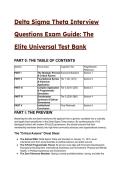
Delta Sigma Theta Interview
Questions Exam Guide: The
Elite Universal Test Bank
PART 0: THE TABLE OF CONTENTS
Section Focus Area Cognitive Tier Page/Section
Reference
PART I The Strategic Preview Executive Baseline Section 1
& Critical Axioms
PART II Foundational Syntax Tier 1 (Q1–Q15) Section 2
& Historical
Application
PART III Complex Application Tier 2 (Q16–Q35) Section 3
& Programmatic
Simulation
PART IV Grandmaster Tier 3 (Q36–Q60) Section 4
Synthesis & Ethical
Governance
PART V Institutional Final Rationale Section 5
Conclusion
PART I: THE PREVIEW
Mastering this elite test bank transforms the applicant from a generic candidate into a culturally
and legally fluent practitioner of the Delta Sigma Theta mission. By synthesizing the 1913
ideological schism with modern 501(c)(3) governance, the scholar ensures that their
membership translates directly into high-level community advocacy and organizational solvency.
The "Critical Axioms" Cheat Sheet
● The Activist DNA: Delta Sigma Theta was founded on January 13, 1913, as an
intentional pivot from social activities to political activism and public service.
● The 5-Point Programmatic Thrust: All service must align with Economic Development,
Educational Development, International Awareness and Involvement, Physical and Mental
Health, or Political Awareness and Involvement.
● The Zero-Tolerance Mandate: Hazing is strictly prohibited before, during, and after the
, Membership Intake Process; violation results in permanent barring or expulsion.
● The Statutory Baseline: The Grand Chapter was nationally incorporated on January 20,
1930, establishing a perpetual legal body for all chapters.
PART II: THE ELITE TEST BANK (Tier 1)
Q1: On January 13, 1913, twenty-two collegiate women at Howard University initiated a formal
split from their predecessor organization. Based on the historical analysis of this "ideological
schism," which factor was the PRIMARY driver for the creation of Delta Sigma Theta? A) A
desire to simplify the initiation ritual and reduce membership dues for undergraduate students.
B) A shift in focus from campus social activities toward social activism and a national
infrastructure for public service. C) A disagreement regarding the selection of the official flower
and the color scheme of the existing sorority. D) A preference for a localized organization that
would not seek national incorporation or expansion.
● The Answer: B (A shift in focus from campus social activities toward social activism and
a national infrastructure for public service.)
● Distractor Analysis:
○ A is incorrect: The founders actually increased the complexity of their mission, and
financial concerns were secondary to service goals.
○ C is incorrect: While symbols were changed, these were aesthetic representations
of the deeper philosophical shift toward political orientation.
○ D is incorrect: The founders specifically sought a national charter to avoid the "legal
entity" limitations they perceived in the previous organization.
The Mentor's Analysis: The founding of Delta Sigma Theta was a deliberate pivot from social
accommodation to activist confrontation. By leveraging the environment of Howard University,
the founders created an institution designed to meet the specific political needs of the
disenfranchised. Professional/Academic Intuition: Organizational identity is forged in its
founding intent; Delta’s intent is non-negotiable public service.
Q2: Following the founding, the sorority quickly mobilized to establish a legal framework.
According to the organizational timeline, when was the Grand Chapter of Delta Sigma Theta
nationally incorporated as a perpetual body? A) February 18, 1913 B) January 20, 1930 C) May
7, 1976 D) April 28, 1979
● The Answer: B (January 20, 1930)
● Distractor Analysis:
○ A is incorrect: This was the date the Alpha Chapter specifically was locally
incorporated.
○ C is incorrect: This is the founding date of the Nu Epsilon Chapter, a specific local
milestone.
○ D is incorrect: This was the unveiling date of the Fortitude sculpture at Howard
University.
The Mentor's Analysis: National incorporation in 1930 provided the centralized authority
necessary to maintain uniformity across chapters. This eliminated the need for individual
chapters to seek separate charters, ensuring operational cohesion. Professional/Academic
Intuition: Centralized legal authority is the prerequisite for global scalability.
Q3: The sorority's official motto, "Intelligence is the Torch of Wisdom," serves as a guiding
principle for all members. How does this motto MOST ACCURATEY reflect the academic
standards of Delta Sigma Theta? A) It suggests that academic achievement is a private pursuit
, unrelated to the sorority's public service acts. B) It mandates that members prioritize their status
as students first, using scholarship as the foundation for community impact. C) It indicates that
wisdom is only granted to those who hold a Ph.D. or higher professional designation. D) It
serves as a reminder that social networking is more important than intellectual development in
the Greek system.
● The Answer: B (It mandates that members prioritize their status as students first, using
scholarship as the foundation for community impact.)
● Distractor Analysis:
○ A is incorrect: Scholarship is one of the four core pillars (Sisterhood, Scholarship,
Service, Social Action) and is inextricably linked to service.
○ C is incorrect: While Eliza Pearl Shippen was the only founder with a Ph.D., all
members are expected to be high-achieving scholars.
○ D is incorrect: The founders specifically broke away to move toward a model of
excellence and activism, away from pure social networking.
The Mentor's Analysis: In the Delta framework, scholarship is not an end in itself but the
"torch" that illuminates the path of service. Academic excellence provides the credibility required
for effective social advocacy. Professional/Academic Intuition: You are a student first; your
intellect is your primary tool for community uplift.
Q4: The Nine Cardinal Virtues are symbolized by the jewels in the Sigma of the sorority's
emblem. To whom is the first jewel, "Compassion," specifically dedicated? A) The National Staff
B) The Mothers of Delta Members ) The Founders of Delta Sigma Theta Sorority, Inc. D) The
Deceased Sorors of the Omega Chapter
● The Answer: C (The Founders of Delta Sigma Theta Sorority, Inc.)
● Distractor Analysis:
○ A is incorrect: The jewel of Temperance is dedicated to the National Staff.
○ B is incorrect: The jewel of Courtesy is dedicated to the Mothers of Delta members.
○ D is incorrect: The jewel of Purity is dedicated to deceased sorors (the Omega
Chapter).
The Mentor's Analysis: Compassion is defined as the essence of the human spirit. Its
dedication to the Founders honors their "courage and hope" in establishing an organization
committed to the vulnerable. Professional/Academic Intuition: The virtues are a blueprint
for character; Compassion is the primary requisite.
Q5: Founder Madree Penn White is described as the "driving force" of the early sorority. Which
of the following was NOT one of her direct contributions to the organizational structure? A)
Designing the Sorority Pin B) Drafting the Constitution and Bylaws C) Writing the Delta Oath in
1914 D) Selecting the Greek symbols and the initiation ritual
● The Answer: C (Writing the Delta Oath in 1914)
● Distractor Analysis:
○ A is incorrect: White designed the pin, which features the three Greek letters.
○ B is incorrect: She was the primary author of the original governing documents.
○ D is incorrect: She was an accomplished linguist who selected the symbols that
represent the organization’s identity.
The Mentor's Analysis: While White provided the structural and symbolic foundation, the Delta
Oath was written by Mary Church Terrell. This distinction highlights the collaboration between
the undergraduate founders and established civic leaders. Professional/Academic Intuition:
Differentiate between the structural architect (White) and the ethical orator (Terrell).
Q6: During the historic Women's Suffrage March on March 3, 1913, the founders of Delta Sigma
Theta participated in their first public act. Which founder was selected to hold the banner, and
Questions Exam Guide: The
Elite Universal Test Bank
PART 0: THE TABLE OF CONTENTS
Section Focus Area Cognitive Tier Page/Section
Reference
PART I The Strategic Preview Executive Baseline Section 1
& Critical Axioms
PART II Foundational Syntax Tier 1 (Q1–Q15) Section 2
& Historical
Application
PART III Complex Application Tier 2 (Q16–Q35) Section 3
& Programmatic
Simulation
PART IV Grandmaster Tier 3 (Q36–Q60) Section 4
Synthesis & Ethical
Governance
PART V Institutional Final Rationale Section 5
Conclusion
PART I: THE PREVIEW
Mastering this elite test bank transforms the applicant from a generic candidate into a culturally
and legally fluent practitioner of the Delta Sigma Theta mission. By synthesizing the 1913
ideological schism with modern 501(c)(3) governance, the scholar ensures that their
membership translates directly into high-level community advocacy and organizational solvency.
The "Critical Axioms" Cheat Sheet
● The Activist DNA: Delta Sigma Theta was founded on January 13, 1913, as an
intentional pivot from social activities to political activism and public service.
● The 5-Point Programmatic Thrust: All service must align with Economic Development,
Educational Development, International Awareness and Involvement, Physical and Mental
Health, or Political Awareness and Involvement.
● The Zero-Tolerance Mandate: Hazing is strictly prohibited before, during, and after the
, Membership Intake Process; violation results in permanent barring or expulsion.
● The Statutory Baseline: The Grand Chapter was nationally incorporated on January 20,
1930, establishing a perpetual legal body for all chapters.
PART II: THE ELITE TEST BANK (Tier 1)
Q1: On January 13, 1913, twenty-two collegiate women at Howard University initiated a formal
split from their predecessor organization. Based on the historical analysis of this "ideological
schism," which factor was the PRIMARY driver for the creation of Delta Sigma Theta? A) A
desire to simplify the initiation ritual and reduce membership dues for undergraduate students.
B) A shift in focus from campus social activities toward social activism and a national
infrastructure for public service. C) A disagreement regarding the selection of the official flower
and the color scheme of the existing sorority. D) A preference for a localized organization that
would not seek national incorporation or expansion.
● The Answer: B (A shift in focus from campus social activities toward social activism and
a national infrastructure for public service.)
● Distractor Analysis:
○ A is incorrect: The founders actually increased the complexity of their mission, and
financial concerns were secondary to service goals.
○ C is incorrect: While symbols were changed, these were aesthetic representations
of the deeper philosophical shift toward political orientation.
○ D is incorrect: The founders specifically sought a national charter to avoid the "legal
entity" limitations they perceived in the previous organization.
The Mentor's Analysis: The founding of Delta Sigma Theta was a deliberate pivot from social
accommodation to activist confrontation. By leveraging the environment of Howard University,
the founders created an institution designed to meet the specific political needs of the
disenfranchised. Professional/Academic Intuition: Organizational identity is forged in its
founding intent; Delta’s intent is non-negotiable public service.
Q2: Following the founding, the sorority quickly mobilized to establish a legal framework.
According to the organizational timeline, when was the Grand Chapter of Delta Sigma Theta
nationally incorporated as a perpetual body? A) February 18, 1913 B) January 20, 1930 C) May
7, 1976 D) April 28, 1979
● The Answer: B (January 20, 1930)
● Distractor Analysis:
○ A is incorrect: This was the date the Alpha Chapter specifically was locally
incorporated.
○ C is incorrect: This is the founding date of the Nu Epsilon Chapter, a specific local
milestone.
○ D is incorrect: This was the unveiling date of the Fortitude sculpture at Howard
University.
The Mentor's Analysis: National incorporation in 1930 provided the centralized authority
necessary to maintain uniformity across chapters. This eliminated the need for individual
chapters to seek separate charters, ensuring operational cohesion. Professional/Academic
Intuition: Centralized legal authority is the prerequisite for global scalability.
Q3: The sorority's official motto, "Intelligence is the Torch of Wisdom," serves as a guiding
principle for all members. How does this motto MOST ACCURATEY reflect the academic
standards of Delta Sigma Theta? A) It suggests that academic achievement is a private pursuit
, unrelated to the sorority's public service acts. B) It mandates that members prioritize their status
as students first, using scholarship as the foundation for community impact. C) It indicates that
wisdom is only granted to those who hold a Ph.D. or higher professional designation. D) It
serves as a reminder that social networking is more important than intellectual development in
the Greek system.
● The Answer: B (It mandates that members prioritize their status as students first, using
scholarship as the foundation for community impact.)
● Distractor Analysis:
○ A is incorrect: Scholarship is one of the four core pillars (Sisterhood, Scholarship,
Service, Social Action) and is inextricably linked to service.
○ C is incorrect: While Eliza Pearl Shippen was the only founder with a Ph.D., all
members are expected to be high-achieving scholars.
○ D is incorrect: The founders specifically broke away to move toward a model of
excellence and activism, away from pure social networking.
The Mentor's Analysis: In the Delta framework, scholarship is not an end in itself but the
"torch" that illuminates the path of service. Academic excellence provides the credibility required
for effective social advocacy. Professional/Academic Intuition: You are a student first; your
intellect is your primary tool for community uplift.
Q4: The Nine Cardinal Virtues are symbolized by the jewels in the Sigma of the sorority's
emblem. To whom is the first jewel, "Compassion," specifically dedicated? A) The National Staff
B) The Mothers of Delta Members ) The Founders of Delta Sigma Theta Sorority, Inc. D) The
Deceased Sorors of the Omega Chapter
● The Answer: C (The Founders of Delta Sigma Theta Sorority, Inc.)
● Distractor Analysis:
○ A is incorrect: The jewel of Temperance is dedicated to the National Staff.
○ B is incorrect: The jewel of Courtesy is dedicated to the Mothers of Delta members.
○ D is incorrect: The jewel of Purity is dedicated to deceased sorors (the Omega
Chapter).
The Mentor's Analysis: Compassion is defined as the essence of the human spirit. Its
dedication to the Founders honors their "courage and hope" in establishing an organization
committed to the vulnerable. Professional/Academic Intuition: The virtues are a blueprint
for character; Compassion is the primary requisite.
Q5: Founder Madree Penn White is described as the "driving force" of the early sorority. Which
of the following was NOT one of her direct contributions to the organizational structure? A)
Designing the Sorority Pin B) Drafting the Constitution and Bylaws C) Writing the Delta Oath in
1914 D) Selecting the Greek symbols and the initiation ritual
● The Answer: C (Writing the Delta Oath in 1914)
● Distractor Analysis:
○ A is incorrect: White designed the pin, which features the three Greek letters.
○ B is incorrect: She was the primary author of the original governing documents.
○ D is incorrect: She was an accomplished linguist who selected the symbols that
represent the organization’s identity.
The Mentor's Analysis: While White provided the structural and symbolic foundation, the Delta
Oath was written by Mary Church Terrell. This distinction highlights the collaboration between
the undergraduate founders and established civic leaders. Professional/Academic Intuition:
Differentiate between the structural architect (White) and the ethical orator (Terrell).
Q6: During the historic Women's Suffrage March on March 3, 1913, the founders of Delta Sigma
Theta participated in their first public act. Which founder was selected to hold the banner, and


